Ethereum's Buterin Shifts Strategy Away from L2 Focus, Advocates for Native Rollups
Ethereum's co-creator expressed concerns that numerous layer-2 solutions have not achieved decentralization goals and rely on multisig bridges rather than benefiting from Ethereum's inherent security features.

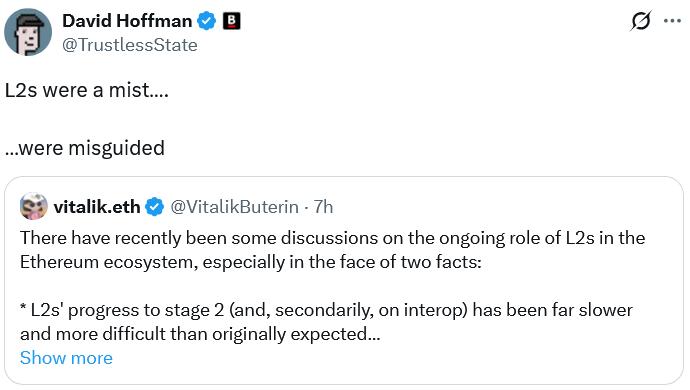
Vitalik Buterin, the co-creator of Ethereum, has shifted away from his previously held position that layer-2 networks should serve as Ethereum's main scaling solution, declaring that this strategy "no longer makes sense."
In a Tuesday post on X, Buterin stated "We need a new path," contending that numerous layer-2 solutions have not successfully decentralized and that Ethereum's mainnet is now achieving adequate scaling through gas limit expansions and the forthcoming implementation of native rollups.
"Both of these facts, for their own separate reasons, mean that the original vision of L2s and their role in Ethereum no longer makes sense, and we need a new path."
The original concept for layer-2s positioned them as Ethereum extensions, processing the majority of transactions with enhanced speed and reduced costs while maintaining Ethereum's security guarantees.
According to Buterin, layer-2 networks were designed to contribute to "Ethereum scaling" through the generation of block space that would be completely secured by Ethereum's mainnet, ensuring all transactions achieve validity, censorship resistance, and finality; many layer-2s, however, have not met this benchmark, he noted:
"If you create a 10000 TPS EVM where its connection to L1 is mediated by a multisig bridge, then you are not scaling Ethereum."
According to Buterin, layer-2 solutions — including Arbitrum, Optimism, Base and Starknet — ought to shift their emphasis away from scalability toward specialized use cases, proposing areas like privacy, identity, finance, social apps and AI.
The technical development plan for Ethereum had historically emphasized layer-2 networks as the main pathway for expanding the network's capacity.
This announcement arrives at a time when certain Ethereum developers have been advocating for prioritizing the scaling of Ethereum's mainnet.
One such developer is Max Resnick, a previous researcher at Ethereum infrastructure company Consensys, who transitioned to the Solana ecosystem following unsuccessful efforts to generate adequate support for mainnet scaling prioritization.
Ryan Sean Adams, who co-hosts the Ethereum-focused program Bankless, voiced his agreement with Buterin's perspective, declaring: "This is 'the pivot.' I'm glad it's now being said. Strong ETH, Strong L1."
Native rollups, gas limit rises key scaling Ethereum mainnet
Buterin indicated growing confidence in the significance of precompiled native rollups for scaling Ethereum's mainnet, especially after zero-knowledge Ethereum Virtual Machine (zkEVM) proofs become integrated into the base layer.
Traditional rollups operate by being constructed on top of Ethereum, bundling transactions and executing them off-chain prior to submitting transaction data to Ethereum, whereas native rollups are embedded within Ethereum itself — which means transaction processing receives direct verification from Ethereum validators.
During mid-December, Ethereum developers also engaged in discussions about increasing the gas limit from 60 million to 80 million following the implementation of the second blob-parameter-only hard fork. This hard fork was activated in January.
Such an increase would result in a direct expansion of the quantity of transactions and smart contract operations that each Ethereum block can accommodate, thereby enhancing overall throughput and potentially reducing fees.
In July of last year, Ethereum researcher Justin Drake presented a 10-year roadmap designed to reach 10,000 transactions per second (TPS) on Ethereum's mainnet after complete implementation of all scaling features, representing a substantial improvement over the 15–30 TPS currently being achieved.