Congressional Representatives Release Cryptocurrency Tax Framework Excluding Bitcoin Exemptions
Proposed legislation would provide tax exemptions for stablecoins pegged to the US dollar, exempting them from capital gains taxation provided they maintain a tight peg to their underlying fiat currency.

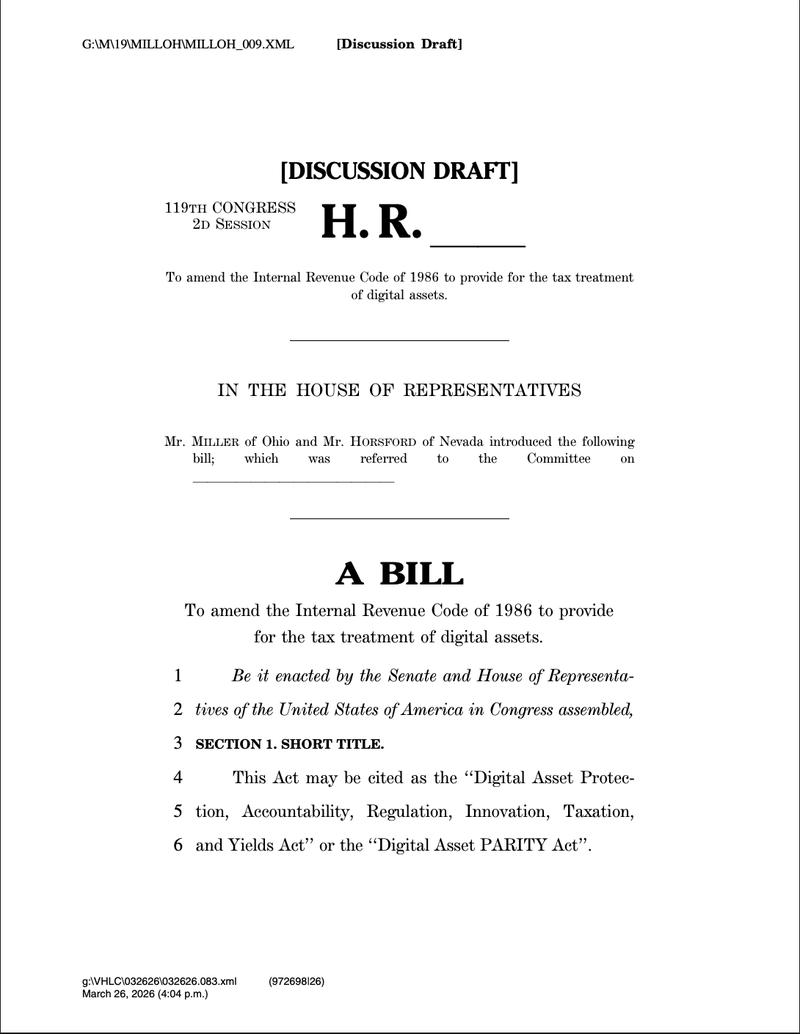
Two members of the United States House of Representatives, Max Miller and Steven Horsford, unveiled a discussion draft of proposed legislation on Thursday known as the ''Digital Asset Protection, Accountability, Regulation, Innovation, Taxation, and Yields Act,'' abbreviated as the ''Digital Asset PARITY Act," which aims to completely restructure how digital assets are treated under tax law.
Through the Digital Asset PARITY Act, lawmakers aim to modernize the Internal Revenue Code of 1986 through the inclusion of new provisions designed to provide clarity around how digital assets should be handled for taxation purposes.
Under the proposed legislation, stablecoins would be exempt from capital gains taxation provided that the cost basis, defined as the original purchase price paid by an investor, remains within a 1% fluctuation range of $1, which equals $0.01, as outlined in the discussion draft document.
Furthermore, the proposed bill stipulates that any transaction costs an investor incurs when acquiring or transferring regulated stablecoins pegged to the US dollar cannot be included in calculating that investor's cost basis.
Additionally, the proposed legislation establishes a de minimis tax exemption applicable to stablecoin transactions valued under $200, which means any stablecoin transaction falling beneath this $200 threshold would not create tax obligations or reporting requirements for the holder. However, a maximum annual exemption limit has not yet been established.
Revenue generated from lending activities, staking operations, or earnings derived from "passive" validator services would be classified as part of the recipient's gross income on an annual basis, with calculations based on "fair market" valuation, according to the draft proposal.
It's important to note that the Digital Asset PARITY Act has not been formally introduced to Congress at this time; instead, it was released as a discussion draft designed to facilitate dialogue among lawmakers, stakeholders, and participants in the cryptocurrency industry regarding the optimal approach to reforming crypto taxation policy across the United States.

Proposed cryptocurrency tax legislation reveals division within crypto community
"We need digital asset tax clarity or activity will never fully onshore," Cody Carbone, the CEO of crypto advocacy organization Digital Chamber, said in response to the discussion draft.
Nevertheless, advocates for Bitcoin have pointed out that the proposed bill only includes a de minimis tax exemption applicable to stablecoins, while excluding Bitcoin (BTC), a pattern similar to other pending legislation such as the CLARITY crypto market structure bill, which similarly fails to include a BTC de minimis tax exemption.
"This is the wrong direction to go in," Pierre Rochard, CEO of The Bitcoin Bond Company, a BTC financial product issuer, said about the draft.
"It's Bitcoin that should have a de minimis tax exemption. Stablecoins are not decentralized, and they are not permissionless. They're not real money; they're just fiat," he added.