Circle introduces native cross-blockchain USDC Bridge platform
The stablecoin issuer Circle has introduced USDC Bridge, a platform that allows native USDC transfers across a minimum of 17 different blockchains.

Circle, the company behind the USDC stablecoin, has introduced USDC Bridge, a new platform that enables users to conduct native transfers of USDC across a minimum of 17 different blockchains without requiring wrapped tokens or synthetic alternatives.
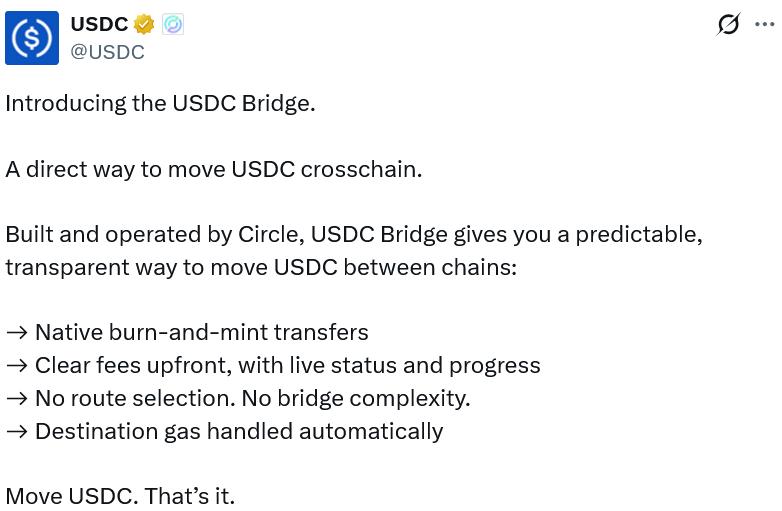
The announcement came on Friday through Circle's USDC X account, which explained that the bridge provides users with the ability to transfer the USDC stablecoin in a "predictable, transparent way," referencing a native burn-and-mint transfer mechanism and no bridge complexities.
According to Circle, the system will automatically manage gas fees, display fees in advance, and deliver live status updates during the entire transfer process, Circle added.
The newly launched USDC Bridge is built upon Circle's Cross-Chain Transfer Protocol (CCTP), a technology that debuted in April 2023 and currently facilitates hundreds of millions of stablecoin transfers each day.
Bridges that operate across different chains aim to create interoperability within the wider crypto ecosystem, enabling it to operate as a unified network instead of a series of fragmented, isolated blockchains.
Simplifying bridges and enhancing their user-friendliness has become a priority area for numerous crypto infrastructure companies.
Historically, bridges have created confusion among users and potentially hindered crypto adoption, particularly for newcomers who find it challenging to understand bridge interfaces, trade routes and gas fees.
USDC Bridge supports over a dozen blockchains
According to Cointelegraph's investigation, USDC Bridge facilitates USDC transfers among at least 17 Ethereum Virtual Machine-compatible blockchains, which include Ethereum, Avalanche, Arbitrum, Base, Monad, Optimism, Polygon, Sonic and World Network.
Circle's CCTP is compatible with a wider range of blockchains, encompassing Solana, Sui and Aptos, which do not have native EVM compatibility.
Earlier this week on Wednesday, Circle became the target of a class action lawsuit over its failure to freeze approximately $230 million worth of USDC that transferred through its CCTP following the Drift Protocol exploit on April 1.
The lawsuit accuses Circle of aiding and abetting conversion and negligence.
The class action lawsuit includes more than 100 members as participants. Mira Gibb, the law firm representing the plaintiffs, is pursuing damages, with the precise amount to be established during trial.