BTC Dips Below $80,000 While Record ETF Inflows Since January May Limit Downside
After facing resistance at the $82,800 level, Bitcoin declined beneath $80,000, though a record $1.105 billion in weekly spot BTC ETF inflows may prevent further selling pressure.

The price of Bitcoin (BTC) fell to $79,800 during Thursday's trading session following a rejection at a critical dynamic resistance point. This decline unfolded even as weekly inflows into spot Bitcoin exchange-traded funds (ETFs) exceeded $1 billion for the first time since the month of January, though technical indicators suggest this corrective phase might prove temporary.
Technical divergences indicate potential BTC price targets
The retreat of Bitcoin beneath the $80,000 threshold occurred alongside a bearish divergence visible in the relative strength index (RSI) across both the one-hour and four-hour timeframes. This bearish divergence pattern manifests when BTC establishes higher price peaks while the RSI demonstrates weakness on shorter time intervals, indicating diminishing buying pressure throughout an upward price movement.
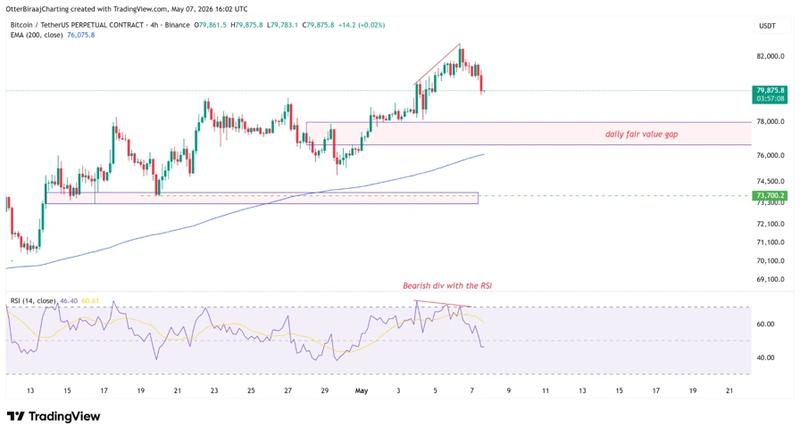
Maintaining a position above the weekly opening price of $78,500 may help stabilize near-term market dynamics. The crucial technical support zone continues to sit between $76,000 and $78,000, a region where the daily fair value gap (FVG) converges with Bitcoin's 200-day exponential moving average (EMA). Should the downward correction persist, BTC may revisit the FVG area before launching another rally attempt toward surpassing its latest peak of $82,800.
The concept of a fair value gap identifies a region where rapid price action previously took place with minimal trading volume, creating an imbalance that frequently transforms into a liquidity area during price pullbacks.
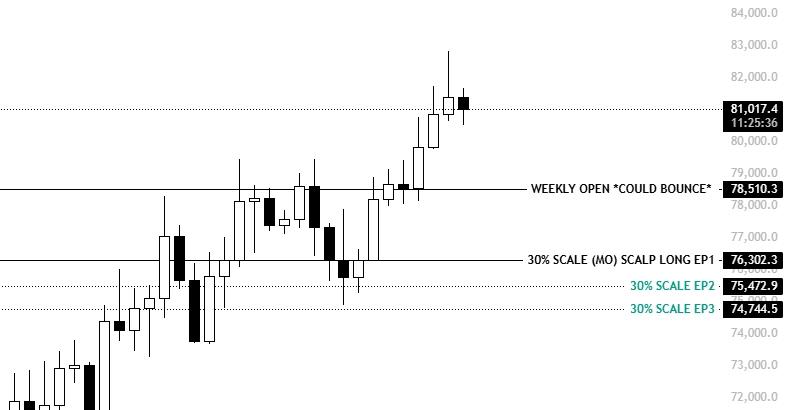
Cryptocurrency analyst Jelle noted that the "200-day MA/EMA cluster" was functioning as a resistance barrier, simultaneously highlighting $78,000 as the initial significant support level. In Jelle's assessment, a successful retest of the 200-day moving average might enable Bitcoin to pursue elevated price objectives.
At the same time, cryptocurrency analyst Killa XBT pinpointed the $76,300 to $74,700 range as a more substantial support area should selling momentum intensify. The analyst emphasized the weekly opening level around $78,500 as the primary near-term threshold that bullish traders are working to protect.
Will spot ETF demand counterbalance bearish price action?
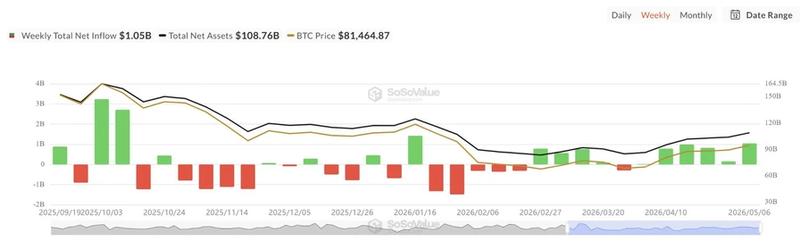
Demand for spot Bitcoin ETFs experienced a significant surge during the current week. Net capital inflows achieved $1.05 billion, representing the most robust weekly accumulation since January's third week. A positive weekly close on Friday would validate the most substantial weekly ETF inflow resurgence observed in approximately four months.
In parallel, analysis from Swissblock reveals that the Bitcoin Risk Index has declined to approximately zero, coinciding with ETF net flows returning to positive territory at around 3,000 BTC. Historical patterns demonstrate that increased risk measurements corresponded with ETF capital outflows and intensified selling activity throughout the broader market.
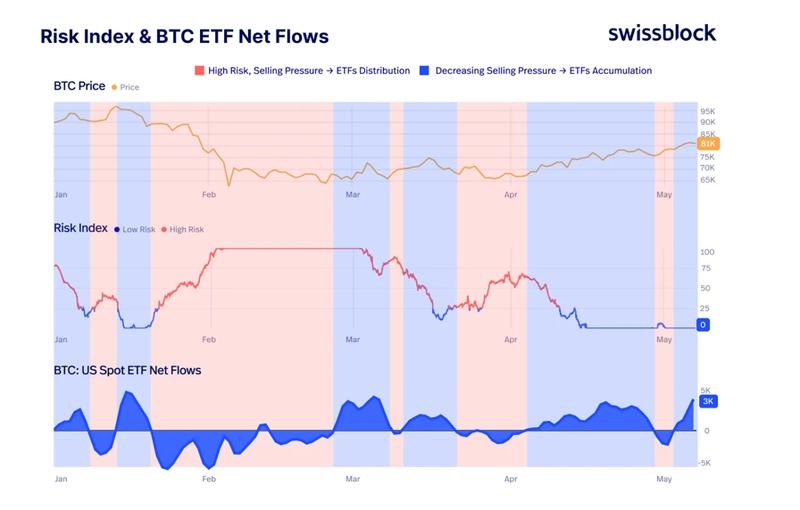
These reversals into the minimal-risk territory have frequently aligned with fresh accumulation activity near significant support zones. The research further noted,
"That synchronization is still in place. Even when the Risk Index ticked slightly higher last week, ETF selling appeared briefly, but accumulation quickly resumed. That tells us ETF demand is absorbing selling pressure. This remains a flow-driven breakout."