Bitcoin ETF Investors Chase Trends Rather Than Create Them, According to DWF Labs Analysis
New research from DWF Labs reveals that Bitcoin ETF investor behavior mirrors past BTC price action instead of forecasting future movements, with market participants purchasing during upswings and exiting during downturns.

Daily capital flows in and out of United States spot Bitcoin exchange-traded funds (ETFs) don't serve as dependable indicators for BTC's future direction, as market participants display a tendency to pursue price increases and exit during downturns, according to research conducted by DWF Labs.
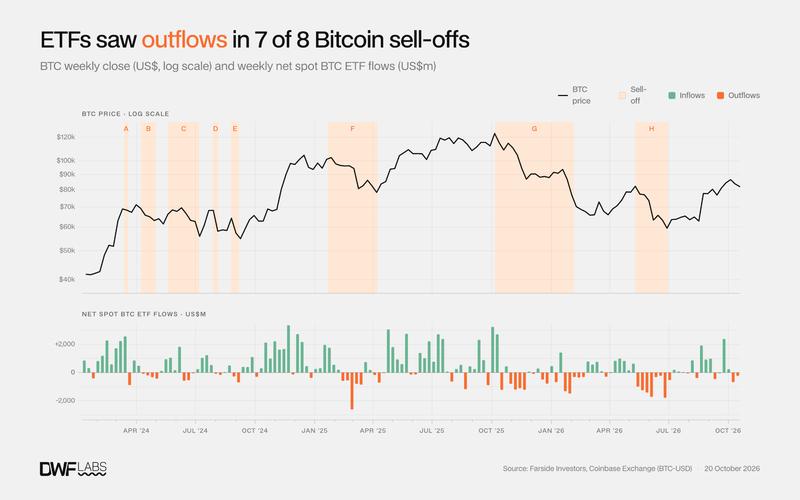
A research analysis released on Thursday by DWF revealed that market participants withdrew capital from these investment vehicles in seven out of eight instances when Bitcoin's valuation declined by a minimum of 15%. Conversely, all nine price surges of equivalent magnitude attracted positive net capital inflows. The comprehensive study examined 694 trading days beginning from January 2024, marking the debut of Bitcoin ETFs in the United States.
ETF flows confirm moves; they don't predict them. The evidence points mostly to investors reacting to price, not driving it.
DWF Labs
Market participants demonstrated a pattern of allocating capital to Bitcoin ETFs following price appreciation and withdrawing funds subsequent to price depreciation. These capital movements provided virtually no indication regarding whether Bitcoin's price would experience upward or downward movement during the subsequent five-day period.
Daily ETF flows exhibited a moderate correlation with Bitcoin's price fluctuations across the five trading sessions preceding that particular day, registering a correlation coefficient of 0.54. Using a measurement scale where zero indicates no correlation whatsoever, the correlation coefficient for the subsequent five-day period measured just 0.03.
ETF outflows don't show who sold
The most substantial capital withdrawals occurred during the pair of most recent market downturns. Market participants extracted a net total of $6.9 billion spanning the period from October 2025 through February 2026, which was then followed by an additional $8.2 billion in outflows throughout the May–June price decline.
These numerical figures fail to reveal whether institutional market participants or individual retail investors were responsible for driving the selling activity. DWF's research methodology did not distinguish between these two distinct investor categories in the course of its examination.
We don't have a clear split on the exact buyers/sellers of the ETFs.
DWF Labs spokesperson to Cointelegraph
A portion of ETF trading activity also originates from market participants who purchase fund shares while simultaneously establishing short positions against Bitcoin via CME futures contracts to capture the price differential existing between these two positions. DWF's calculations suggested that approximately one-fifth of total flows may have involved this hedging strategy, though the available data could not definitively confirm that identical investors maintained both positions of these trades.
An examination conducted by CoinShares and released in June determined that institutional investors decreased their Bitcoin ETF holdings by 17% throughout the initial quarter of 2026. Hedge funds and brokerage firms were responsible for approximately 96% of this reduction, whereas banking institutions expanded their positions.
Bitcoin's sell-offs have slowed
Bitcoin has experienced roughly three market sell-offs of 15% or greater annually since these ETFs commenced trading, in comparison to approximately four per year during the 2022–2023 period and eight during 2021, according to the research findings.
The price declines have additionally transitioned to more gradual patterns, though the magnitude of losses remains similar. The median sell-off eliminated 21.3% of value, measured against 19.4% during the 2022–2023 timeframe.
The changes aren't solely due to the ETF.
DWF Labs spokesperson
The company spokesperson emphasized that market volatility and the occurrence rate of sell-offs had already begun trending downward prior to the launch of these funds in 2024.