Battle for Payment Infrastructure Intensifies Among Stablecoin Providers and Fintech Giants
Major cryptocurrency and financial technology enterprises are vying for position in the lucrative stablecoin payment sector through the development of proprietary settlement systems.

Companies issuing stablecoins alongside fintech-related businesses are rolling out blockchain networks centered on payments in an effort to gain greater control over the settlement infrastructure that powers digital-dollar transfers denominated in US currency.
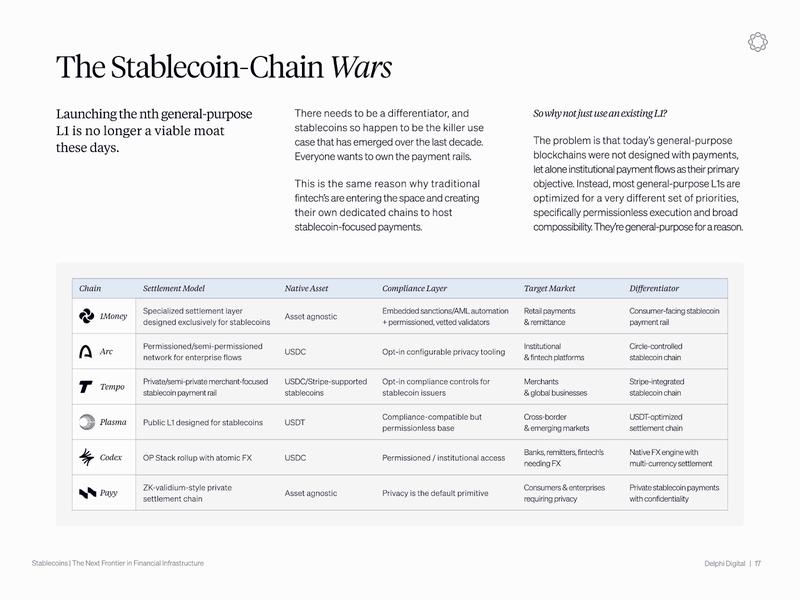
A new generation of blockchain networks is being constructed by certain stablecoin issuers and fintech-associated entities, with these platforms specifically engineered for institutional payment operations instead of the wider token creation and smart-contract functionality typically linked to multipurpose layer-1 networks, as reported by Delphi Digital.
Among these initiatives is Plasma, a public L1 network backed by stablecoin heavyweight Tether and optimized for cross-border USDt (USDT) transactions, which went live on mainnet on Sept. 25, 2025 following a $24 million fundraising round in February. One month subsequently, Circle, another stablecoin issuer, introduced the public testnet for Arc, which the company characterizes as an open L1 blockchain specifically engineered for stablecoin finance.
These developments contribute to mounting evidence of a fundamental transition away from general-purpose blockchain infrastructure and toward payment-specialized networks, as enterprises vie for dominance over the rails that support stablecoin settlement, which Delphi Digital identified as among crypto's most evident real-world use cases.
Financial technology firms have similarly entered the payments infrastructure competition, aiming to secure market share within the expanding stablecoin payments industry.
Control over the payment rails is emerging as "strategically important," according to Ran Goldi, senior vice president of payments and network at Fireblocks, a digital asset custody platform, who spoke with Cointelegraph. He said:
"Instead of relying on external networks and paying fees to ecosystems like Ethereum, companies are looking to capture more of that value themselves by building or controlling the settlement layer."
For entities operating in the payments space, maintaining ownership of the underlying rails enables them to circumvent being "taxed" for the mint and burn operations of the stablecoin, Goldi further explained.
Fintech companies are also joining the stablecoin chain wars
Tempo announced Wednesday that its mainnet has gone live, characterizing the network as a merchant-oriented settlement layer engineered for high-throughput stablecoin transactions. The initiative claims to be incubated by Paradigm and Stripe.

During October 2024, Stripe completed the acquisition of Bridge, a stablecoin infrastructure startup, for $1.1 billion. In June 2025, the company purchased Privy, a crypto wallet infrastructure provider, and subsequently acquired Metronome, a billing platform, on Jan. 14.
According to Delphi Digital, these acquisitions have positioned Stripe to exert greater control over the issuance, wallet and billing layers surrounding stablecoin payments in addition to settlement infrastructure.
Infrastructure for stablecoin payments is progressively being viewed as a novel "revenue layer," with entities that control the complete end-to-end payment workflow positioned to collect fees on each transaction, as explained by Alvin Kan, chief operating officer at Bitget Wallet.
"As settlement costs at the protocol level trend lower, value capture shifts to the orchestration layer around the rail: compliance, FX conversion, wallet infrastructure, on- and off-ramps, local payout connectivity and merchant integration," he told Cointelegraph.
Command over the settlement infrastructure underlying stablecoins represents the emerging battleground among cryptocurrency and fintech companies, as stated by Irina Chuchkina, chief growth officer of Wallet in Telegram. She said:
"Stablecoin payment rails could become the defining revenue driver of this cycle, for the same reason Visa and Mastercard became indispensable: not because they issued currency, but because they owned the pipes."
Organizations developing settlement rails with interoperability for agentic artificial intelligence are positioned to "capture a disproportionate share of the value flowing through these networks," she added.