American 'Laptop Farmers' Receive Prison Terms for Supporting North Korean Remote IT Operatives
Federal authorities have obtained 18-month jail terms for two individuals who facilitated laptop operations for North Korean remote IT workers, part of an operation specifically focused on cryptocurrency firms.
Federal prosecutors announced they have obtained a total of eight convictions over the past five months targeting individuals who served as United States-based intermediaries for information technology workers operating from North Korea, providing fresh insights into the methods used to penetrate American businesses.
Just this month, two individuals received their sentences. The Department of Justice announced on Wednesday that different judicial proceedings resulted in sentencing for Matthew Issac Knoot, a Nashville resident, and Erick Ntekereze Prince, who resides in New York, for facilitating remote work arrangements between North Korean nationals and American corporations.
The American conspirators, referred to as "laptop farmers," served as the delivery points for computer equipment that American businesses would ship to newly hired workers. They configured remote access desktop applications on these machines, enabling information technology professionals based in North Korea to operate them from afar while maintaining the appearance of working within United States borders.
The remote worker operation orchestrated by North Korea, which produces income for the nation's government, has specifically and aggressively pursued technology-focused positions within cryptocurrency organizations in attempts to obtain entry to corporate resources or comprehend their technical infrastructure for purposes of theft or exploitation.
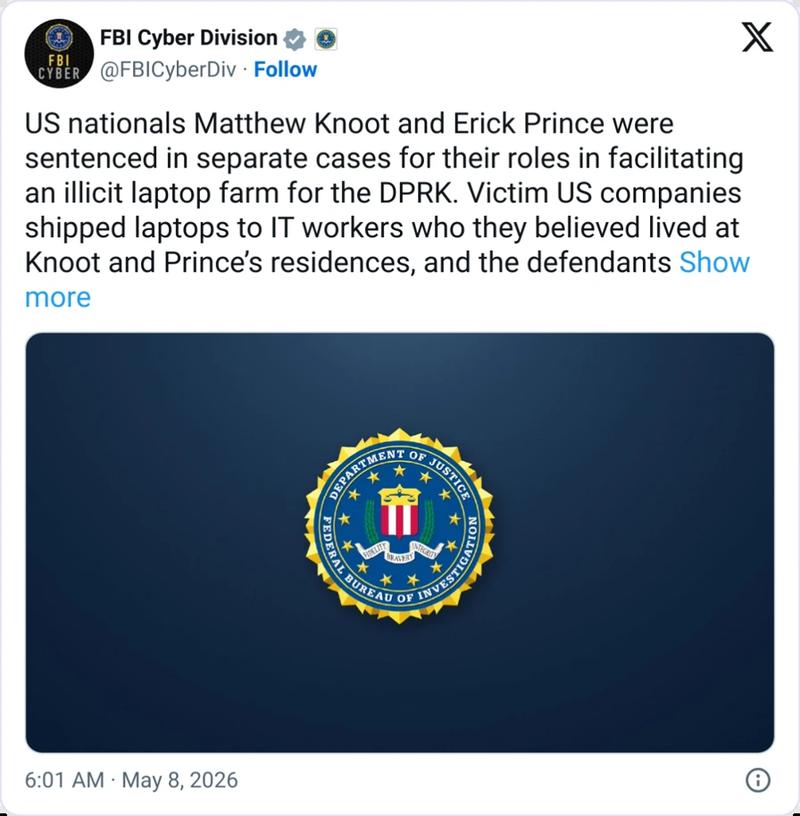
According to prosecutors, Knoot received his sentence on May 1, while Prince was sentenced on Wednesday, with both men receiving identical 18-month prison terms.
Prince received an order to surrender $89,000, representing the compensation the North Korean operatives provided him for participating in the operation, whereas Knoot received an order to provide $15,100 in restitution payments to the affected businesses and to surrender an additional $15,100, reflecting his earnings from participating in the scheme.
Combined, the Department of Justice stated the two individuals produced $1.2 million in income for North Korea, with the operation impacting close to 70 American corporations.
In the previous month, Kejia Wang and Zhenxing Wang, both residents of New Jersey, received sentences of nine years imprisonment and seven years, eight months imprisonment, in that order, for operating laptop farming operations benefiting North Korea.
In that particular case, prosecutors stated the operation continued for several years, utilized the compromised identities of 80 individuals residing in the United States and generated more than $5 million in revenue for the government of North Korea.
Based on a CrowdStrike report published in August, the quantity of businesses that employed North Korean operatives during the preceding 12 months increased by 220%, with these workers successfully infiltrating over 320 organizations throughout that timeframe.
The report highlighted that North Korean operatives were extensively utilizing artificial intelligence technologies to streamline and enhance their processes for submitting applications and performing duties in remote employment positions.
Federal authorities filed charges against four North Korean nationals in June of last year, alleging they embezzled over $900,000 in cryptocurrency following their use of fraudulent identities to secure remote positions at a blockchain research and development firm based in Atlanta and a cryptocurrency organization located in Serbia.