AI Debt Insurance Costs Hit All-Time Peak as Asian Chip Markets Plunge
A catastrophic two-day collapse in Seoul markets combined with expanding credit spreads among major cloud providers indicates the AI sector's debt burden is causing damage across both stock and bond markets.

Key points:
- The KOSPI experienced consecutive trading halts that erased $620 billion across two sessions, amplified by high-leverage retail positions
- Credit default swaps for major hyperscalers surged from 115 basis points to 162bps over recent months, suggesting approximately 12% probability of default within five years, with Oracle's OpenAI connection presenting the most significant concern
- Despite delivering a record operating profit of 60.54 trillion Korean won, Hynix fell short of the anticipated 64 trillion won forecast
Korean markets suffer $620 billion destruction over two sessions
On Wednesday, South Korean stock markets experienced their second consecutive day of unprecedented turmoil as system-wide trading halts were triggered once more. When combined with the previous session's decline, the KOSPI index has plummeted approximately 17%, eliminating $620 billion in total market value. The severity of the situation has forced governmental authorities to organize an urgent gathering of financial regulators.
The catalyst that ignited this massive sell-off was SK Hynix's disappointing second-quarter financial results. Shares of the semiconductor giant fell an additional 4% during Wednesday's session, compounding the previous day's devastating 15% decline. When considered alongside Samsung Electronics, these two technology behemoths represent approximately half of the entire Korean stock index's weight.
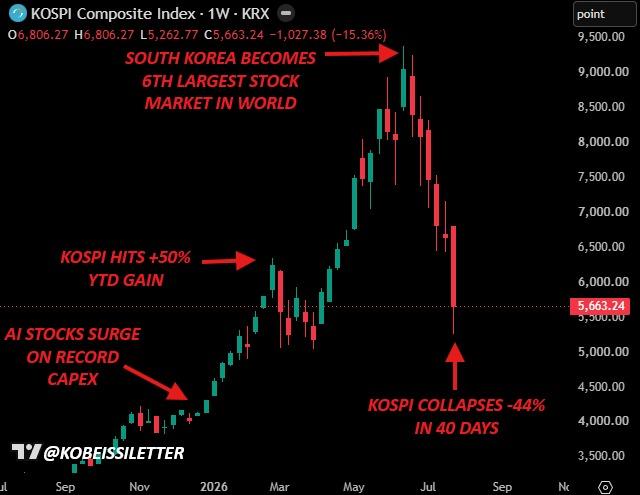
Within a cohort of younger Koreans who find themselves unable to afford real estate and facing increasingly competitive employment prospects, high-stakes wagers on volatile financial products have become more commonplace. The current week's market carnage is particularly devastating for aggressive young retail investors in Korea, who have traditionally shown enthusiasm for cryptocurrency markets, but recently migrated toward artificial intelligence and semiconductor stocks. Trading volumes in Korean cryptocurrency exchanges have declined 28%, even as the KOSPI index maintains a 31% gain for the current year.
Following regulatory approval and the introduction of single-stock leveraged exchange-traded funds available for retail purchases in May, these individual investors entered the market with significantly amplified positions. These investment vehicles saw their total assets under management surpass $50 billion during July. In the wake of substantial financial losses over recent trading sessions, senior government officials have issued public apologies for authorizing these products and are advocating for reinstating prohibitions on retail access to such leveraged instruments.
This market downturn represents additional evidence that semiconductor and artificial intelligence equities are valued based on assumptions of perfect operational performance, creating significant vulnerability when the industry's ambitious expansion projections fall short. Despite the fact that Hynix delivered unprecedented operating profit of 60.54 trillion won ($41.25 billion), representing a 557% increase compared to the prior year, this performance failed to reach the 64 trillion won figure anticipated by analyst consensus estimates.
Credit markets scrutinize AI sector investments
The decline affecting semiconductor companies aligns with wider indications of exhaustion within the artificial intelligence investment thesis. Growing uncertainty surrounding this sector has extended beyond equity markets into credit instruments. Five-year credit default swaps covering a portfolio of the five dominant American hyperscalers — Amazon, Meta, Microsoft, Google and Oracle — have risen dramatically from 115bps to 162bps over the past several months and currently stand at an unprecedented level. These financial contracts enable bondholders to make regular premium payments to a counterparty who agrees to compensate them should the underlying debtor fail to meet obligations. When evaluated against comparable-maturity government securities, the resulting credit spread reveals an even more troubling situation.
Market pricing currently indicates a 12% probability that these corporations will default on their obligations within a five-year timeframe. According to Sage Advisory, hyperscaler companies have expanded their combined dollar-denominated debt exposure by more than double since September, surpassing $360 billion as free cash flow has turned negative. Oracle represents the most significant contributor to elevated credit risk following its aggressive capital allocation toward artificial intelligence infrastructure. Although the database giant maintains a substantial contract backlog, a considerable portion depends on OpenAI as a sole client, which has experienced challenges generating positive cashflow and has postponed its initial public offering.
Aggregate capital expenditure projections for 2026 from Alphabet, Microsoft, Amazon, and Meta are currently estimated to reach between $725 billion and $730 billion. Alphabet itself recorded its inaugural cash burn during the second quarter, totaling $5.9 billion, notwithstanding its cloud division achieving 82% revenue growth. Meta is scheduled to announce its second-quarter financial performance later this evening following the conclusion of United States market trading.