Washington's regulatory standoff fuels explosive growth in yield-generating stablecoins
As United States legislators continue sparring over cryptocurrency yield regulations, yield-generating stablecoins are experiencing growth rates that far exceed the wider stablecoin market.

According to data from Messari, yield-generating stablecoins are experiencing expansion at a pace significantly faster than the general stablecoin marketplace, even as Washington continues to grapple with disagreements over the proper legal treatment of cryptocurrency-related yield under United States regulatory frameworks.
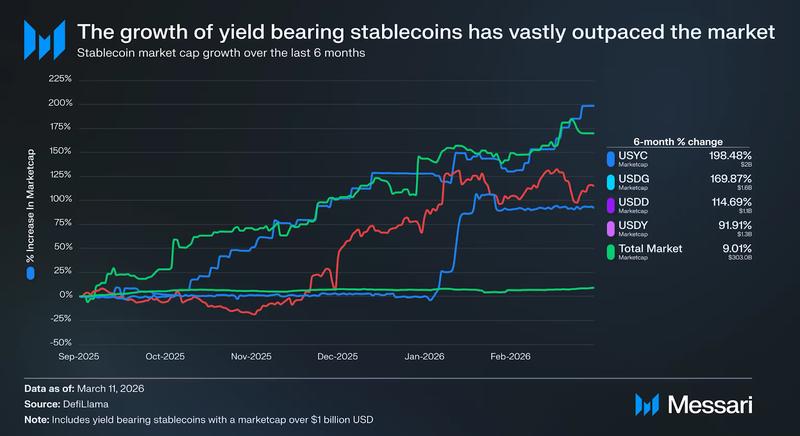
Data from a Messari research report released on Thursday indicates that yield-generating stablecoins have surpassed the expansion rate of the wider stablecoin marketplace by a factor of 15 throughout the last six months.
This substantial growth was propelled by Circle's USYC (USYC) experiencing a market capitalization surge of 198%, while Paxos' Global Dollar (USDG) saw an expansion of 169%, the Tron DAO-associated Decentralized USD (USDD) recorded a 114% value increase, and Ondo Finance's Ondo US Dollar Yield (USDY) registered a 91% uptick. By comparison, the total market capitalization across all stablecoins increased by just 9%.
According to Messari's analysis, the most prominent yield-generating stablecoins are beginning to operate in a manner more similar to money market funds or traditional bank deposits. Messari noted that "The winners don't do payments," further observing that the leading issuers concentrate their offerings on a singular asset rather than pursuing payment-focused applications.
According to Messari, yield-generating stablecoins began exceeding the growth trajectory of overall stablecoin supply starting in mid-October 2025. This emerging pattern points to increasing appetite for blockchain-based United States dollar instruments that deliver yield while avoiding direct exposure to the volatility characteristic of the broader cryptocurrency market.
Currently valued at a combined $22.7 billion, yield stablecoins have seen their collective market capitalization climb 11% during the last 30 days, based on data from Stablewatch.
Though this represents a doubling from the $11 billion market capitalization recorded in May 2025, the current $22.7 billion valuation of yield-generating stablecoins comprises merely approximately 7.4% of the overall $303 billion stablecoin market capitalization, an increase from the 4.5% share recorded in May of the previous year.
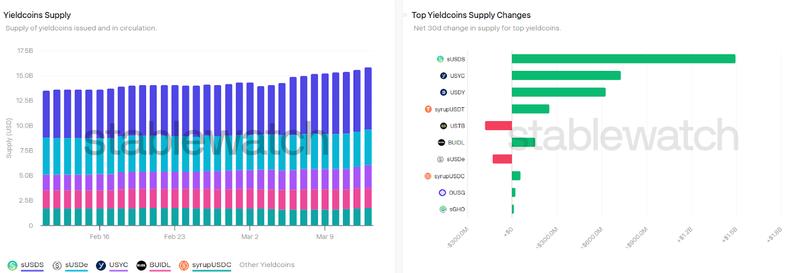
DefiLlama data shows that the largest yield-generating stablecoins measured by total value include Sky's (sUSDS), Ethena's (sUSDe) and Maple's Syrup USDC.
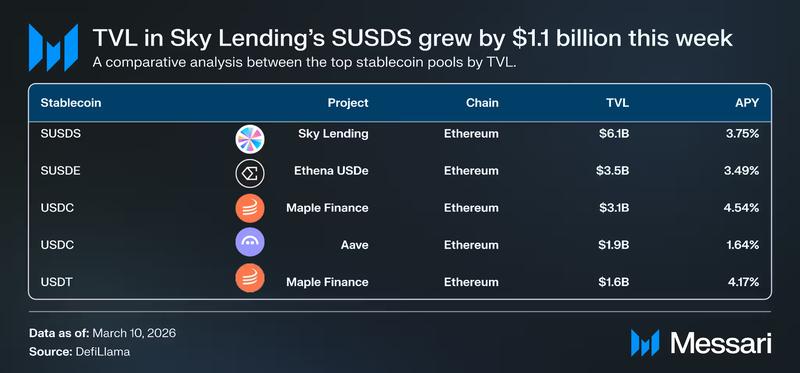
When examining yield performance, Messari data reveals that Maple's Syrup USDC topped the charts this week delivering a 4.54% annual percentage yield, with Maple USDT following at a 4.17% APY, Sky Lending's SUSDS claiming third position with a $3.75% APY, and Ethena's USDe offering 3.49% APY.
Lawmakers at odds over stablecoin yield regulations
Even as demand continues expanding, United States legislators find themselves locked in disagreement regarding the market structure legislation's clauses concerning yield-generating stablecoins.
Reports on Thursday indicated that US Senate Majority Leader John Thune stated his expectation that the chamber will not advance the cryptocurrency market structure legislation prior to April.
Yield-generating stablecoins have emerged as a central point of contention within the legislative debate, with banking industry groups issuing warnings that these instruments could establish a regulatory loophole capable of siphoning deposits away from conventional banking institutions.
The Senate Banking Committee delayed its markup session in mid-January while bipartisan negotiations remained ongoing, a delay that drew public criticism from United States President Donald Trump for holding up the legislation.
The Digital Asset Market Structure Clarity Act, commonly referred to as the CLARITY Act, aims to establish a comprehensive regulatory framework providing clarity for digital assets. The House of Representatives approved the legislation on July 17, 2025, and the measure has remained under consideration in the Senate ever since.
Under the United States federal stablecoin framework known as the GENIUS Act, issuers are barred from providing interest or yield for simply holding a payment stablecoin, though the legislation still permits third-party platforms to provide reward programs connected to stablecoin holdings. The GENIUS Act received presidential signature and became law on July 18, 2025.