Over 2% of Bitcoin Nodes Now Support BIP-110 Amid Escalating Spam Conflict
A Bitcoin enhancement proposal seeks to limit arbitrary data insertion as a countermeasure against spam originating from non-financial transactions on Bitcoin's blockchain.

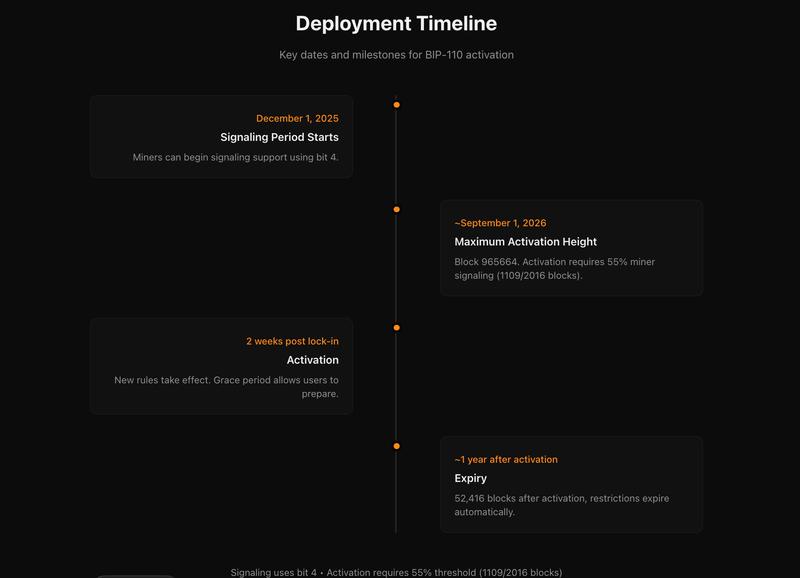
Support for Bitcoin Improvement Proposal 110 (BIP-110) among Bitcoin (BTC) nodes has climbed to 2.38%, marking a significant milestone for the temporary soft fork designed to restrict the volume of data permitted in individual transactions at the consensus layer.
Data from The Bitcoin Portal reveals that 583 nodes out of a total of 24,481 are currently operating BIP-110, with Bitcoin Knots serving as the main node software implementation enabling users to run the soft fork proposal.
According to the proposal's GitHub page, BIP-110 restricts transaction output sizes to a maximum of 34 bytes while imposing an 83-byte ceiling on OP_RETURN data. The temporary soft fork is scheduled for a 1-year deployment period, with the possibility of being extended or modified following the conclusion of the initial term.
The script code known as OP_RETURN enables users to insert arbitrary data into transactions and has become a focal point of heated discussion within the Bitcoin community since the launch of Bitcoin Core version 30, which represents the most recent upgrade of the predominant Bitcoin node software.
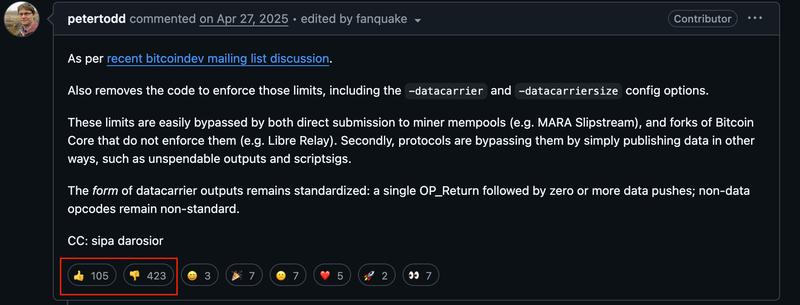
Previously, the OP_RETURN limit stood at 83 bytes, a restriction that Bitcoin Core developers chose to eliminate unilaterally in Bitcoin Core version 30 after a contentious pull request that was initially proposed in April 2025. This proposal faced widespread opposition from members of the Bitcoin community.
Arbitrary data controversy splits Bitcoin community down the middle
The Bitcoin Core upgrade eliminating the data cap became operational in October 2025, triggering a wave of harsh criticism from detractors who contend that lifting the arbitrary data restriction creates incentives for spam to proliferate on the Bitcoin ledger.
The presence of arbitrary data drives up the storage expenses associated with operating a Bitcoin node, and these elevated costs contribute to greater centralization within the Bitcoin network.
Running Bitcoin nodes is possible on consumer-grade computing equipment, a stark contrast to high-throughput blockchain networks that produce massive volumes of data and necessitate specialized hardware infrastructure.
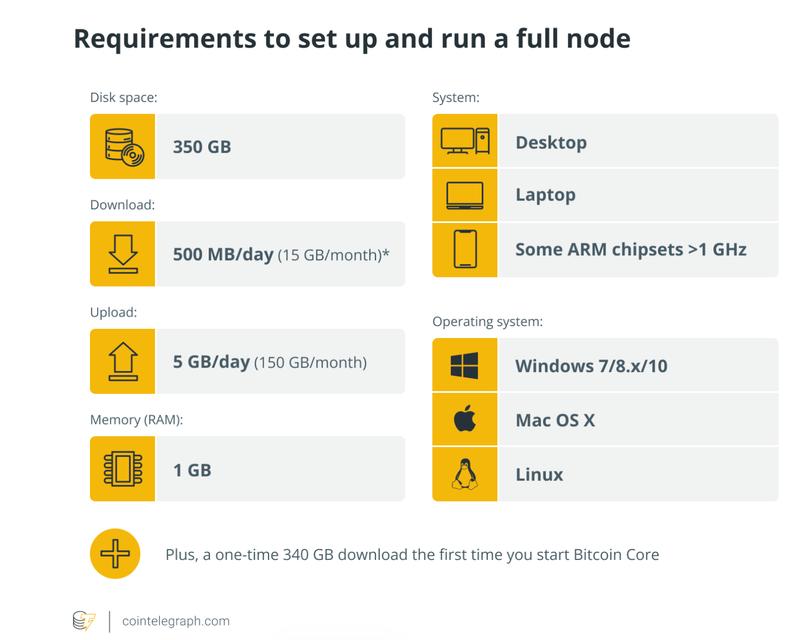
Critics argue that raising node hardware requirements erodes the fundamental value proposition of the Bitcoin protocol as a decentralized monetary network. Bitcoin advocate and educator Matthew Kratter expressed this concern:
"It's like one of those parasitical plants, like ivy, completely covering a tree, eating up the tree, and then the inner scaffolding collapses, and the ivy collapses because it's basically destroyed the structure. This is what spam has the potential to do to Bitcoin."
Conversely, individuals such as Jameson Lopp, a Bitcoin Core contributor, defend the removal of the OP_Return limit cap, maintaining that filtering mechanisms provide minimal effectiveness in preventing spam from proliferating across the network.