Near One warns proof of ownership systems crucial as quantum threat looms
The development team behind NEAR Protocol warns that blockchain networks must implement new methods to verify legitimate asset ownership when quantum computing threatens to break wallet encryption.
The research and development organization responsible for the NEAR Protocol layer-1 blockchain has emphasized that protocols preparing defensive measures against quantum computing threats must simultaneously address the challenge of rapidly confirming legitimate asset ownership following potential theft incidents.
While anxiety about quantum computers potentially breaking the cryptographic foundations of blockchain technology has sparked widespread discussion about wallet security and private key protection, the majority of discourse has concentrated on attack prevention strategies.
Speaking on Wednesday, Anton Astafiev, who serves as chief technology officer at Near One, explained that distinguishing between legitimate asset holders and malicious actors executing transactions would become impossible. He noted this reality would force blockchain protocols into difficult choices regarding whether compromised cryptocurrency wallets should be frozen.
According to Astafiev, protocols will confront a critical decision point: "block all assets at this moment, or enter a wild west."
The CTO proposed that zero-knowledge proof systems could provide a solution, allowing legitimate owners to prove they possess knowledge of their original seed phrase while keeping that sensitive data private.
"This is one example of how research across blockchain ecosystems is essential and valuable as everyone prepares for quantum unknowns."
This initiative follows announcements from Google and California Institute of Technology researchers in March suggesting that viable quantum computers might materialize earlier than industry experts anticipated, requiring significantly reduced computational power to crack cryptographic protections compared to previous estimates.
According to Google's research, quantum computers might successfully breach Bitcoin's cryptographic defenses in as little as 10 minutes, creating opportunities for malicious actors to execute what's known as an "on-spend" attack.
Near One is actively investigating solutions to address the fundamental problem of determining whether transactions originate from legitimate owners or unauthorized parties, Astafiev confirmed.
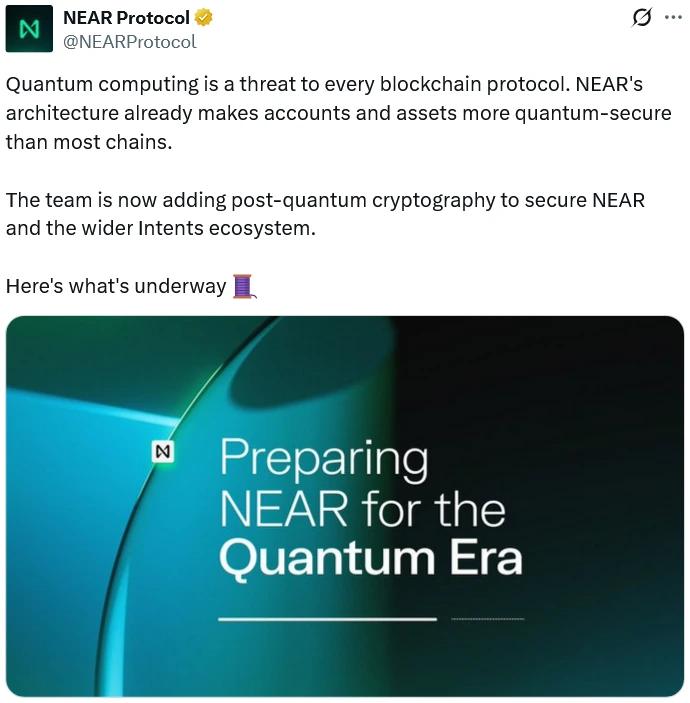
Additionally, he revealed that NEAR's development team is constructing a signing system designed to withstand post-quantum threats for the layer-1 blockchain network, which currently safeguards over $137.6 million in user assets.
Among the initial quantum-resistant technologies being deployed on NEAR is "FIPS-204," which has received official approval from the US National Institute of Standards and Technology, with testnet deployment scheduled for completion before the second quarter concludes.
Meanwhile, additional cryptocurrency ecosystems are implementing rapid countermeasures as well.
Ethereum Foundation established the Post-Quantum Ethereum team with a mandate to integrate quantum-resistant solutions directly into Ethereum's protocol architecture by 2029.
Anza and Firedancer, two validator clients operating on Solana, have deployed experimental versions of Falcon, an innovative post-quantum signature technology, as part of preparations to shield the Solana network against emerging quantum dangers.
Bitcoin's developer community has similarly initiated exploration of potential countermeasures.
In April, Adam Back, CEO of Blockstream, characterized present-day quantum computers as "basically lab experiments," reinforcing his previous statements that functional quantum computers remain decades in the future.
Nevertheless, he urged Bitcoin's developer community to begin investigating and constructing quantum-resistant solutions proactively.