Gen Z Crypto Holdings Reach 23% as Australian Regulator Sounds Alarm on AI and Social Media 'Finfluencers'
Two-thirds of Australia's Gen Z population rely on social media platforms for financial decision-making, a trend the country's securities watchdog says is driving increased risk-taking in investments.

Young Australian investors are being cautioned against depending on artificial intelligence chatbots and social media personalities for investment guidance, according to Australia's financial regulatory body, which also discovered that nearly one-quarter of Gen Z individuals hold cryptocurrency investments.
On Sunday, the Australian Securities and Investments Commission (ASIC) released survey findings revealing that Gen Z demonstrates elevated confidence in "frequently unreliable information sources," a pattern that has resulted in more hazardous investment choices.
"The Moneysmart Gen Z study revealed that although Gen Z demonstrates significant interest in credible and reliable financial information, many face challenges locating it – with their searches frequently directing them toward content created for user engagement instead of factual accuracy," ASIC stated.
In June of last year, ASIC pursued enforcement measures against social media influencers regarding their financial content, delivering warning notices to 18 individuals "believed to be unlawfully marketing high-risk financial instruments and delivering unlicensed financial guidance."
The most recent survey, which ran from Nov. 28 through Dec. 10 of the previous year and included 1,127 participants aged 18 to 28, revealed that 63% of this demographic turns to social media platforms for financial knowledge and direction, while 18% utilize artificial intelligence (AI) tools and 30% specifically rely on YouTube.
The study additionally discovered that 56% of Gen Z respondents report they "somewhat or completely trust" financial content found on social media platforms, while 52% expressed similar confidence levels in "finfluencers" — influencers on social media who primarily focus on financial or investment topics and present themselves as financially knowledgeable.
Among younger generations, AI emerged as the most trusted source, garnering confidence from 64% of respondents.
ASIC calls for caution on crypto influencers
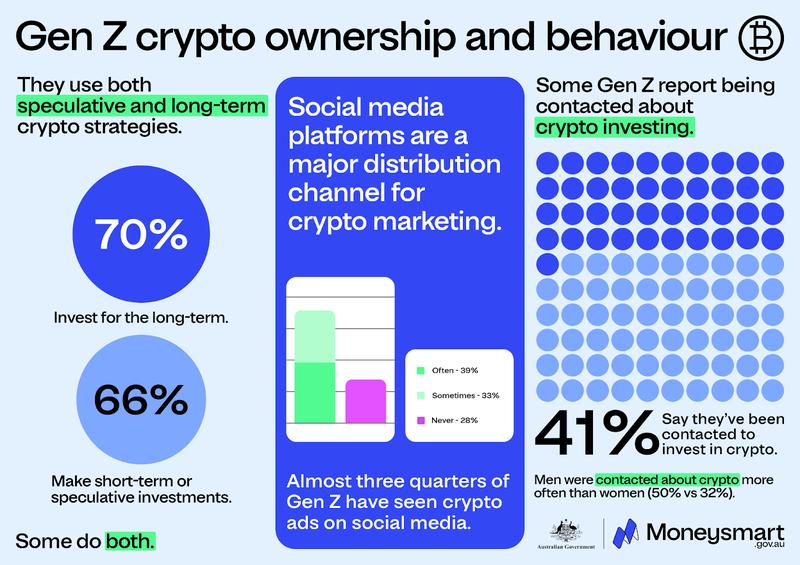
Survey findings also indicated that cryptocurrency ownership among Australia's Gen Z population has reached 23%, with 29% of these investors making trading decisions influenced by social media and influencer material, leading to warnings that such personalities might "establish unrealistic expectations" regarding investment profits, market fluctuations, and the complexities of investing for the long term.
In an interview with the Australian Financial Review (AFR) published Sunday, ASIC commissioner Alan Kirkland revealed the regulatory body has been monitoring promotional activities intended to persuade individuals to make investment decisions, highlighting that some constitute fraudulent schemes.
"We're conscious that there's a lot of marketing activity on social media to encourage crypto investment, and our work has shown some that is actually encouraging people to invest in scams," Kirkland said.
"It's really important for people to be aware of those risks, because you don't see that same volatility in other types of investments and often that volatility is driven by forces that it's impossible for an individual sitting in Australia to understand," he added.
Kirkland additionally identified Australian superannuation funds — representing a $4.5 trillion industry composed of retirement savings — as a sector where influencers lacking proper qualifications are dispensing advice.
"We see it most where people are lured in through social media ads and then encouraged to switch their super, because super is often people's most valuable asset, and that's why disreputable people often target it and why it can be so tragic if people are encouraged to put it into a risky investment," he said.
ASIC has AI financial advice in its crosshairs
In his AFR interview, Kirkland disclosed that ASIC is "watching very closely" the categories of financial guidance being generated through AI platforms. The commissioner emphasized that licensing requirements apply to any service delivering information that constitutes specific financial recommendations.
"It is clear under Australian law that if any entity is giving financial advice, they need to be licensed. So if an AI tool, whoever's providing it, is actually making recommendations about individual financial products, taking into account individual circumstances, that would be personal advice, so it needs to be licensed," he said.
The regulator's apprehensions emerge as several cryptocurrency trading platforms have already incorporated AI chatbots into their service offerings to provide customized trading advice or "trading partners", with platforms such as MEXC, KuCoin and Bitget among those leading this integration.
"One of the most surprising findings from this research was the degree of trust young people are placing in AI platforms," he said, adding:
"Depends very much on the nature of the questions you're asking, how specific those questions are and the quality of the sources that AI is able to draw upon in order to serve us the results."
Financial guidance delivered through AI systems is not the sole focus area for ASIC during the current year. Toward the end of January, the regulatory authority issued a warning that cryptocurrency or AI companies taking advantage of licensing ambiguities surrounding payment services in Australia would constitute one of its primary enforcement focuses throughout 2026.