Galaxy Research Warns Bitcoin Could Drop to $56K Amid Lack of Bullish Catalysts
According to Galaxy's Alex Thorn, Bitcoin faces potential decline to its realized price of $56,000 due to absence of compelling catalysts that could trigger an upward price movement.

The leading cryptocurrency Bitcoin may extend its current downward trajectory due to a shortage of positive catalysts capable of reversing its declining price action, according to Alex Thorn, head of research at Galaxy Digital.
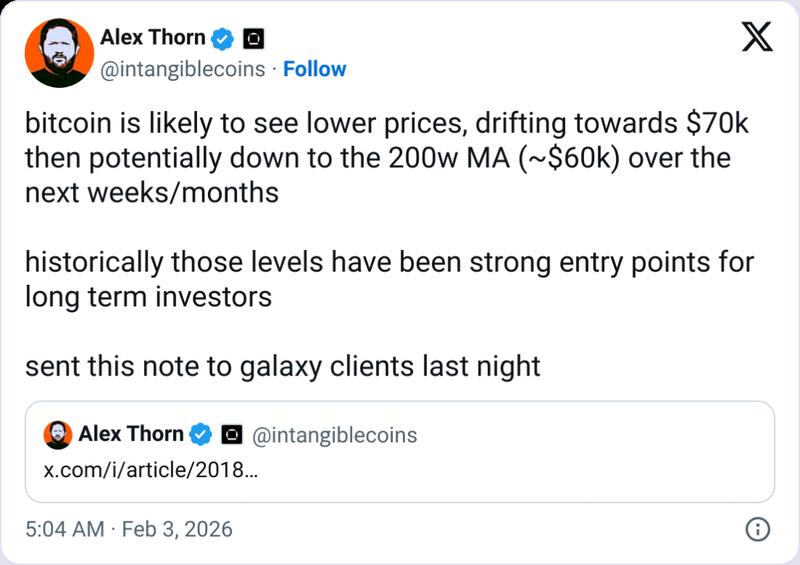
In a research note released on Monday, Thorn stated that there exists a "significant chance" that Bitcoin (BTC) could decline in the weeks ahead to the lower boundary of a supply gap positioned at $70,000, subsequently testing its realized price level of $56,000, which represents the average acquisition cost of all BTC currently in circulation.
"Catalysts remain hard to find and narratives are also working against Bitcoin as it fails to trade along with gold and silver as part of a market-wide 'debasement hedge trade,'" he added.
The world's largest cryptocurrency by market capitalization gained 3% on Monday, reaching a trading level just beneath $78,500 following its recovery from a 9-month low. Bitcoin currently trades 39% below its all-time high of over $126,000, which was achieved in early October, according to data from CoinGecko.
Realized price level could provide crucial support, potentially indicating market bottom
According to Thorn, historical data demonstrates that Bitcoin has previously traded beneath its realized price during the bottoms of past bear market cycles, and has consistently discovered support "around or slightly below" this realized price level prior to resuming upward price action.
The research lead further noted that Bitcoin has also experienced "key support" at its 200-week moving average, representing its average price over that extended timeframe, during each of the previous three bull market cycles when the price has dropped below its 50-week moving average.
Thorn highlighted that Bitcoin lost its support level at the 50-week moving average in November, while the 200-week moving average is presently positioned at $58,000.
"Those levels have historically marked cycle bottoms and made strong entry points for long-term investors," he added.
Declining sales activity from long-term holders may indicate approaching bottom
Thorn observed that there is currently "little evidence of significant accumulation" occurring from major buyers and long-term holders. This absence of accumulation could exert downward pressure on Bitcoin's price as it suggests potential buyers may be waiting for further price declines before entering positions.
Nevertheless, Thorn pointed out that profit-taking activity from long-term holders, which has the capacity to suppress prices, has "begun to notably abate" though he cautioned it's "possible there are more long-term holders who are waiting for higher prices to sell," which can create resistance to price gains.
"Nonetheless, the recent decline in long-term holder realized profit taking is notable and should signal we are closing in on a bottom," he added.
Cryptocurrency market structure legislation unlikely to serve as major catalyst
The cryptocurrency sector is maintaining close attention on the US Senate, where legislators are working to advance a crypto market structure bill designed to establish regulatory frameworks for the industry.
Yet Thorn noted that although the enactment of this legislation "could act as a near-term exogenous catalyst, odds of passage have diminished in recent weeks."
Members of Congress have encountered challenges in securing bipartisan support for the proposed bill, and the forward momentum toward passing the legislation has weakened as the Senate Banking Committee, which plays a crucial role in advancing the bill, has failed to reschedule a meeting to move the legislation forward.
Nevertheless, Thorn suggested that "any positive momentum generated by passage [is] more likely to yield benefit to altcoins than BTC."