Federal Credit Union Watchdog Unveils Licensing Framework for Stablecoins
A federal licensing framework for payment stablecoin issuers has been put forward by the US National Credit Union Administration for those operating via credit union subsidiaries.

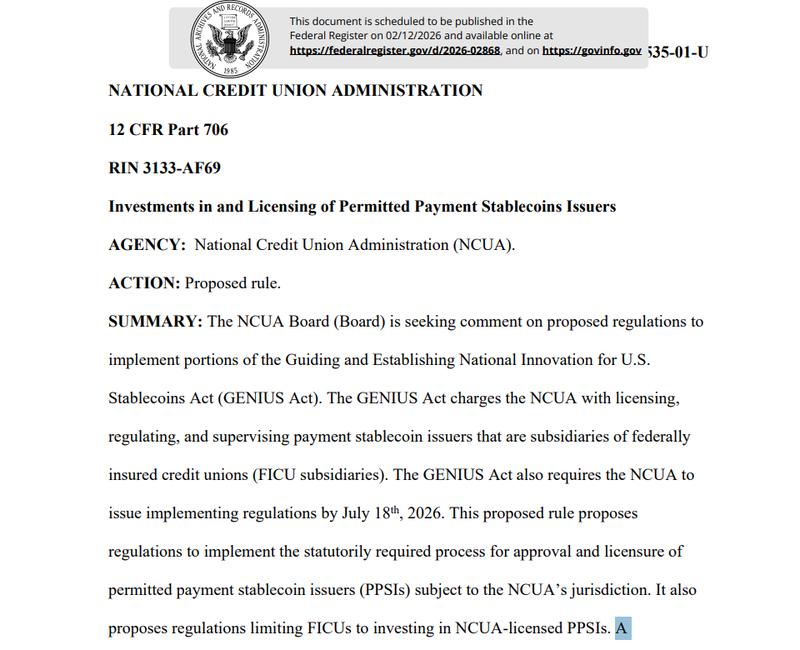
For the first time, the National Credit Union Administration (NCUA) of the United States has introduced regulatory guidelines under the Guiding and Establishing National Innovation for US Stablecoins (GENIUS) Act, outlining the pathway for subsidiaries of federally insured credit unions to seek approval as federally supervised issuers of payment stablecoins.
The regulatory body, which provides oversight for more than 4,000 federally insured credit unions that serve approximately 144 million members and hold around $2.38 trillion in assets as of mid-2025, is utilizing this proposed framework to establish both the application procedure and the criteria required for licensing these entities.
According to the proposal, any entity issuing payment stablecoins that qualifies as a "subsidiary of an insured credit union" must secure an NCUA permitted payment stablecoin issuer (PPSI) license prior to launching any coin issuance activities.
Additionally, federally insured credit unions would be barred from making investments in, or extending loans to, issuers of payment stablecoins unless such entities possess an NCUA PPSI license.
The current draft maintains a narrow scope, concentrating on licensing procedures and investment restrictions. An upcoming proposal is expected to establish GENIUS Act compliance standards and limitations for PPSIs, encompassing requirements concerning reserves, capital adequacy, liquidity provisions, combating illicit finance, and managing information technology risks.
At this stage, the regulatory effort centers on establishing the licensing and supervisory framework, and any future deployment of stablecoin offerings to credit union members would require subsequent approvals and compliance with additional regulatory standards.
"A forthcoming proposal will propose regulations to implement the standards and restrictions imposed by the GENIUS Act on PPSIs," the preamble states.
Blockchain neutrality and automatic approval timeline
Two provisions are particularly noteworthy for the wider cryptocurrency industry. Initially, the NCUA would be prohibited from rejecting a substantially complete application exclusively on the grounds that a stablecoin operates "on an open, public, or decentralized network," wording that specifically ensures public blockchain-based issuance cannot be turned down based on that characteristic alone.
Additionally, after an application receives designation as "substantially complete," the regulatory agency would be given a 120-day period to either grant approval or issue a denial, and should the NCUA not take action during that timeframe, the application would automatically receive "deemed approved" status.
The proposed framework also executes a fundamental GENIUS Act structural requirement. Federally insured depository institutions, credit unions included, are prohibited from directly issuing payment stablecoins and are required to utilize separately supervised subsidiary entities that satisfy uniform federal requirements.
In the case of credit unions, this typically involves channeling operations through credit union service organizations and other eligible structures that come under NCUA's regulatory authority as "subsidiaries of an insured credit union."
It should be noted that the document represents only a notice of proposed rulemaking. Interested parties will have a 60-day period following Federal Register publication to submit comments before the NCUA proceeds to finalize or modify the licensing framework.
Cointelegraph reached out to NCUA for additional comments, but had not received a response by publication.