EURAU Stablecoin Expands DeFi Presence as AllUnity Targets Major Decentralized Exchanges
The MiCA-compliant firm AllUnity is broadening its euro-backed EURAU stablecoin's reach by establishing liquidity pools on leading decentralized exchanges like Uniswap and Raydium, featuring pairs with USDT and USDT0.

European stablecoin issuer AllUnity, which operates under regulatory compliance, is broadening the reach of EURAU, its euro-backed stablecoin, by integrating it into leading decentralized exchanges (DEXs).
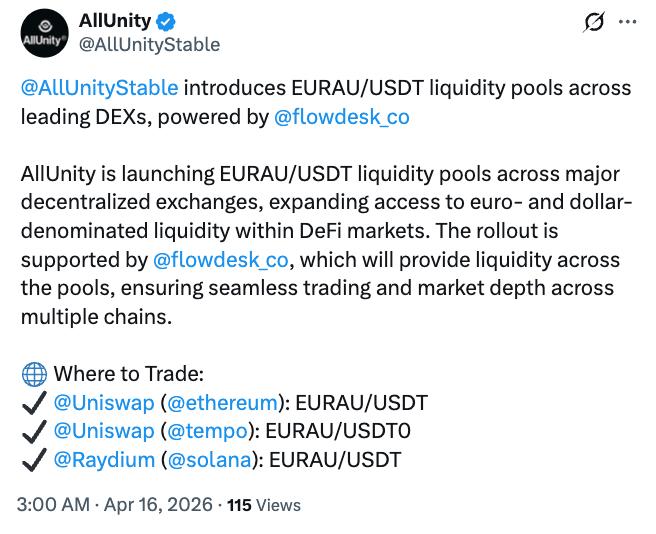
In an announcement made on Thursday, the firm revealed that its EURAU stablecoin is being deployed into liquidity pools on prominent DEXs, notably Uniswap, which currently holds the position of the world's largest decentralized exchange measured by trading volume.
The expansion encompasses two distinct trading pairs for EURAU: the first pairs it with Tether USDt (USDT) on the Ethereum network, while the second matches it with USDT0 — an omnichain iteration of USDT — operating on the Tempo blockchain. Additionally, the deployment features a EURAU/USDT trading pair available on Solana through the Raydium DEX platform.
The strategic move by AllUnity to expand into DEX platforms arrives at a time when ambiguity continues surrounding the extent to which decentralized finance (DeFi) is covered under the European Union's Markets in Crypto-Assets Regulation (MiCA) framework.
Although DeFi is typically viewed as falling outside the boundaries of the regulatory framework, the European Central Bank raised questions last month about whether decentralized autonomous organizations possess sufficient decentralization to stay beyond MiCA's regulatory scope.
AllUnity built EURAU under BaFin licence
As a MiCA-compliant issuer of stablecoins, AllUnity functions under an Electronic Money Institution license granted by the German Federal Financial Supervisory Authority (BaFin) in July 2025.
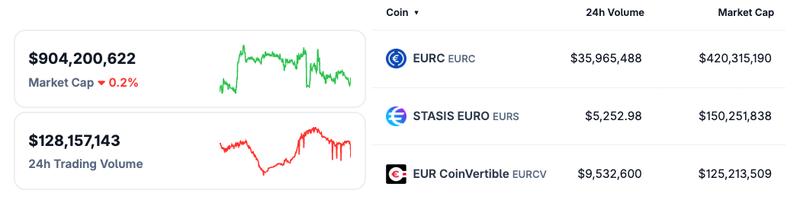
The EURAU token was officially launched by AllUnity on July 31, 2025. When measured by market capitalization, the token continues to be relatively small in comparison to the leading euro-denominated stablecoins in the market.
The company has been actively working to expand EURAU stablecoin availability across various exchange platforms, securing listings on centralized exchanges (CEXs) including Bullish, in addition to decentralized platforms such as Aerodrome. The integration with Aerodrome marked the initial DEX integration for EURAU, which occurred in December 2025.
Dollar stablecoins still dominate
The MiCA regulatory framework, which became fully effective in late 2024, has frequently been viewed as a mechanism to counter the overwhelming prevalence of stablecoins tied to the US dollar.
Several prominent issuers, notably Tether, have publicly expressed criticism of the framework and refused to pursue compliance within the EU, expressing reservations about its regulatory requirements, resulting in certain compliant exchanges removing its USDT stablecoin from their platforms.
Following these developments, some banking regulators have expressed the view that MiCA might not be adequate to challenge the supremacy of US dollar-pegged stablecoins, which continue to represent 97% of the $316 billion global market, based on data from CoinGecko.
Given that AllUnity's expansion into DEX platforms also incorporates prominent US dollar stablecoins, questions remain about how regulatory authorities will react to these strategic moves.
"Expanding EURAU liquidity across DEXs is an important step in building a robust and accessible euro liquidity layer. We're enabling seamless euro — dollar trading, empowering institutions and liquidity providers to participate in deep, efficient markets."
Rupertus Rothenhäuser, AllUnity executive
Cointelegraph reached out to AllUnity seeking commentary on possible regulatory conflicts with EU regulations but had not received a response by the time of publication.