Crypto Firms Phantom and Hyperliquid Push CFTC to Revise Onchain Derivatives Framework
In a joint effort, Phantom and Hyperliquid have called on the CFTC to revise its regulatory framework for onchain derivatives, maintaining that blockchain technology developers and non-custodial wallet providers should be exempt from broker-focused regulations.
Digital asset wallet provider Phantom along with the Hyperliquid Policy Center have called on the United States Commodity Futures Trading Commission (CFTC) to provide exemptions for blockchain protocol developers and non-custodial wallet providers from regulatory frameworks that were originally designed for traditional financial intermediaries.
Responding to a CFTC call for information regarding regulations that impact fintech companies, the firms requested that the agency provide confirmation that blockchain protocol developers should not be required to register simply for developing onchain software, publish guidance that would enable regulated derivatives firms to utilize blockchain infrastructure, and establish formal exemptions that would prevent non-custodial wallet providers from being classified as introducing brokers.
The firms contended that current CFTC regulatory frameworks were crafted with custodial financial intermediaries in mind—entities that maintain custody of customer assets and handle trade processing—whereas onchain protocols enable users to engage in transactions directly without intermediaries maintaining control over funds or executing orders on their behalf.
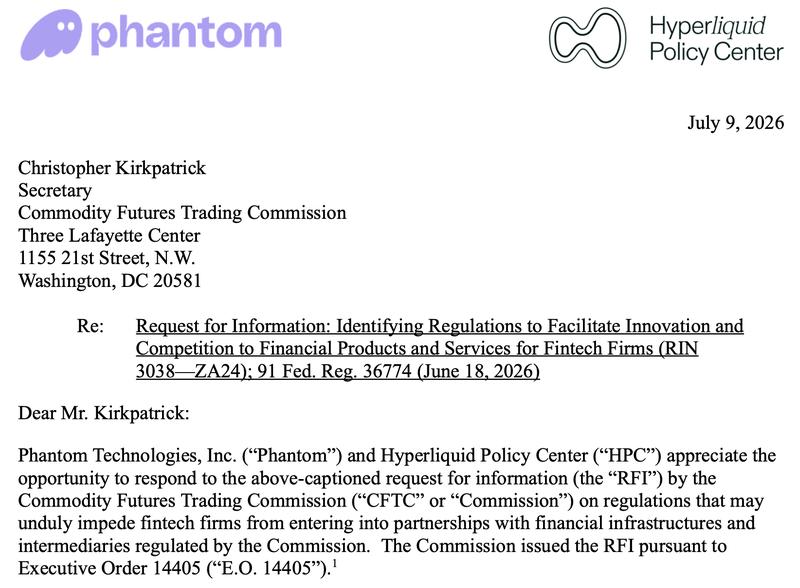
According to their submission, registration requirements should be directed toward entities that maintain custody of customer funds or execute trades on behalf of customers, as opposed to developers who build blockchain software or participate in open-source protocol development without exercising control over the software's ultimate usage.
The organizations additionally requested that the CFTC provide clarification confirming that registered derivatives exchanges, clearinghouses and intermediaries are permitted to leverage onchain infrastructure for various functions such as trade execution, clearing, settlement, margining and recordkeeping, as long as they maintain compliance with existing regulatory requirements.
According to the groups, the consequence of not implementing the proposed recommendations is maintaining the status quo, under which "American users continue to be walled off from onchain derivatives markets," while innovation continues to take place offshore.
Regulatory debate over onchain derivatives intensifies
The correspondence arrives amid increasing pressure from crypto companies and traditional exchanges on US regulators concerning the appropriate regulatory treatment of blockchain-based derivatives, with stakeholders on all sides requesting enhanced clarity regarding the agency's regulatory stance.
During May, Intercontinental Exchange and CME Group allegedly pressured regulators to conduct closer scrutiny of Hyperliquid's move into commodity-linked perpetual futures, contending that the decentralized platform's energy derivatives presented risks related to market integrity and manipulation.
Following that by two weeks, ICE CEO Jeffrey Sprecher advocated for a "level playing field" that would permit regulated exchanges to provide 24/7 onchain perpetual futures, asserting that current regulations were hindering traditional exchanges from competing effectively with platforms like Hyperliquid. Sprecher further disclosed that ICE had conducted exploratory conversations with Hyperliquid to gain deeper insights into onchain derivatives markets.
CME, for its part, has pursued expansion of its own regulated crypto derivatives offerings. During the current year, the exchange revealed futures products linked to Avalanche and Sui, introduced CFTC-regulated Bitcoin volatility futures and rolled out the Nasdaq CME Crypto Index futures, a market-cap weighted contract that tracks seven digital assets.
Notwithstanding that expansion effort, CME filed a lawsuit against the CFTC in June challenging the agency's approval of crypto perpetual futures, contending the regulator overstepped its authority under the Commodity Exchange Act.