Class-Action Lawsuit Against Nvidia Over Crypto GPU Revenue Moves Forward
An investor class has been certified by a federal judge in California in the securities lawsuit against Nvidia concerning purported false statements regarding cryptocurrency mining GPU revenue, pushing the litigation closer to trial.

A federal judge in California has granted certification to an investor class in a securities litigation case alleging that Nvidia and its Chief Executive Officer Jensen Huang provided false information to shareholders regarding the portion of the company's gaming division revenue that originated from graphics processing unit sales to cryptocurrency miners during the 2017-2018 digital asset mining surge.
In an order dated March 25, US District Judge Haywood S. Gilliam Jr. determined that investors may move forward with their allegations as a collective group, though he emphasized that the certification of the class represents a procedural milestone and does not determine whether Nvidia's public statements constituted fraud.
The judicial order establishes the class as those who purchased Nvidia shares during the period spanning from Aug. 10, 2017, through Nov. 15, 2018, and places significant emphasis on the concept of "price impact" and whether the purported false statements influenced the trading price of Nvidia's stock.
Back in 2022, Nvidia reached an agreement to remit a $5.5 million financial penalty and accept a cease-and-desist directive concerning insufficient disclosures related to cryptocurrency mining's influence on its gaming GPU operations, and in December 2024, the US Supreme Court declined to intervene in a Ninth Circuit decision that permitted the shareholder litigation to move forward.
Judge certifies Nvidia investor class
The group of shareholders contends that the semiconductor manufacturer and Huang provided misleading information to the marketplace regarding what proportion of its rapidly growing gaming division revenue was attributable to graphics processing unit (GPU) sales directed toward cryptocurrency mining operations.
According to their allegations, the actual facts started becoming apparent after Nvidia's earnings call and guidance reduction on Aug. 16, 2018, at which point the company's stock price declined approximately 4.9%, and then again after an additional revenue warning issued on Nov. 15, 2018, when the share price plummeted roughly 28.5% across two consecutive trading sessions.
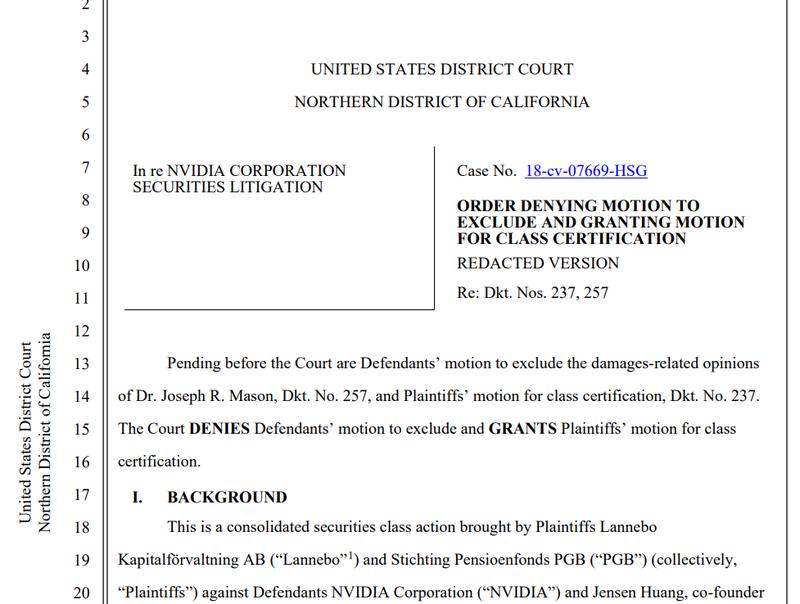
The initial lawsuit against Nvidia was brought by investors in 2018, with the present amended complaint having been submitted in 2020. The legal complaint asserts that Nvidia minimized the degree to which its gaming division revenue depended on GPU sales directed to cryptocurrency mining operations and failed to properly report in excess of $1 billion in cryptocurrency-related sales revenue.
A representative from Nvidia provided a statement to Cointelegraph indicating that investors who acquired Nvidia shares during the 2017-2018 period "have done incredibly well, as our corporate strategy unfolded as we consistently predicted." The spokesperson further stated that the company would "address the complaint in court."
Nvidia case heads toward next phase
Within the March 25 ruling, the judge additionally rejected efforts to exclude the plaintiffs' "out-of-pocket" damages calculation methodology and a statistical "event study" that examines the movements of Nvidia's share price surrounding critical disclosure dates.
The court has set a case conference to take place on April 21, 2026, scheduled for 2:00 pm Pacific Time, which will be conducted through a public Zoom webinar platform.