CLARITY Act provides unprecedented safeguards for crypto developers, Lummis affirms
According to crypto attorney Jake Chervinsky, the legislative provisions protecting cryptocurrency developers have been eclipsed by the overwhelming attention directed toward stablecoin yield provisions within the CLARITY Act.

Senator Cynthia Lummis of the United States has rejected assertions claiming the Digital Asset Market Clarity Act provides insufficient protection for decentralized finance builders against potential legal consequences, countering that newly introduced modifications to the legislation will establish the "strongest protection for DeFi and developers ever enacted."
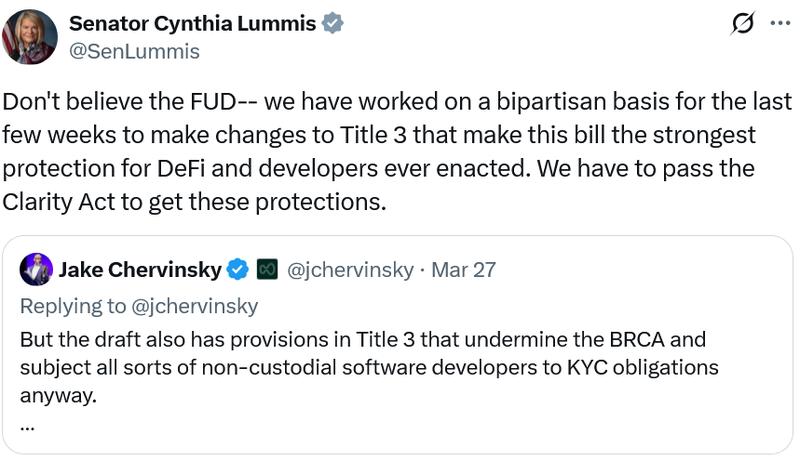
These remarks delivered on Friday directly addressed concerns raised by cryptocurrency attorney Jake Chervinsky, who contended that the current draft's Title 3 weakens the Blockchain Regulatory Certainty Act — separate legislation dedicated to developer protections — through the imposition of know-your-customer requirements on developers of non-custodial software.
"Don't believe the FUD," Lummis stated, further explaining, "We have worked on a bipartisan basis for the last few weeks to make changes to Title 3 that make this bill the strongest protection for DeFi and developers ever enacted. We have to pass the Clarity Act to get these protections."
The most recent modifications made to the CLARITY Act remain unavailable to the public at this time.
According to Chervinsky, the protective measures for decentralized finance contained within the bill have been relegated to secondary importance due to concentrated scrutiny of stablecoin rewards language in the CLARITY Act.
Chervinsky's primary concern regarding the Senate Banking Committee's most recent CLARITY Act draft centers on Title 3's definitions of money transmitters, which he believes could continue to subject numerous non-custodial DeFi developers to legal exposure.
These concerns persist even though the CLARITY Act has integrated the BRCA through section 604, which establishes that developers without controlling interests and providers of non-custodial software should not be categorized as financial institutions bound by Bank Secrecy Act KYC requirements.
"The biggest challenge is ensuring non-custodial software developers aren't misclassified as money transmitters," Chervinsky contended.
"That's non-negotiable for DeFi, and it's still unsettled."
These concerns arise against the backdrop of multiple prominent prosecutions and convictions targeting developers within the United States over recent months, including the case of Tornado Cash co-founder, Roman Storm, who received a conviction in August 2025 for conspiracy to operate an unlicensed money transmitting business.
According to United States lawmakers, the CLARITY Act is advancing toward a Senate Banking Committee markup anticipated in April following recent bipartisan achievements on stablecoin rewards provisions.
The passage of the CLARITY Act represents a necessary step to guarantee that DeFi developers receive legal protections provided under the BRCA, according to Lummis.