Capital exodus looms as Netherlands proposes taxing unrealized gains on crypto and stocks
A planned tax on paper profits has triggered warnings from cryptocurrency holders and investors about potential mass departures of wealth and expertise.

Dutch authorities are moving forward with a controversial plan to impose taxes on unrealized capital gains across multiple investment categories, including cryptocurrencies, bonds and equities, prompting concerns about a potential exodus of wealth from the country.
Parliamentary support appears to be coalescing around revisions to the Netherlands' Box 3 wealth tax framework, which would mandate that investors settle annual tax obligations on both realized profits and paper gains, regardless of whether holdings have been liquidated, according to a Tuesday report from NL Times.
The proposed changes come in response to judicial decisions that invalidated the previous framework for calculating taxes based on presumed returns instead of actual investment performance. This week, the Tweede Kamer (House of Representatives) conducted another round of deliberations on the measure, during which caretaker State Secretary for Taxation Eugène Heijnen fielded over 130 inquiries from legislators.
Despite recognizing deficiencies in the proposal, a substantial number of representatives indicated their intention to approve it, pointing to potential revenue losses estimated at 2.3 billion euros ($2.7 billion) annually should implementation face additional postponements.
Dutch parties back tax on unrealized gains
The framework under consideration would subject holders of cryptocurrencies, bonds and equities to yearly taxation on gains that exist only on paper. During parliamentary proceedings, Heijnen reportedly acknowledged that limiting taxation to actual realized profits would be the superior approach but indicated the administration considers such a system unfeasible prior to 2028. Given the strain on government finances, authorities have determined that additional delays are not an option.
Multiple political organizations, including People's Party for Freedom and Democracy (VVD), Christian Democratic Appeal (CDA), JA21 (Right Answer 2021) and Farmer–Citizen Movement (BBB) Party for Freedom (PVV), are projected to vote in favor of the legislation.
Progressive political groups including Democrats 66 (D66), GreenLeft–Labour Party (GroenLinks–PvdA) have also expressed approval for the modifications, contending that implementing taxes on unrealized appreciation simplifies administrative processes and prevents significant budgetary deficits, according to the report.
It bears mentioning that the updated Box 3 framework would provide more advantageous treatment for those investing in real estate, permitting expense deductions and imposing taxation exclusively when gains are actually realized, although vacation properties would be subject to an extra charge reflecting personal usage.
Dutch unrealized gains tax sparks crypto backlash
The taxation proposal has generated fierce opposition from cryptocurrency advocates and investment professionals, who caution that the policy could hasten the departure of capital from Dutch jurisdiction.
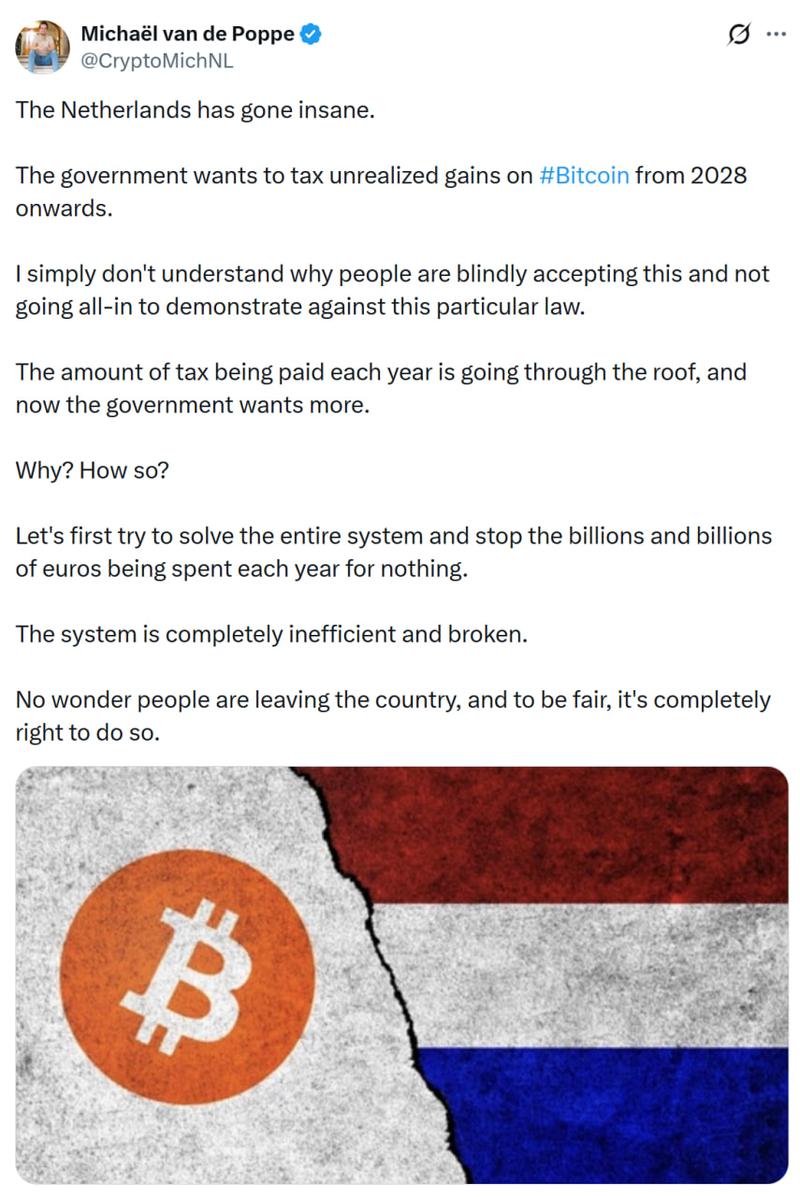
Well-known Dutch cryptocurrency expert Michaël van de Poppe characterized the proposal as "insane," contending it would dramatically increase yearly tax liabilities and incentivize citizens to relocate abroad. "No wonder people are leaving the country, and to be fair, it's completely right to do so," he wrote.
"Taxes on unrealized gains and wealth may be this century's Boston Tea Party, Reign of Terror, or Bolshevik moment," another user wrote.