Blockchain-based commodity markets gain traction despite persistent liquidity challenges
Increased trading volumes in oil and gold demonstrate expanding appetite for blockchain macro trading, though liquidity constraints ensure traditional markets maintain dominance.

The rise of onchain commodity trading demonstrates it has evolved beyond a temporary trend, though insufficient liquidity remains a significant barrier preventing these markets from effectively rivaling traditional trading platforms.
On March 23, Hyperliquid's HIP-3 market achieved a record high, processing approximately $5.4 billion in perpetual futures trading volume spanning commodities and macro assets. The activity was dominated by silver at $1.3 billion, with WTI crude oil following at $1.2 billion, Brent crude reaching $940 million and gold totaling $558 million. Significant volumes were also observed in equity indices such as the Nasdaq and S&P 500.
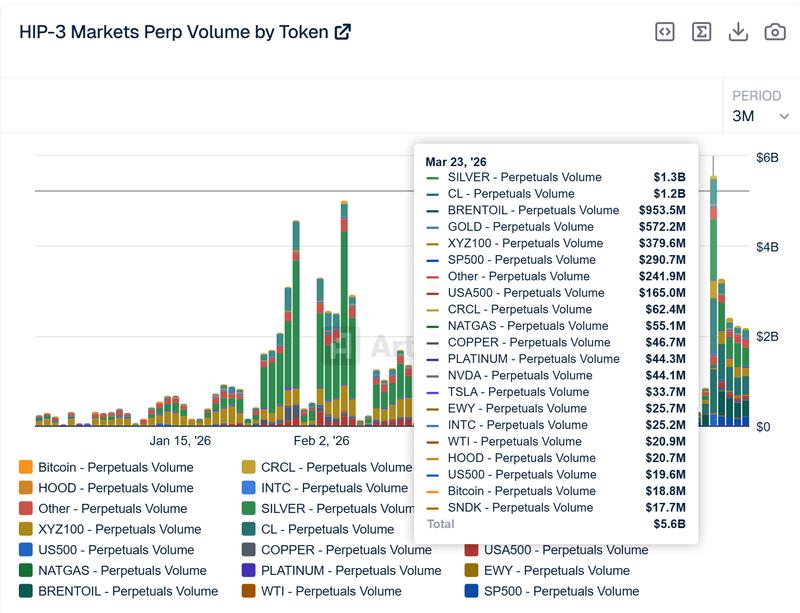
Market experts indicate this surge reflects increasing appetite for macro asset exposure through blockchain platforms.
"Previously, onchain commodity futures were mostly a venue for crypto-native investors, that is no longer the whole story. The real tell is not just the volume, it's when the volume shows up and who is showing up to trade."Iggy Ioppe, chief investment officer at Theo
According to Ioppe, onchain oil futures markets are currently handling over $1 billion in daily trading volume during weekends, periods when conventional exchanges remain closed. He explained that this transformation is partly fueled by individual traders from the traditional finance sector who are utilizing these markets via personal trading accounts.
"Geopolitics does not stop on Friday afternoon, and markets are starting to adapt to that fact."
Weekend gap gives onchain markets an edge
Round-the-clock trading capability has become a distinguishing competitive advantage for blockchain-based trading venues. Given the approximately 49-hour window between traditional market closure on Friday and reopening on Sunday, decentralized platforms have positioned themselves as among the limited options where traders can respond to macroeconomic developments as they unfold.
This phenomenon is beginning to shape price formation during non-traditional trading hours, despite the majority of liquidity remaining concentrated in conventional markets.
"For now, onchain is the price discovery layer when the rest of the market is asleep. TradFi is still the depth layer when size matters most."Iggy Ioppe
At the CME, oil futures independently record between 1 million and 4.5 million contracts in daily trading activity, representing approximately $100 billion to $300 billion in notional volume.
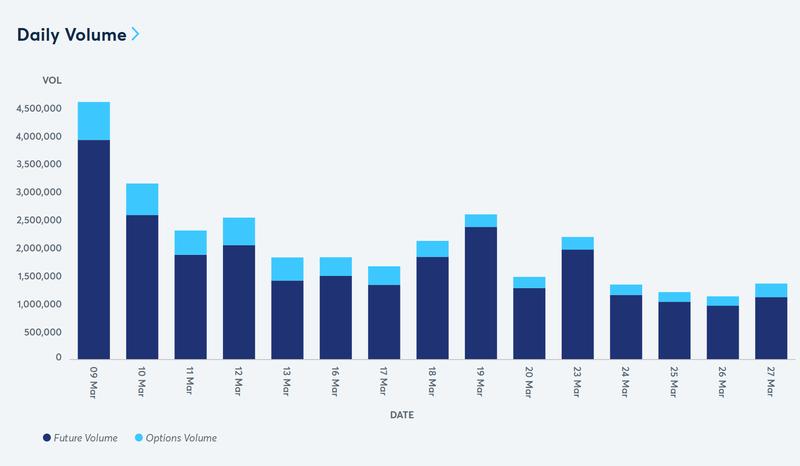
"Traditional venues still dominate when it comes to liquidity, execution quality, and institutional-scale pricing depth."Sergej Kunz, co-founder of 1inchHe emphasized that superior liquidity and narrower spreads constitute the primary obstacle. In their absence, onchain markets face difficulty executing large orders without causing significant price movements, thereby restricting institutional market participation.
Further hurdles encompass pricing reliability concerns, market structure development and the need for regulatory clarity, as outlined by Shawn Young, chief analyst at MEXC Research.
According to Young, commodity tokenization exhibits "signs of real behavioral changes" while remaining in an embryonic stage, with deficiencies in liquidity and price aggregation mechanisms yet to be resolved.
Onchain macro trading expands beyond commodities
Notwithstanding these limitations, trading activity continues its upward trajectory.
"The broader direction is clear: traders are becoming more comfortable accessing macro-style exposure onchain."Sergej Kunz
While gold and oil have spearheaded the present movement, market observers anticipate comparable developments across additional asset classes as market volatility evolves.
Ioppe suggested that trading volume on onchain futures platforms is expected to remain sustained as confidence develops around weekend price discovery. As an increasing number of traders depend on these platforms during off-market hours, trading volume naturally increases. This development, consequently, bolsters growing open interest, which reinforces trust in the price formation mechanism. Through time, this pattern establishes a self-sustaining feedback loop, whereby expanded participation enhances market legitimacy and attracts additional trading flow.