Bitcoin Network Sees 10% Mining Difficulty Reduction in Historic Downward Shift
The Bitcoin network experienced its second-biggest difficulty reduction of the year, trailing only the 11% decrease recorded in February.

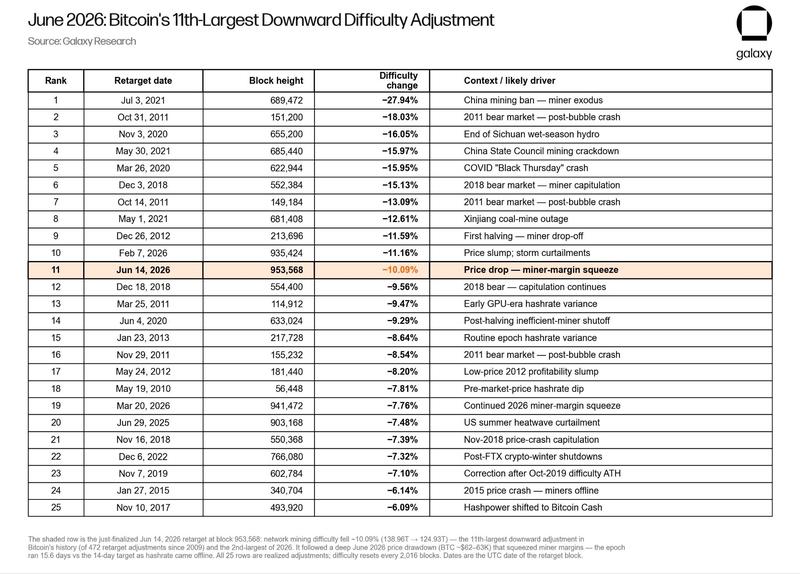
On Sunday, Bitcoin's mining difficulty experienced a 10.09% reduction, representing the network's 11th-largest downward difficulty adjustment in history and providing miners with some much-needed relief from mounting pressures.
According to Galaxy Research, the mining difficulty decreased from 138.96 trillion down to 124.93 trillion at block height 953,568 on Sunday, representing the year's second-largest reduction in 2026 and marking a 20% decline from the November peak levels.
Bitcoin (BTC) has experienced approximately 15% in price declines throughout June to date, a factor that has "squeezed miner margins," according to Galaxy's analysis. The research firm also noted that the epoch, defined as the period between mining difficulty adjustments, extended to 15.6 days, surpassing the standard 14-day interval, as hashrate dropped off the network.
The purpose of mining difficulty is to maintain stable block production rates regardless of fluctuations in the total mining power operating on the network. This reduction indicates that Bitcoin miners will face less challenging conditions when mining blocks, since the declining hashrate translates to reduced competition among participants.
The total hash rate, representing the aggregate computing power dedicated to mining operations, stands at 886 exahashes per second (EH/s) at present. It has experienced a 12% decline during the current month and shows a 23% decrease from its October peak, based on data from Blockchain.com.
According to crypto trader Merlijn Enkelaar, miners who have remained operational are now generating approximately 9% more revenue per machine following the adjustment.
In February, Bitcoin mining difficulty saw a reduction exceeding 11%, driven by storm-related curtailments and a 25% BTC price crash. The largest difficulty reduction ever recorded occurred in July 2021, following China's mining prohibition and the subsequent mass migration of miners.
The upcoming difficulty adjustment is anticipated to occur on June 27, with Coinwarz forecasting a modest 1.69% uptick to approximately 127 trillion.
Hashprice returns to above $30
Hashprice, the metric that quantifies miner earnings potential from a given amount of hashrate, has risen 13% following the difficulty reduction and currently stands at $33 per Petahash per second per day, based on data from Hashrate Index.
This represents a crucial threshold level as it enables a greater number of miners to reach a gross breakeven position, as The Energy Mag noted in its Saturday coverage.
The publication highlighted that mining operations utilizing efficient equipment fleets will maintain profitability even at reduced hashprice levels, whereas older-generation mining machines burdened with elevated electricity expenses are more likely to be shut down.