Bitcoin DeFi Platform Botanix Announces Closure After Four-Year Run Due to Insufficient Market Demand
Developers behind Spiderchain have instructed users to retrieve their holdings before July 9 deadline, stating that market appetite for Bitcoin-based DeFi protocols proved inadequate for network sustainability.

After four years of attempting to deliver "genuine utility" to BTC without relying on token incentives, Botanix, a Bitcoin scaling network, has announced it will cease operations.
Through a Tuesday announcement on X, Botanix instructed its user base to remove all Bitcoin and additional assets before July 9, warning that any remaining holdings after this deadline will be consolidated and "be unrecoverable."
The shutdown announcement arrives despite establishing partnerships with prominent crypto infrastructure companies, including Chainlink, Fireblocks and Galaxy, as well as releasing a Bitcoin neobank application designed for consumer use.
The Spiderchain architecture developed by Botanix merges an Ethereum Virtual Machine-compatible blockchain with a consensus mechanism styled after proof-of-stake.
This framework enabled the platform to deliver Ethereum-style programmability for Bitcoin while depending on a validator set and a dynamic federation, instead of relying exclusively on Bitcoin's native consensus for security and settlement processes.
According to the team's shutdown announcement, while the technology and products functioned as intended, they were unable to establish sustainable product-market fit or viable economics.
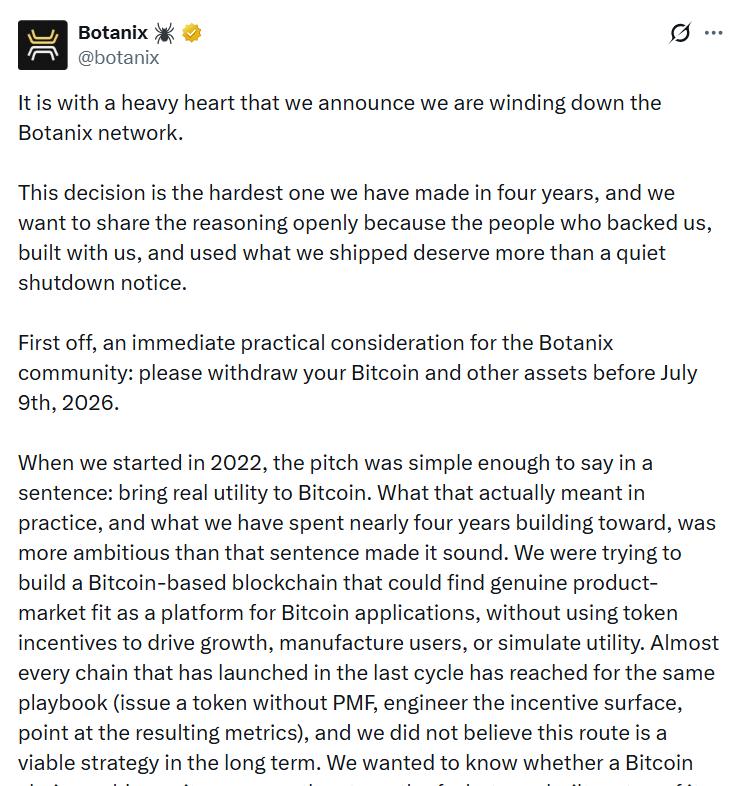
According to Botanix, the majority of users continue to regard Bitcoin predominantly as a reserve asset and yield vehicle instead of something they wish to utilize regularly in onchain applications, and that current demand for Bitcoin-backed decentralized finance (DeFi) is mainly being satisfied by wrapped BTC on Ethereum.
The development team additionally pointed to a wider consolidation of attention and trading volume on major exchanges, trading platforms and traditional financial intermediaries, which resulted in infrastructure-intensive networks such as Botanix finding it difficult to generate sufficient fee revenue to sustain their operational costs.
Users have until July 9 to withdraw assets
Botanix has issued a warning that individuals who fail to retrieve their Bitcoin and additional assets before July 9 will forfeit access, underscoring the tangible risks for retail users when experimental DeFi platforms undergo shutdown procedures.
The closure arrives as alternative projects continue pursuing efforts to expand Bitcoin's programmability, including Stacks and Rootstock, which run independent blockchains connected to Bitcoin, and more recent initiatives such as Citrea that employ varying combinations of Bitcoin anchoring, proof-of-stake-style designs and token incentives
Orkun Mahir Kılıç, co-founder and chief executive of Citrea, told Cointelegraph that Botanix's outcome represents less of a condemnation of Bitcoin DeFi than of "a cloning-first approach" that primarily duplicated existing EVM protocols without providing long-term BTC holders a distinctive value proposition.
According to his argument, Citrea is instead concentrating on applications that "fundamentally require Bitcoin's specific architecture and trust-minimized settlement," instead of positioning itself as yet another general-purpose chain, highlighting use cases such as private payments and Bitcoin-native capital markets instead of generic lending and trading forks.
Cointelegraph reached out to Botanix for comment but did not receive a response by publication.