Banking group calls on OCC to halt crypto trust approvals pending GENIUS Act clarity
American Bankers Association urges the Office of the Comptroller of the Currency to pause granting national trust charters to cryptocurrency and stablecoin companies pending full implementation of GENIUS Act regulations.

The Office of the Comptroller of the Currency (OCC) is facing pressure from the American Bankers Association (ABA) to halt approvals of national trust bank charters designated for cryptocurrency and stablecoin companies until there is greater clarity regarding the regulatory framework established by the Guiding and Establishing National Innovation for US Stablecoins (GENIUS) Act.
Through a comment letter submitted on Wednesday addressing the OCC's National Bank Chartering notice of proposed rulemaking, the industry organization expressed concerns that both current and prospective applicants involved in digital asset and stablecoin operations are confronting uncertain regulatory oversight from various federal and state authorities.
According to the ABA, the OCC ought to refrain from advancing charter applications in cases where the complete regulatory requirements for an institution, encompassing those anticipated under the GENIUS Act rulemakings yet to come, have not been comprehensively established.
The banking association expressed concern that national trust institutions focused on digital assets without insurance coverage present unaddressed questions related to safety and soundness standards, operational challenges, and resolution procedures, with particular emphasis on customer asset segregation requirements, potential conflicts of interest, and cybersecurity vulnerabilities.
The association additionally raised concerns that companies might exploit national trust charters as a mechanism to circumvent registration requirements and regulatory oversight by the Securities and Exchange Commission (SEC) or Commodity Futures Trading Commission (CFTC) in situations where their business activities would normally fall under securities or derivatives regulatory frameworks.
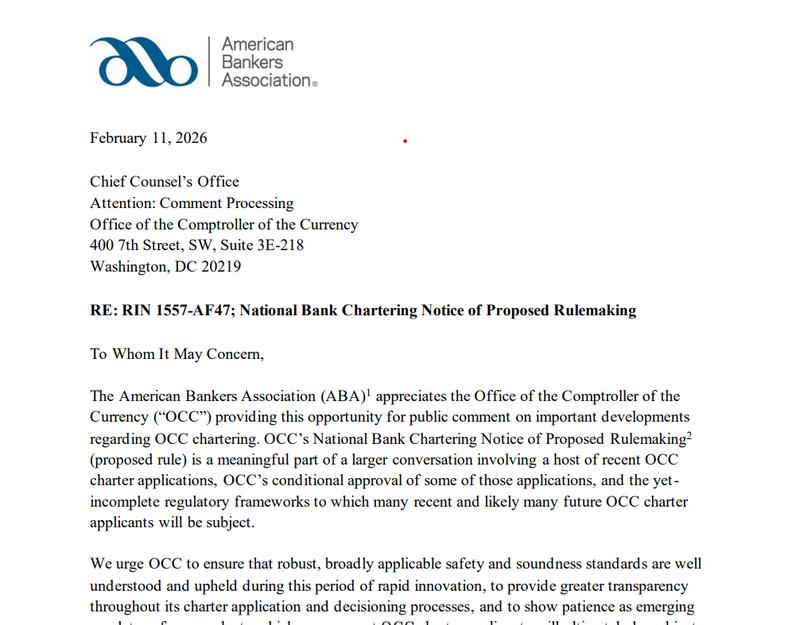
The banking group encouraged the OCC to exercise "patience," avoid imposing conventional timeline expectations on these particular applications, and verify that the complete scope of each charter applicant's regulatory obligations has been thoroughly established and "come fully into view" prior to advancing any applications through the approval process.
Additionally, the association advocated for enhanced transparency concerning the methods by which the OCC establishes capital requirements, operational standards, and resilience benchmarks within conditional approvals granted for charters related to cryptocurrency activities, while also urging the regulatory agency to strengthen naming regulations to prevent limited‑purpose trust banks that do not conduct traditional banking business from incorporating "bank" in their official names.
Such measures, the association contended, would help mitigate the potential for consumer misunderstanding regarding the legal status and security of financial obligations held by entities operating without insurance coverage.
Warning after new crypto trust charters
This advocacy effort arrives fewer than two months following the OCC's decision to grant conditional national trust bank approvals to five cryptocurrency companies: Bitgo Bank & Trust, Fidelity Digital Assets, Ripple National Trust Bank, First National Digital Currency Bank, and Paxos Trust Company.
These approvals, issued on Dec. 12, 2025, established a regulatory pathway allowing the OCC to authorize these organizations to custody and administer customer digital assets operating under a federal charter framework while maintaining operations outside the traditional deposit-accepting and loan-origination functions of banking.
This same banking industry advocacy organization is simultaneously lobbying Congress through proposed cryptocurrency market structure legislation, including the Digital Asset Market Clarity (CLARITY) Act, seeking to impose restrictions on stablecoin rewards programs, arguing that stablecoins offering yields and affiliated "rewards" initiatives would effectively operate as bank‑like financial products while avoiding comprehensive bank regulatory oversight and requirements.