$36M Security Breach Pushes Humanity Protocol to Enhance Operational Defenses
Following a significant security breach, Humanity Protocol plans to redirect its cybersecurity strategy toward operational security measures, responding to an emerging trend where attackers increasingly target human vulnerabilities rather than smart contract weaknesses.

Following a devastating $36 million security breach in June that originated from an employee's compromised laptop, Humanity Protocol plans to redirect its cybersecurity strategy toward operational security, the decentralized identity company's founder, Terence Kwok, has announced.
During a conversation with Cointelegraph, Kwok explained that the security breach's underlying cause traced back to the previous year's mainnet deployment, during which multiple production keys were unintentionally saved to the laptop that would later be compromised, encompassing admin hot wallet keys along with a quorum of multisig owner keys spanning both chains. His statement emphasized:
The hard lesson here is that operational security is as critical as smart-contract security, and we're rebuilding accordingly.
Both the security breach and Humanity Protocol's subsequent response underscore a growing trend of cryptocurrency hackers pivoting their strategies toward staff-level weaknesses and operational gaps, moving away from traditional smart contract code exploitation methods.
The attack on Humanity Protocol took place last month, with perpetrators leveraging a compromised employee's laptop to successfully extract $36 million worth of Humanity (H) tokens. Data from CoinMarketCap indicates the token's present market capitalization stands at approximately $211 million.
According to blockchain security firm Quantstamp's analysis, the malicious file delivered via a phishing email campaign suggested the involvement of North Korean-affiliated cyber threat groups. The harmful attachment masqueraded as a token lockup schedule revision from Bithumb, a South Korean cryptocurrency exchange, and deployed malware that granted attackers remote control of the compromised device.
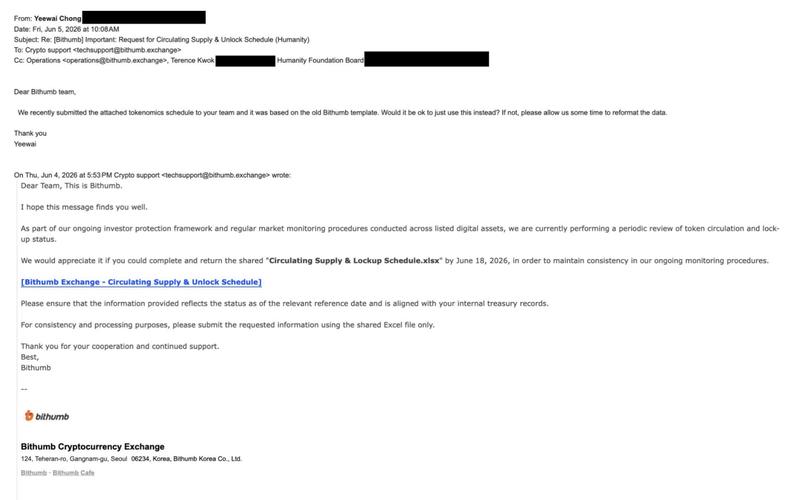
Cyber threat groups with connections to North Korea were linked to a minimum of $578 million out of the total $634 million taken in cryptocurrency-related security incidents during April alone.
Phishing and wallet compromises lead attack vectors in H1 2026
The security incident involving Humanity Protocol happened amid a resurgence of cryptocurrency exploits originating from operational breakdowns and social engineering tactics.
According to blockchain security firm CertiK's analysis, phishing attacks accounted for the bulk of first quarter financial losses totaling $508 million, whereas wallet compromises became the predominant attack method in the second quarter, resulting in $807 million in financial damages.
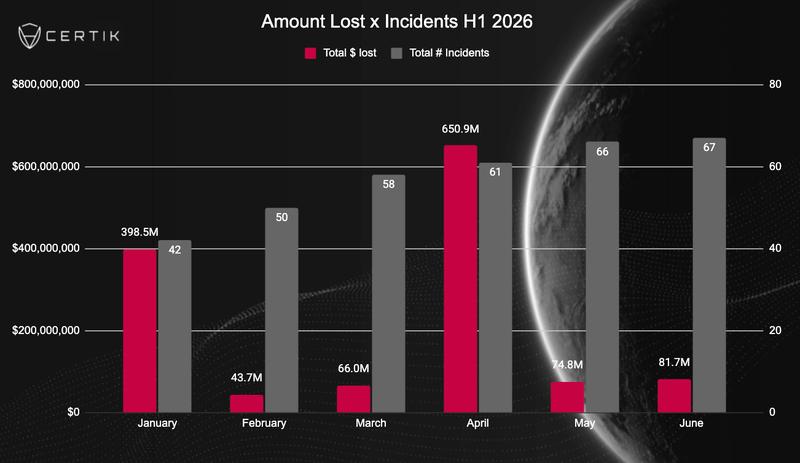
While cryptocurrency losses attributed to hacking incidents decreased by 46.8% on a year-over-year basis to $1.32 billion during the first half of 2026, CertiK cautioned that this decline presents a misleading picture given the $1.4 billion Bybit security breach in early 2025, and emphasized that North Korean cyber threat actors remain a persistent danger to the cryptocurrency sector.