Zcash Security Audit by Anthropic's Mythos AI Shows No Additional Critical Vulnerabilities, Says Wilcox
Following the resolution of a previously identified forgery vulnerability, Zcash's founder Zooko Wilcox reported that Anthropic's Mythos artificial intelligence model discovered no additional critical security issues in the privacy-focused cryptocurrency protocol.

According to Zooko Wilcox, the founder of Zcash, a comprehensive security review conducted using Anthropic's Claude Mythos artificial intelligence system revealed no significant security flaws in the privacy-focused digital currency's underlying protocol.
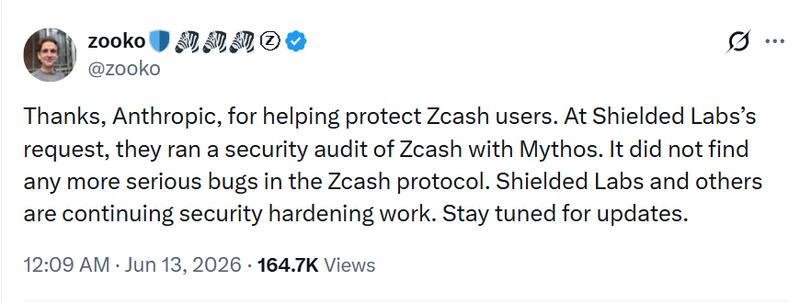
The AI-powered security examination, which was commissioned by Shielded Labs, a Switzerland-based nonprofit organization that provides support for Zcash's ongoing development, did not identify "any more serious bugs" within the Zcash protocol, as Wilcox disclosed in a social media post on X published on Saturday.
Zcash developers took the precautionary measure of temporarily halting Orchard transactions on June 3 following the identification of a security flaw in the shielded pool. Later during the same day, normal operations were reinstated following the implementation of an emergency software upgrade.
The security problem originated from a forgery-related bug that had existed for four years within the Orchard shielded pool, which was identified by security researcher Taylor Hornby utilizing Anthropic's Claude Opus 4.8 artificial intelligence model. According to statements from the Zcash Foundation, there was no indication that malicious actors had taken advantage of the security weakness, and no unauthorized creation of value was detected, while the privacy of users remained intact throughout.
AI models spark crypto security concerns
Although development teams are leveraging emerging AI technologies to discover security weaknesses, these same advanced systems are concurrently generating new security challenges throughout the cryptocurrency sector.
Anthropic made available to the public the initial version of its Claude Mythos artificial intelligence model, known as Fable 5, on Tuesday. The organization revealed last month that the Mythos model successfully identified over 10,000 vulnerabilities classified as high or critical-severity within "systemically important software," which prompted debates regarding whether making it publicly accessible was appropriate.
The organization assured users that Fable 5 had been "made safe for general use" and incorporates protective measures that redirect certain subject matters, including cybersecurity-related queries, to an alternative model known as Claude Opus 4.8.
Anthropic announced on Friday that it had halted access to both its Fable 5 and Mythos 5 artificial intelligence models in response to a US government directive related to export controls that cited national security considerations.
The widespread emergence of these advanced AI models has tilted the cybersecurity landscape to the advantage of malicious actors, generating a "vulnerability apocalypse" that is driving a renewed wave of attacks targeting decentralized finance (DeFi) platforms, as explained by Mitchell Amador, the chief executive officer of bug bounty platform Immunefi, during a recent conversation with Cointelegraph.
Cryptocurrency-related security breaches escalated to $634 million during April, representing the largest monthly total since the Bybit security incident resulted in approximately $1.4 billion in losses during February 2025, based on information from DefiLlama data.