Why Ethereum Continues Trading Under $2,400 Despite Multiple Attempts
Since April, Ethereum has struggled to surpass the $2,400 threshold amid weak ETF capital flows compared to Bitcoin, while Binance experiences 2026's highest ETH deposit volume.
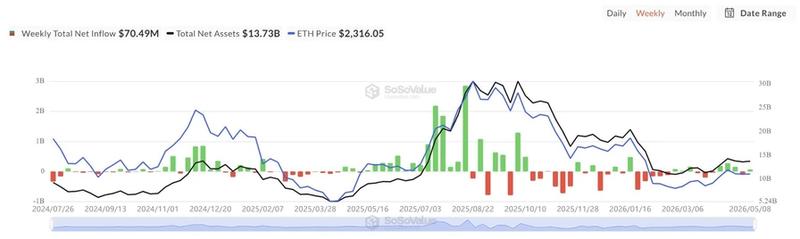
Throughout the last month, Ether (ETH) has made five separate attempts to breach the $2,400 resistance level, only to see each rally lose steam approaching that price point. This price stagnation occurs alongside modest spot Ether exchange-traded fund (ETF) inflows totaling merely $500 million from March onwards. During this period, Binance exchange witnessed its Ether holdings surge by 400,000 ETH, while futures market participants simultaneously scaled back their leveraged positions over recent days.
Limited institutional ETF appetite constrains price growth
During the period beginning in March, spot Bitcoin ETFs successfully captured approximately $4.5 billion in net capital inflows, providing fundamental support for BTC's ascent beyond the $82,000 mark. In stark contrast, Ether ETFs managed to accumulate a mere $500 million in inflows throughout this identical timeframe, depriving ETH of comparable institutional purchasing power.
This disparity in demand carries significant implications, as Ether continues encountering identical resistance barriers repeatedly in the absence of new spot market buyers stepping in.
Cryptocurrency market analyst Darkfost observed that futures market activity for ETH provided early support during the price recovery phase. Open interest in Ethereum contracts expanded by $4.5 billion throughout its 33% rebound from the February bottom at $1,736, demonstrating that market participants were actively building positions as prices climbed higher.
Additionally, Binance's calculated leverage ratio climbed to 0.76 on March 16, representing one of the exchange's most elevated measurements for the current year, which indicated traders were increasingly utilizing borrowed funds to amplify their futures market positions.
However, this leveraging pattern has experienced a complete reversal in proximity to the resistance threshold. By Sunday, Binance's calculated leverage ratio had declined to 0.57. According to the analyst's assessment, long positions that were established in anticipation of a price breakthrough were subsequently liquidated following ETH's retreat beneath $2,350.
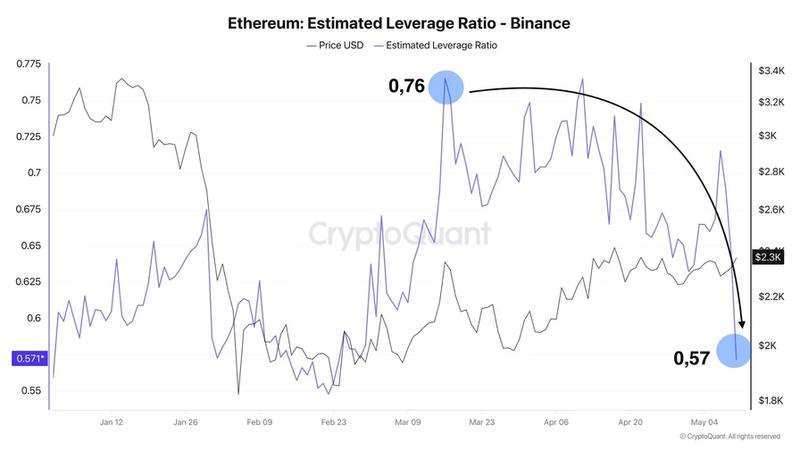
Diminished leverage levels decrease the likelihood of cascading liquidation events that could propel prices upward. Darkfost further commented,
This is not necessarily a bearish signal. Lower leverage tends to stabilize the market, especially as ETH attempts to break out of its range. Now, for a breakout to materialize, spot demand will need to take over.
Rising Ether deposits on Binance create selling pressure concerns
Cryptocurrency market analyst Rei identified a substantial spike in ETH holdings on Binance during May. The analyst's data reveals that Binance reserves expanded from 3.4 million to 3.8 million ETH. Concurrently, aggregate exchange deposits on Binance reached a peak of 771,689 ETH on Sunday.
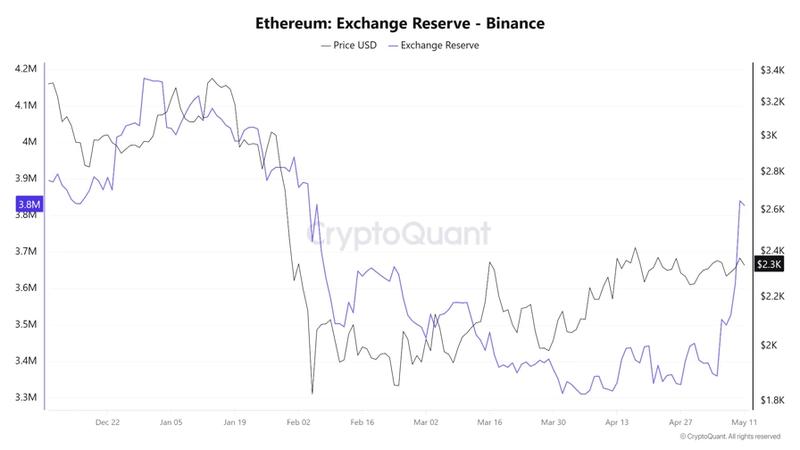
This represents the most substantial volume of exchange deposits recorded since Feb. 6, a date that saw 1.1 million ETH flow into Binance. These ETH transfers occurred while the asset was trading near $2,330, remaining confined within a narrow trading corridor between $2,400 and $2,250 beginning April 14.
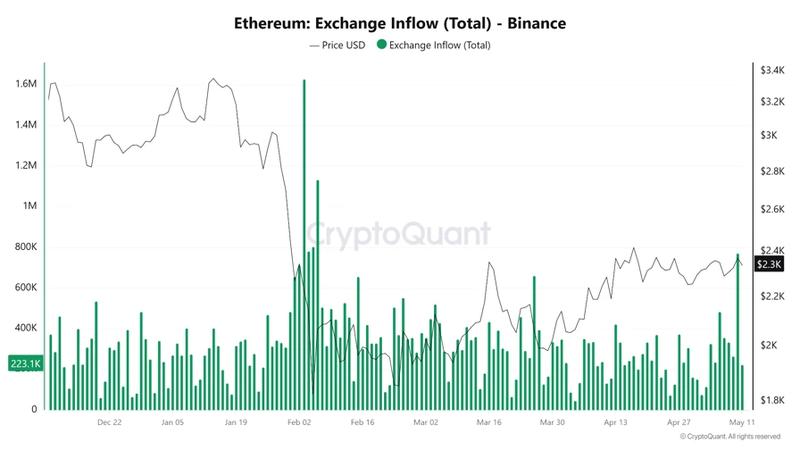
According to the analyst's interpretation, substantial exchange deposit volumes can indicate traders either establishing fresh positions or securing profits amid the price recovery phase. This influx of available liquidity expands the readily accessible supply in the vicinity of the resistance threshold and intensifies challenges facing ETH purchasers working to recapture the $2,400 level.
The primary objective for ETH bulls at present involves successfully converting $2,400 from a resistance barrier into a foundational support level. In the absence of more robust spot market demand or a meaningful decrease in exchange-held supply volumes, this price zone could persist as a ceiling limiting upward movements throughout the immediate future.