Rebuilding Unity: How Ethereum's Economic Zone Aims to Solve Fragmentation
The Ethereum Economic Zone seeks to reunify scattered rollup networks into a cohesive ecosystem, though Cosmos faced challenges with a comparable approach.

A fresh initiative from Ethereum developers seeks to reunify the ecosystem following years of division created by the scaling solutions that were meant to expand it.
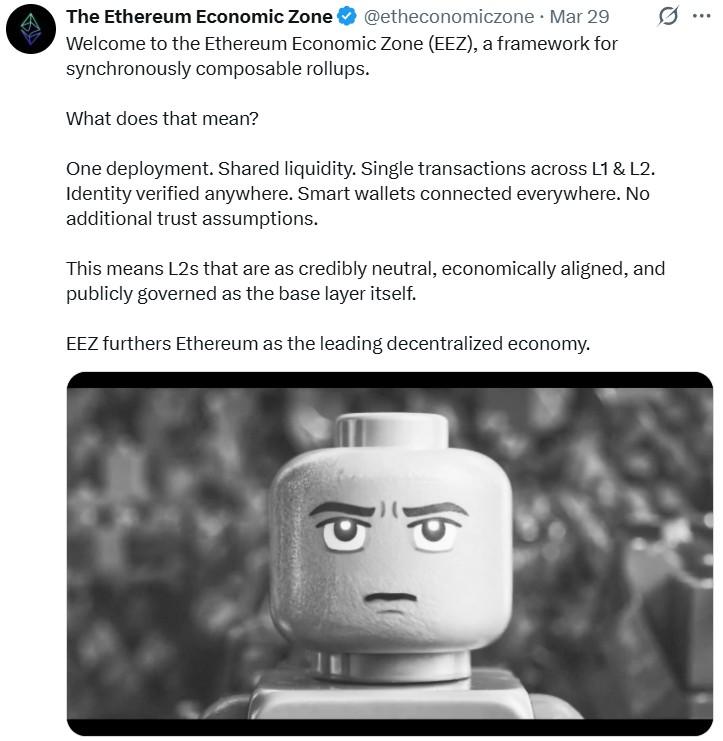
This past Sunday, long-time Ethereum developer Gnosis alongside zero-knowledge virtual machine initiative Zisk announced the Ethereum Economic Zone (EEZ), a structural framework designed to connect layer-2 rollups more closely with the foundational network.
The framework establishes Ethereum as the primary hub, maintaining Ether (ETH) as both the gas token and the settlement layer. Additionally, it presents a system enabling smart contracts to communicate between mainnet and EEZ rollups through atomic execution.
This development arrives at a time when Ethereum is reevaluating its rollup-focused strategy. Following the migration of activity toward layer-2 solutions, a substantial portion of economic value moved away from the foundational layer. While rollups depend on Ethereum for security and final settlement, they effectively capture user fees and revenue in actual practice, a dynamic that certain critics have characterized as "parasitic."
Prior efforts to consolidate fragmented blockchain networks have been attempted previously, yielding varying degrees of success.
The fragmentation challenge facing Ethereum
During the most recent cryptocurrency bull market, ETH's price action left many investors disappointed. The asset reached a fresh all-time high approaching $5,000 this past August, though it represented only a modest increase from its prior peak. The performance lagged behind Bitcoin (BTC), which surged beyond $120,000.
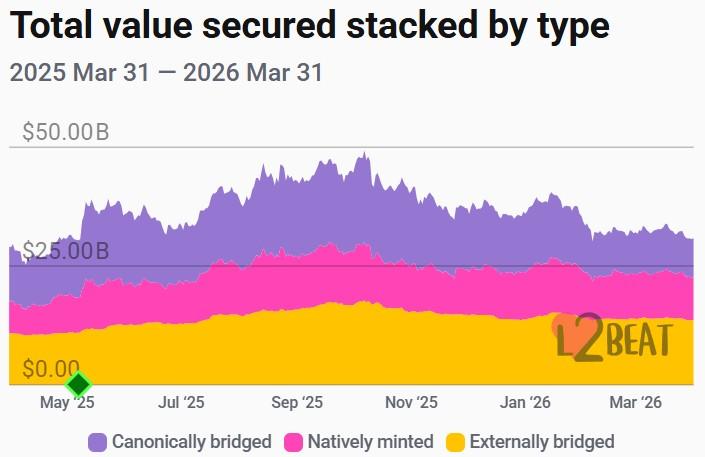
Numerous analysts pointed to liquidity fragmentation and the proliferation of layer-2 networks as reasons for Ethereum's underwhelming performance. As of Tuesday, 23 rollups collectively held $30.77 billion in total value locked, based on L2BEAT data.
"Ethereum doesn't have a scaling problem. It has a fragmentation problem," Friederike Ernst, co-founder of Gnosis, said in a statement shared with Cointelegraph. "Every new L2 that launches with its own liquidity pool and its own bridge is another walled garden."
She added:
"The EEZ is designed to do the opposite. One Ethereum, not a hundred islands."
In reality, this liquidity continues to be predominantly isolated within individual rollups, each maintaining its own DeFi infrastructure. The outcome more closely resembles a series of separate economies instead of an integrated marketplace.
Bankless co-founder Ryan Sean Adams compared the current state of Ethereum and its L2s to the North Atlantic Treaty Organization (NATO), describing it as a "loose alliance of chains that opt in to shared security."
The EEZ would transform this arrangement toward a federated economic union of chains — similar to the US and its 50 states — without requiring a hard fork.
"I hadn't seen much movement on this vision until now," said Adams.
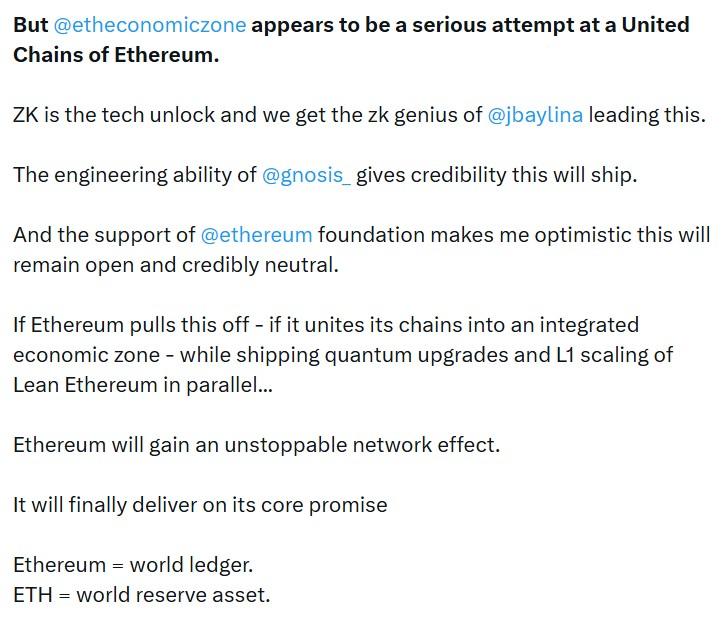
The framework primarily affects three categories. Initially, for Ethereum, it has the potential to enhance liquidity flow throughout the ecosystem through decreased dependence on bridges, which continue to represent a significant attack vector as assets are secured in contracts and vulnerable to security breaches.
Secondly, from a user perspective, EEZ seeks to facilitate frictionless transitions between Ethereum and its rollups by minimizing the friction and expense of transferring assets. Users can accomplish this without requiring continuous bridging.
Lastly, for protocols, it eliminates the necessity to oversee bridges, wrapped tokens and chain-specific implementations, streamlining operations throughout the ecosystem, as outlined by the EEZ.
Ethereum is not the first to experiment with an "economic zone"
A precedent for an economic zone already exists. The "Atom Economic Zone," or AEZ, represented Cosmos' effort to connect chains via a hub-and-spoke architecture based on "Interchain Security." Chains could obtain security from the Cosmos Hub by sharing fees and staking rewards with ATOM holders.
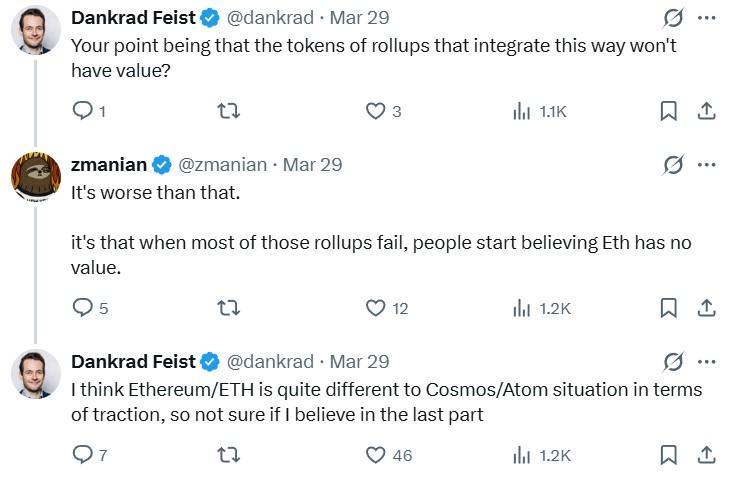
The approach attracted fresh interest after the EEZ reveal, with early Cosmos contributor Zaki Manian observing that a comparable concept launched in 2023 failed to achieve success.
"Most things fail and so the ecosystem inevitably [becomes] littered with corpses of failed projects and this inevitably leads to lack of confidence in the project as a whole," Manian said.
Blockchain researcher Dankrad Feist questioned how that experience applies to Ethereum's proposed economic zone. Manian responded that many projects building within the EEZ framework are also likely to "fail."
"The Atom experience is that the broader public will interpret this as a failure of EEZ," Manian added.
Cosmos is not quite Ethereum. It's a framework and a networking layer, and the Cosmos ecosystem is a network of sovereign L1 chains.
Meanwhile, Ethereum is a layer-1 blockchain that has a clear hierarchy. Ethereum rollups are structurally dependent on Ethereum for settlement and security, aligning their incentives with the base layer.
Gnosis co-founder Martin Köppelmann pitched in to Feist and Manian's discussion by pushing back at the comparison. He framed EEZ around synchronous composability and access to Ethereum's state rather than shared security or revenue models.
The tradeoff is that rollups must follow Ethereum's occasional chain reorganizations, adding complexity, but Köppelmann described those events as infrequent and manageable compared to the benefits.
"So yeah, I am happy to bet on the success of EEZ!" he added.
EEZ builds momentum as Ethereum reconsiders its scaling approach
Ethereum's rollup-centric roadmap was widely viewed as necessary when it was first introduced and did achieve its goal of easing the network's congestion.
That may have come at a cost. Some market watchers argued it blunted a key price rally opportunity during the last bull cycle. They also warn that Ether risks losing its position as the second-largest cryptocurrency to Tether's stablecoin, USDt (USDT).
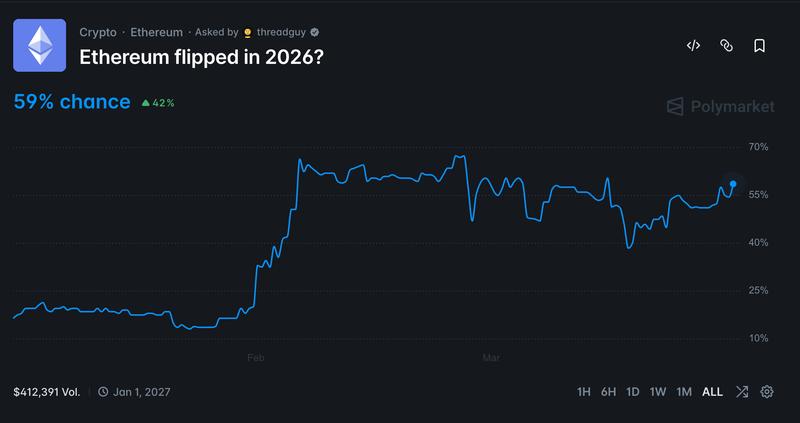
It also follows criticism from Ethereum co-founder Vitalik Buterin, who said many L2s have not fully transitioned to a decentralized model.
"The original vision of L2s and their role in Ethereum no longer makes sense, and we need a new path," Buterin said in a February X post.
Though Ethereum's pivot back toward scaling the base layer is recent, the EEZ has been a long time coming. An early version of the idea was described as an "Ethereum 3.0 vision" by Bankless co-founder Adams after listening to Köppelmann's presentation on native rollups in 2024.
The EEZ has gained widespread attention thanks to backing from the Ethereum Foundation and its development team, which includes Gnosis, known for building the Safe multisig wallet and early prediction market infrastructure.
The EEZ has yet to reveal key details such as its technical architecture and performance benchmarks, but said these will be published in the coming weeks.