Quantum computing still far off, but Bitcoin must act now, says Adam Back
While quantum computing remains years from posing a real threat to Bitcoin, crypto pioneer Adam Back urges the community to develop protective measures without delay.

Adam Back, CEO of Blockstream and an influential figure in cryptocurrency's early days, emphasized that the Bitcoin community needs to start developing quantum-resistant technologies today, despite the threat potentially being many years in the future.
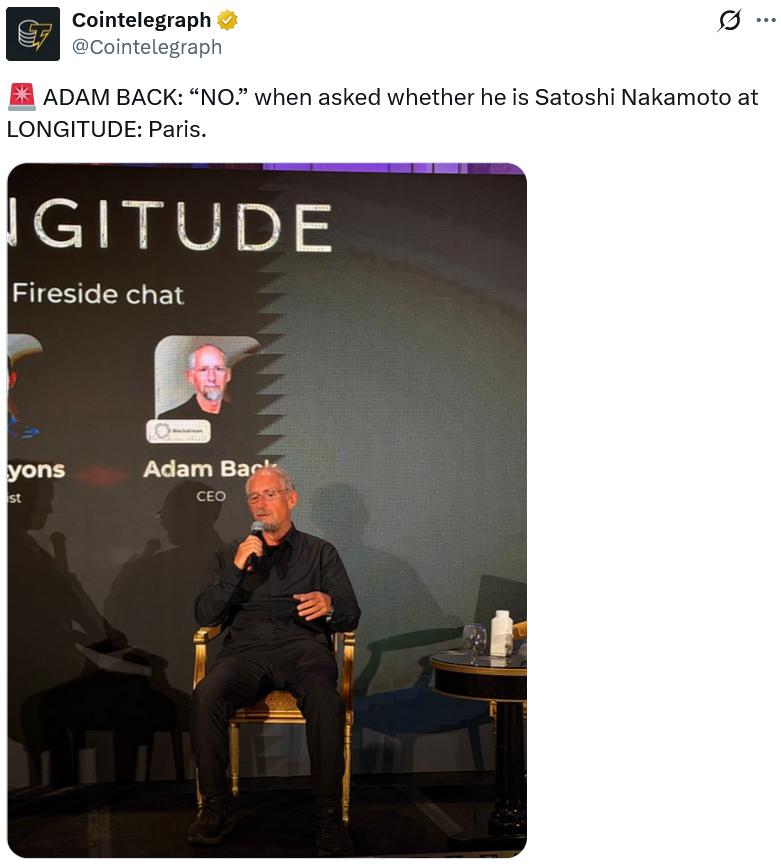
"Current systems are essentially lab experiments. I've followed the field for over 25 years, and progress has been incremental," Back stated during his appearance at Paris Blockchain Week on Tuesday. "Quantum computing still has a lot to prove."
However, Back stressed that "Bitcoin should prepare," noting that the "safest approach" involves creating optional upgrades that would enable migration to quantum-resistant cryptography when necessary.
Widespread anxiety that quantum computers might one day crack blockchain cryptography has sparked industry-wide concerns that malicious actors could exploit such technology to compromise cryptocurrency wallets, potentially throwing the market into complete disarray.
In November, Back estimated the quantum threat remains 20 to 40 years away, and told Bloomberg earlier this month that current quantum computers operate more slowly than basic calculators.
Nonetheless, Blockstream, his Bitcoin development firm, maintains a specialized quantum research team dedicated to investigating possible threat vectors targeting the Bitcoin network.
Some of this research has included deploying hash-based signatures on Blockstream's Bitcoin layer-2 solution, the Liquid Network, according to Back's statements at Paris Blockchain Week.
"Preparation is key. Making changes in a controlled way is far safer than reacting in a crisis."
Back also noted that the Taproot protocol has the capability to accommodate alternative signature schemes on the Bitcoin network while leaving existing users unaffected.
Quantum computing threat may be closer than it appears
Research published last month by Google and California Institute of Technology scientists suggested that operational quantum computers might materialize sooner than many anticipate and that significantly less computational power may be required to compromise cryptography than earlier estimates indicated.
Google's findings went so far as to suggest that quantum computers might potentially crack Bitcoin's cryptographic protections in as little as nine minutes, enabling attackers to execute an "on-spend" attack.
When questioned about what actions would be taken if the quantum threat materializes earlier than expected, Back indicated that Bitcoin developers would "act quickly."
"We've seen that before — bugs have been identified and fixed within hours. When something becomes urgent, it focuses attention and drives consensus."
Quantum proposal to freeze old Bitcoin met with backlash
Earlier this week on Tuesday, Bitcoin developer Jameson Lopp alongside five additional crypto security researchers unveiled a proposal aimed at freezing quantum-vulnerable Bitcoin holdings — including Satoshi Nakamoto's $81.9 billion stash — as a preventive measure against theft once quantum computers achieve functional status.
The proposal triggered intense criticism from multiple members of the Bitcoin community, with developer and researcher Mark Erhardt characterizing it as "authoritarian and confiscatory."
Phil Geiger, head of business development at Metaplanet, remarked: "We have to steal people's money to prevent their money from being stolen."