Ohio Court Rejects Kalshi's Legal Challenge in Sports Betting Dispute
Kalshi sought a court order to block Ohio regulators, asserting that federal commodity trading regulations took precedence over state-level sports betting restrictions.

A federal court in Ohio has rejected a preliminary injunction motion submitted by Kalshi, a prediction markets platform, seeking to prevent Ohio state regulators from taking action against the company based on accusations that it violated gambling statutes.
Through an order issued on Monday, Chief Judge Sarah Morrison of the US District Court for the Southern District of Ohio turned down Kalshi's petition for an injunction that would have prevented the Ohio Casino Control Commission and the state's attorney general from enforcing regulations on platform contracts, particularly those related to sports wagering.
Judge Morrison concluded that Kalshi did not successfully demonstrate that sports event contracts offered through the platform fell under the "exclusive jurisdiction" of the Commodity Futures Trading Commission (CFTC).
"Even if this Court were to find that sports-event contracts are swaps subject to the CFTC's exclusive jurisdiction, Kalshi has not shown that the [Commodity Exchange Act, or CEA] would necessarily preempt Ohio's sports gambling laws," said the opinion and order, adding:
"Kalshi argues that Ohio's sports gambling laws are field and conflict preempted by the CEA when it comes to sports-event contracts traded on its exchange [...] Kalshi fails to establish that Congress intended the CEA to preempt state laws on sports gambling."
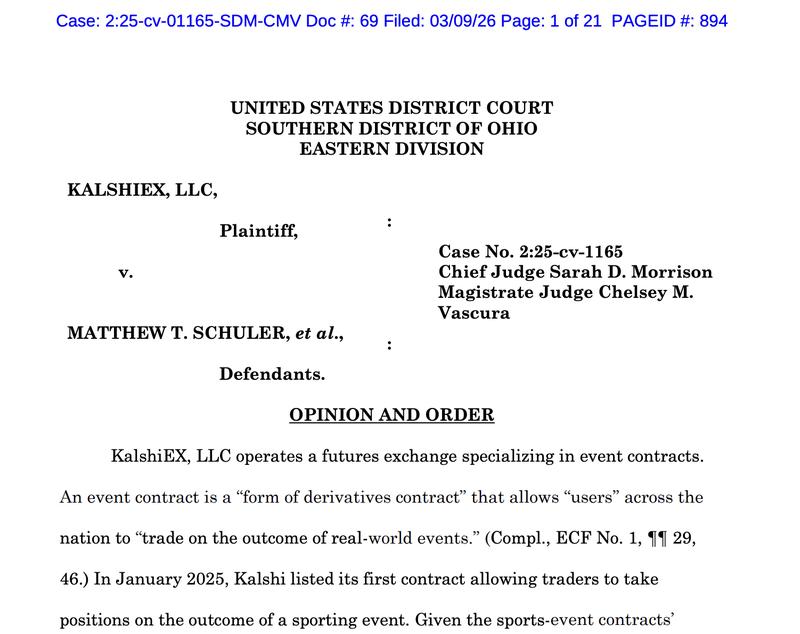
The court's denial contradicted the position taken by CFTC Chair Michael Selig, who stated in February that the federal regulatory body maintained "exclusive jurisdiction" over prediction market platforms and issued warnings of potential legal action against any entity asserting otherwise. Both Kalshi and other prediction market platforms are currently defending themselves against lawsuits filed in multiple US states on comparable allegations concerning unauthorized sports wagering operations.
"This Court does not endeavor to explain why the CFTC has not exercised its authority [...] with respect to the sports-event contracts," said the Monday filing in Ohio. "But the agency's inaction is not proof that the sports-event contracts are regulated by or permissible under the CEA—and the Court has concluded they are not."
In a statement to Cointelegraph, a Kalshi spokesperson said that the company "respectfully disagree[d] with the Court's decision, which splits from a decision from a federal court in Tennessee just a few weeks ago, and will promptly seek an appeal."
CFTC guidance on prediction markets could be looming
Last week, Selig said that the federal regulator was working to provide guidance regarding prediction markets "in the very near future." The CFTC chair is the sole Senate-confirmed commissioner in a panel normally consisting of five people.