Negative Ether Funding Rates Signal: Have ETH Bears Regained Market Dominance?
Negative sentiment in Ether derivatives markets combined with declining network activity pressure ETH prices, despite developer initiatives to accelerate transaction speeds and introduce flexible wallet fee structures.

Key takeaways:
- ETH faced downward pressure as spot ETFs experienced $225 million in withdrawals, while Ethereum staking yields lagged behind those offered by stablecoins.
- Although recent network improvements and enhanced wallet security proposals represent positive developments, they haven't been sufficient to stimulate renewed appetite for Ether.
The price of Ether (ETH) has consistently been unable to maintain momentum above the $2,100 threshold throughout the previous month, progressively undermining trader optimism in the digital asset. Despite experiencing a 7% increase from Monday through Tuesday, derivatives market indicators for ETH reveal diminished enthusiasm for bullish leveraged trades, suggesting that bearish forces may still hold the upper hand.
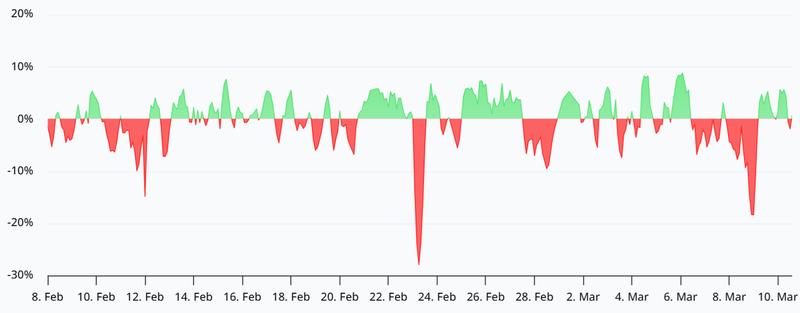
On Tuesday, perpetual futures for ETH moved into negative funding rate territory, indicating heightened appetite for short positions with bearish bias. Even more significantly, this indicator has stayed beneath the neutral 6% to 12% threshold throughout the last month. Investor disillusionment can be partially attributed to a 54% valuation drop spanning six months, though diminishing onchain transaction activity has also contributed substantially to the malaise.
Average weekly base layer transaction fees across the Ethereum blockchain registered $2.3 million during the past month, representing a decline from the $8 million high point recorded in early February. Although weekly transaction volumes have stabilized around the 14 million mark, the industry's current emphasis on layer-2 rollup scaling solutions has not yet succeeded in creating additional demand for native Ether tokens.
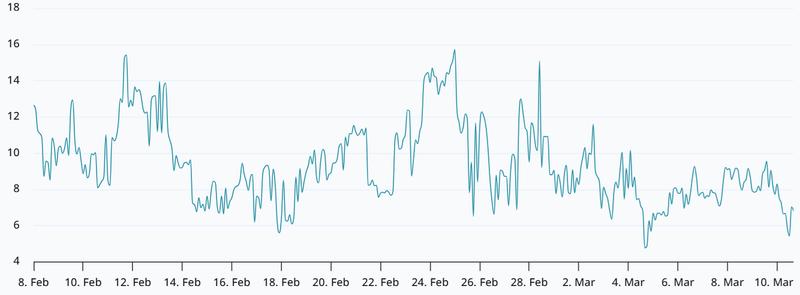
In contrast to the perpetual futures marketplace, the risk assessment metric for ETH options remained close to the neutral -6% to +6% band on Tuesday. Sell options (puts) commanded a 7% premium when compared with buy instruments (calls), indicating that optimism is gradually rebuilding among bullish Ether traders. Additionally, no rival blockchain platform has managed to surpass Ethereum's $56 billion total value locked (TVL) position.
Between Thursday and Monday, exchange-traded funds (ETFs) focused on Ether recorded $225 million in net capital withdrawals, completely reversing the $169 million in inflows observed on Wednesday. This measurement functions as an indicator of institutional appetite, which currently faces headwinds from the 2.8% native staking reward rate. In comparison, stablecoin lending rates offered by Sky Lending (formerly MakerDAO) stood at a higher 3.75%.
Lackluster spot ETH ETF appetite and apprehensions regarding Ethereum's development trajectory
The enthusiasm generated by US approval of ETF staking during late 2025 has failed to materialize into consistent institutional demand. Some observers might suggest that the disappointing results were merely attributable to unfortunate timing, given that the product launch coincided with a comprehensive cryptocurrency market correction that commenced in early October following total market capitalization approaching an unprecedented $4 trillion peak.
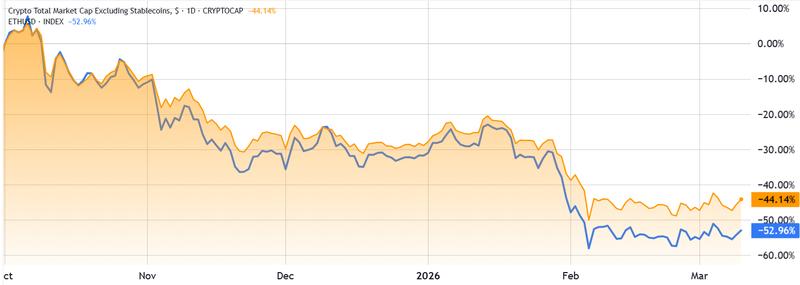
Since October 2025, ETH has delivered weaker returns compared to the overall cryptocurrency sector, with no apparent indicators that this trend is set to reverse course. Market sentiment has been further damaged by the staggering $735 million net loss reported by Ethereum treasury company Sharplink (SBET US) for 2025. These financial disclosures from the firm, which operates under the chairmanship of Ethereum co-founder Joseph Lubin, were made public on Monday.
The rate of progress on native blockchain scalability improvements may have played a role in Ether's underwhelming market performance. As an example, Ethereum co-founder Vitalik Buterin indicated on Saturday that account abstraction, which is essentially equivalent to smart accounts, will probably be delivered "within a year," despite being in development for over a decade. This technology will allow transactions to reference data from other transactions, facilitating the creation of quantum-resistant wallet solutions.
An additional benefit of the forthcoming Ethereum Hegota fork involves the capability to settle gas fees using tokens other than ETH through specialized decentralized exchanges, alongside the introduction of a "general-purpose public mempool" and the elimination of "public broadcasters" within privacy-focused platforms like Railgun and Tornado Cash. Buterin further stated his expectation for "progressive decreases" in both slot time and finality time over the extended term.
Taking everything into account, ETH derivatives markets and onchain usage patterns suggest minimal confidence in a bullish price breakthrough above $2,200, yet simultaneously, there exists no evidence of deteriorating fundamentals or overwhelming dominance by bearish traders.