Jordan Surges Ahead of Chalamet in Polymarket's Best Actor Oscar Race
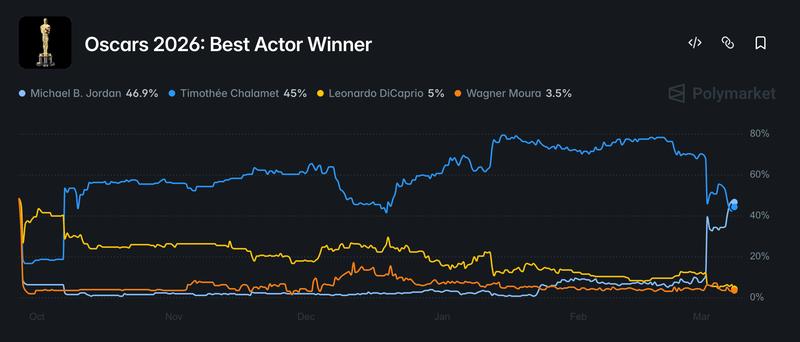
The leading man from "Sinners" saw his chances of securing the Best Actor trophy at the upcoming Academy Awards jump from a mere 10% on March 1, just hours prior to his SAG Awards victory for outstanding male performance.

On the prediction market platform Polymarket, actor Michael B. Jordan has surpassed Timothée Chalamet to become the frontrunner for the "Best Actor" category at the 2026 Academy Awards ceremony, with his probability climbing more than fourfold since the beginning of March.
The "Sinners" leading man secured the top male acting honor at the Actor Awards last week, previously referred to as the Screen Actors Guild Awards, or SAG.
With just seven days remaining until the Academy Awards ceremony, Polymarket participants are placing Jordan's probability of claiming the trophy at approximately 47%, with Chalamet trailing closely behind at 45%, while Leonardo DiCaprio sits at 5%, Wagner Moura holds 4% probability, and Ethan Hawke maintains merely 1% chances. The market favored Chalamet as the leader until this past Saturday.
Jordan earned his Oscar nomination for portraying the dual roles of twin brothers Smoke and Stack Moore in "Sinners," a 2025 horror film centered on vampires. Chalamet received his nomination for his performance in "Marty Supreme," a fictionalized dramatic feature about a competitive table tennis athlete.
The awards ceremony hosted by the Academy of Motion Picture Arts and Sciences is scheduled to broadcast on March 15, and the Best Actor category prediction market on Polymarket has generated more than $5.6 million in trading volume as of this writing.
Polymarket plans US app rollout this year, but regulatory hurdles remain
In December 2025, Polymarket launched its application to a limited group of waitlisted users in the United States, with the full deployment of a domestically regulated platform anticipated to occur later this year in 2026.
Nevertheless, prediction market platforms are still encountering examination from certain state-level regulatory bodies throughout the United States, with these regulators maintaining that they possess the jurisdiction to regulate event-based contracts.
During February 2026, Polymarket initiated legal proceedings against the Commonwealth of Massachusetts, contending that the gambling regulator at the state level lacks authority over prediction markets and that such jurisdiction belongs exclusively to the federal Commodity Futures Trading Commission (CFTC).
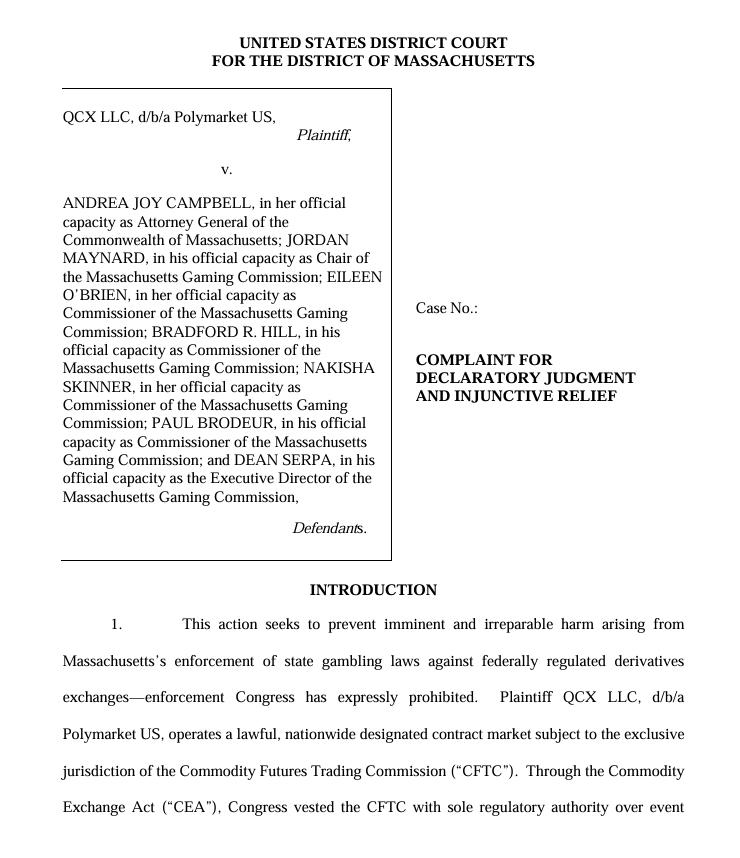
This legal action has the potential to establish a judicial precedent regarding whether prediction markets fall under exclusively federal regulation or whether regulatory authority is distributed between federal and state government entities.
In addition to Massachusetts, Polymarket and Kalshi are confronting heightened regulatory examination in the state of Nevada following a federal judge's dismissal of arguments asserting that the Commodity Exchange Act (CEA) and CFTC prohibit state regulatory bodies from exercising supervisory authority over prediction market platforms.
According to reports, both platforms are investigating new funding opportunities that could establish company valuations at approximately $20 billion apiece, representing roughly twice their latest valuations.
Both companies have conducted initial conversations with prospective investors regarding the procurement of additional capital at this increased valuation, according to a Friday report from the Wall Street Journal, which cited sources with knowledge of the discussions. The publication emphasized that these talks remain in preliminary phases and might not culminate in completed transactions or achieve the desired valuation targets.