Institutional Money Won't Drive Bitcoin to $150K Without Major Catalyst: Analyst
Luke Gromen, founder of FFTT, believes institutional capital won't significantly impact Bitcoin prices in 2026 without major catalysts, contrasting with other experts who view institutions as critical to crypto's comeback.

Don't expect institutional capital to drive Bitcoin toward record-breaking territory this year in the absence of a significant market catalyst, according to Luke Gromen, macro researcher and founder of FFTT.
"If you're counting on institutional investors to run it from you know 90 to you know 150, if that's your plan, that's probably not going to happen without some major catalyst," Gromen stated during his appearance with Natalie Brunell on the Coin Stories episode that aired on YouTube Wednesday.
"That's not how institutional investors act," he explained. "They're going to sit there and just go, I'll wait. I'll wait," he added.
For Bitcoin (BTC) to climb from its present trading level of approximately $89,880 to the $150,000 mark would require a 67% gain, representing an increase of 18.86% beyond its historical peak of $126,198, based on CoinMarketCap data.
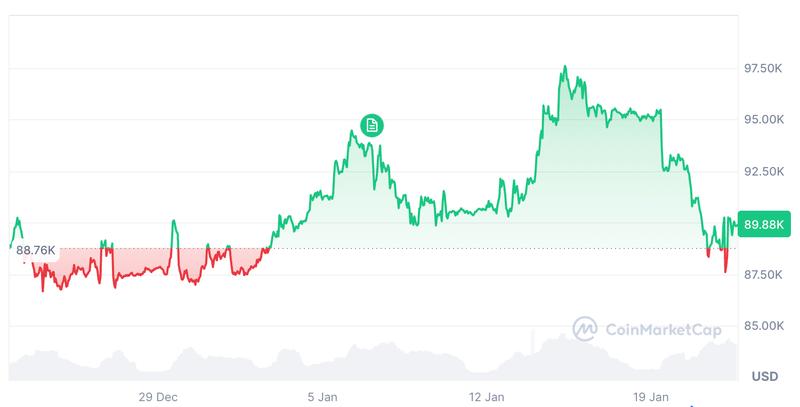
"At the very least that suggests there's a whole lot of wood to chop for Bitcoin," Gromen remarked.
Among the major market catalysts being closely monitored are the US CLARITY Act, which currently faces questions regarding its implementation timeline, along with the possibility of additional quantitative easing measures through further interest rate reductions from the US Federal Reserve.
Institutions still interested in Bitcoin: CryptoQuant CEO
Market observers in the cryptocurrency space frequently interpret increasing institutional participation as an indicator of potential near-term price appreciation. On Wednesday, Ki Young Ju, CEO of CryptoQuant, declared that "institutional demand for Bitcoin remains strong."
Ju highlighted the 577,000 Bitcoin accumulated by institutional funds during the previous year, representing approximately $53 billion in value. "Still flowing in," he emphasized.
Last December, Grayscale, an asset management firm, identified institutional appetite and more transparent US regulatory frameworks as the primary drivers supporting its prediction that Bitcoin would achieve fresh all-time highs during the first six months of 2026.
Gromen plays with idea of Bitcoin dropping to $60K
Gromen indicated there exists a scenario where Bitcoin "could easily" decline to $60,000.
He raised the prospect of an "all-out trade war," the United States finding itself isolated from global markets, or potentially a recession, as situations that might spark substantial Bitcoin liquidations and weaken institutional appetite.
"What happens to the cash flows of those businesses, do they have to turn sellers? Are the treasury companies of this cycle the forced sellers like we saw around FTX in 2022?" he questioned.
Treasury companies compelled to liquidate their holdings would potentially create an oversupply situation in the market.
Strategy, led by Michael Saylor, represents the biggest publicly-traded Bitcoin treasury company with holdings of 709,715 Bitcoin, valued at roughly $63.77 billion, based on SaylorTracker information.
At the same time, publicly-traded Bitcoin treasury companies collectively possess around 1.13 million Bitcoin, with an approximate valuation of $101.56 billion, according to information from BitcoinTreasuries.NET.