Grayscale: Strategy's Bitcoin leverage strategy undergoes initial market pressure test
"A shift toward more Bitcoin held on diversified corporate balance sheets rather than leveraged DAT balance sheets would be beneficial," stated Zach Pandl, head of research at Grayscale.

The leveraged Bitcoin acquisition model employed by Strategy is currently under strain, a situation that may constrain the company's capacity to continue purchasing BTC and could potentially necessitate additional asset sales, Grayscale has indicated.
"Market sentiment has been negatively affected by the strategic pivot from one of the largest BTC holders globally," Zach Pandl, head of research at Grayscale, stated on Thursday.
On Monday, Strategy, led by Michael Saylor, divested 32 BTC—a minuscule portion of its overall holdings totaling 843,706 BTC—yet the sale proved sufficient to shake investor confidence as the digital asset has plummeted 16% following the transaction.
Additionally, Strategy offloaded shares valued at $128 million, with the company's stock experiencing a 12.8% depreciation since the sale, reaching a two-month nadir of $126 on Thursday.
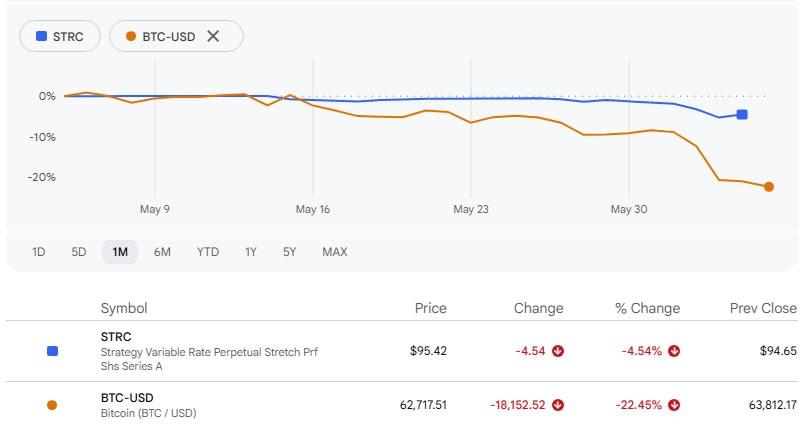
According to Pandl, the situation could exert even more significant pressure on Stretch (STRC), the company's variable rate preferred equity instrument.
The Stretch instrument was structured to maintain a trading price near $100 per share while distributing an 11.5% dividend, however it currently trades at approximately $95, signaling that investors are demanding enhanced returns.
Should Strategy elect to raise its dividend payments to attract investors, this would elevate the company's cash commitments, potentially necessitating additional BTC liquidations and creating further downward price momentum in a vicious cycle.
"The leveraged business model that Strategy employs is experiencing significant pressure, which has amplified volatility across the entire BTC market," Pandl noted.
He further indicated that Grayscale believes Strategy will face a "limited ability to accumulate more tokens at current share prices for both STRC and MSTR."
Gold advocate Peter Schiff echoed similar concerns on X on Thursday. Should Strategy be compelled to boost the dividend to restore STRC to its $100 target, the firm "will run out of cash much sooner, pulling forward Bitcoin sales to fund payments."
In his closing remarks, Pandl emphasized that reducing Bitcoin concentration in leveraged corporate treasury portfolios would benefit the wider market and cryptocurrency ecosystem.
"For the health of the Bitcoin ecosystem over the long run, less BTC on levered DAT [digital asset treasury] balance sheets and more on diversified corporate balance sheets will be a positive, in our view."
It's not all bearish for Saylor's Strategy
Augustine Fan, a partner at cryptocurrency software company SignalPlus, informed Cointelegraph on Friday that while markets attribute the recent downturn to Strategy's sales activity and STRC's trading below par value, "but the reality is that even the most ardent supporters are running out of reason to be structurally bullish."
"All focus will be on the MSTR situation to see how Saylor manages to handle his liquidity strains by balancing dividend payments against STRC and the DAT holdings."
Jeff Ko, serving as chief analyst at CoinEx, shared with Cointelegraph that the first-ever Bitcoin sale by Strategy represented an "important psychological trigger" for the selloff witnessed this week.
Nevertheless, he argued that the decision was more strategically sound than market participants' negative response would suggest, as it provides Strategy with enhanced operational flexibility.
"Greater flexibility around selling Bitcoin can help Strategy manage balance sheet risk more prudently, rather than forcing itself into a one-way accumulation strategy under all market conditions."