GOP Senators Call on Financial Regulators to Define Cryptocurrency Capital Requirements
A coalition of Republican senators, spearheaded by Cynthia Lummis, is pressing federal financial oversight agencies to establish equitable capital standards for digital asset holdings on institutional balance sheets.

Republican members of the United States Senate have called upon federal financial oversight bodies to provide clarity regarding capital requirement standards for institutions participating in cryptocurrency-related operations.
On Thursday, Senator Cynthia Lummis announced that she spearheaded the coalition in dispatching correspondence dated May 27 to three key regulatory officials: Miki Bowman, the Federal Reserve's Vice Chair for Supervision, Travis Hill, who chairs the Federal Deposit Insurance Corp., and Jonathan Gould, the Comptroller of the Currency.
The correspondence expressed appreciation for the regulatory agencies' March guidance that provided clarity on how tokenized securities should be treated from a capital perspective, while simultaneously encouraging them "to build on that progress to move towards a clear and fair capital treatment for on-balance sheet treatment of digital assets."
Existing international frameworks for capitalizing cryptocurrency positions mandate that financial institutions maintain reserve assets of greater value than their digital currency holdings, a requirement the Senators characterized as effectively functioning as a "de facto ban" on cryptocurrency ownership by banking institutions.
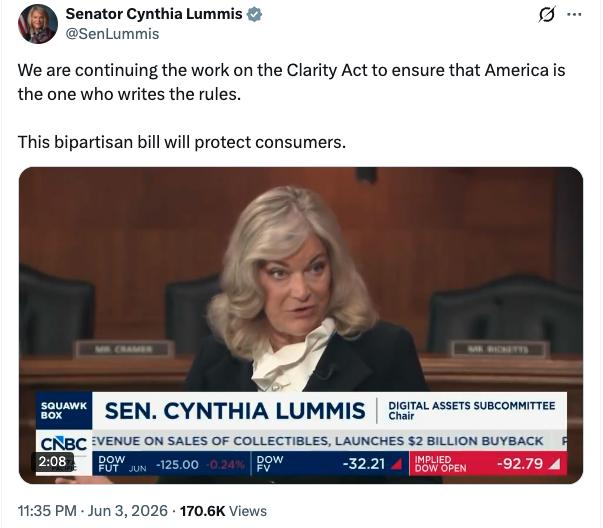
The correspondence arrives at a time when senators are positioning themselves to take action on legislative measures, referred to as the CLARITY Act, which would establish the framework for how federal regulatory bodies will oversee cryptocurrency markets. The present iteration of the legislation permits banking institutions to utilize digital currencies and blockchain technology for various operations including payment processing, loan origination, custodial services and securities trading.
Congressional leadership in the Senate is working to advance the legislation to passage before the November midterm elections, recognizing that failure to pass the measure prior to the electoral cycle could necessitate reintroduction during the subsequent congressional session.
The coalition of lawmakers expressed concerns regarding the Basel Committee on Bank Supervision's established protocols that impose a 1,250% risk weighting on cryptocurrency assets, characterizing this standard as "not derived from a calibrated assessment of the actual risk profile of digital assets."
Any proposed capital treatment of on-balance sheet digital asset activities should accurately reflect the opportunities and risks of digital assets — and be based on, to the extent possible, a technology-neutral approach that gives banks the authority to participate meaningfully in digital asset markets.
The senators further emphasized that cryptocurrency-focused legislation currently being evaluated in the Senate would "undoubtedly require capital guidance" and pressed regulatory authorities to commence development of an updated capital framework specifically designed for digital assets.
Additional signatories to the correspondence included Senators Dan Sullivan, Bill Hagerty, Bernie Moreno, Ted Budd and Jon Husted.
Deliberations on the Senate's cryptocurrency legislation are scheduled to continue this week following the chamber's return from its recess period. The proposed law establishes the regulatory framework through which the Securities and Exchange Commission and the Commodity Futures Trading Commission will exercise oversight authority over cryptocurrency markets and related business entities.
Both the Senate Banking and Agriculture Committees have advanced their respective versions of the legislation that address securities and commodities regulation, though the complete Senate body must now work to harmonize the divergent proposals.
Additional matters that legislators have highlighted, encompassing stablecoin regulation, ethical considerations and rules affecting cryptocurrency developers, must also be incorporated into the final legislation if it is to garner the 60 affirmative votes required for Senate passage without protracted debate that could result in the measure becoming indefinitely delayed.