Foreign Election Meddling Concerns Drive Canada's Push to Prohibit Crypto Campaign Contributions
In an effort to safeguard electoral integrity from external interference and maintain political financing transparency, Canada's national government has put forward legislation to prohibit cryptocurrency contributions.

The Canadian federal government has put forward legislation that would implement a comprehensive prohibition on cryptocurrency contributions to political organizations, expressing worries that international actors could leverage this technology as a vehicle for electoral interference.
Titled the Strong and Free Elections Act, this legislation was brought before parliament on Thursday and seeks to modify the Canada Elections Act by banning political organizations and third-party groups participating in electoral processes from receiving contributions via cryptocurrency, money orders and prepaid payment cards in order to stop anonymous and "hard to trace contributions."
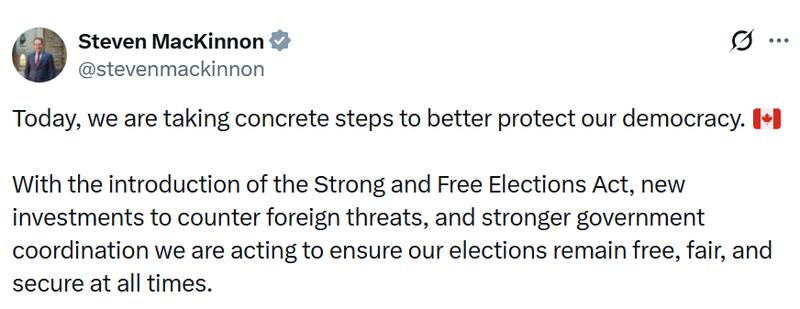
Steven MacKinnon, who serves as the leader of the government in the House of Commons and sponsors the legislation, declared through an X post on Thursday that these regulatory measures aim to prevent foreign interference and additional risks to electoral processes.
"With the introduction of the Strong and Free Elections Act, new investments to counter foreign threats and stronger government coordination, we are acting to ensure our elections remain free, fair and secure at all times," he said.
These concerns are not unique to Canada. On Thursday, the UK government similarly revealed intentions to impose a moratorium on cryptocurrency contributions, a decision made after an independent assessment and mounting pressure from high-ranking political figures.
Previous effort to ban cryptocurrency contributions was unsuccessful
The present Strong and Free Elections Act underwent its initial reading in the House of Commons on Thursday. For this bill to be enacted into law, it needs to move through multiple readings and a committee evaluation stage within that legislative chamber, followed by passage through the Senate before being presented to the Governor General of Canada for royal assent.
Comparable legislation was introduced in 2024 by Dominic LeBlanc, who held the position of minister of public safety at that time, but the bill was unable to progress beyond the second reading stage in the House of Commons and eventually died on the order paper.
Political donations using cryptocurrency have been allowed in Canada since 2019 and receive treatment comparable to contributions made through property.
Nevertheless, a 2024 report authored by Stéphane Perrault, who serves as the chief electoral officer, put forward a recommendation for an outright prohibition on cryptocurrency political contributions based on the rationale that it "poses challenges in identifying a contributor."
Financial penalties could reach twice the contribution amount
Should the proposed bill be enacted into law, any contributions made through any of the prohibited payment mechanisms would need to be returned, destroyed or delivered to the chief electoral officer.
Financial penalties for those who violate these rules could reach up to twice the amount contributed, in addition to $25,000 for individuals and $100,000 for corporate entities.
The legislation also puts forward an expansion of current prohibitions on realistic deepfakes that impersonate electoral candidates with the intention to mislead voters. This matter received considerable attention during the period leading up to the 2024 US elections, including one documented incident involving a deepfake of then-President Biden urging voters not to participate.