Cryptocurrency Tax Errors? Upcoming Legislation Provides Path to Compliance
Proposed legislation in the United States would create a special disclosure program allowing cryptocurrency traders to amend previous tax filing errors, offering reduced penalties for qualifying individuals.

Digital asset holders who neglected to properly declare their transactions from prior tax years could find welcome relief through new legislation that is making its way through the United States Congress.
The Digital Asset Tax Certainty Act, H.R. 10357, includes Section 502, which would mandate that the Treasury secretary create a Digital Asset Voluntary Disclosure Program no later than 12 months after the legislation is enacted into law.
This provision would enable qualifying taxpayers to remedy any historical digital asset tax infractions through the submission of corrected tax returns and payment of owed taxes, in addition to accumulated interest and a penalty associated with the program.
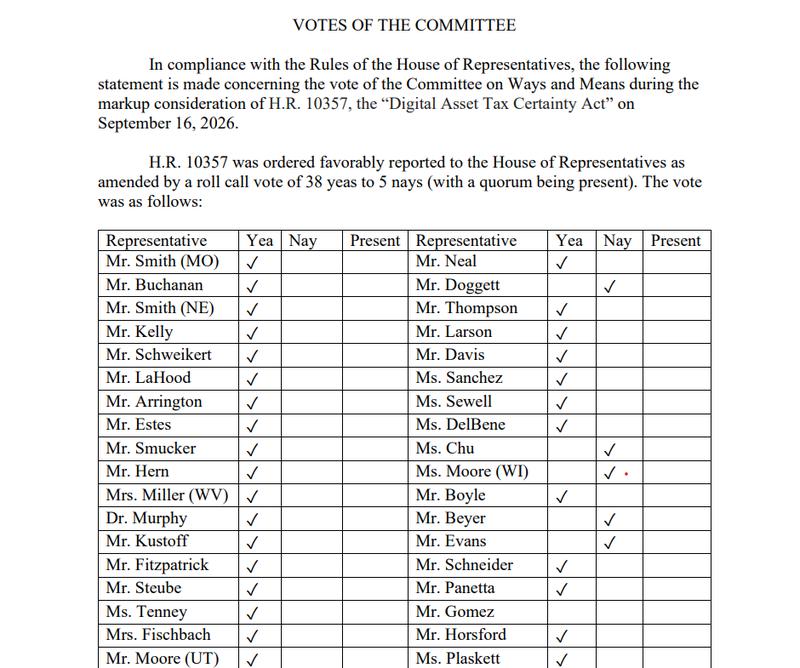
On Sept. 16, the House Ways and Means Committee gave the bill approval through a 38-5 vote, though the legislation has not yet been enacted; it must still receive passage in both the House and Senate before receiving the president's signature.
Andrew Gordon, executive director of Digital Asset Tax Action, tells Magazine that "it's a big change that would help a lot of ordinary taxpayers, and it has gotten very little attention."
A gap in the system
Digital asset holders across the United States are currently navigating the initial filing season subject to the recently implemented 1099-DA broker reporting regulations, which provide the IRS with enhanced transparency regarding cryptocurrency transactions.
According to Gordon, while these regulations should simplify the reporting process moving forward, they do not provide any solution for the tax years preceding their implementation.
He notes that "a large share of investors didn't report correctly over the years," and current mechanisms fail to provide taxpayers who committed "honest mistakes" with a reliable pathway to settle their outstanding tax obligations.
Gordon explains that "today, a crypto investor who learns they didn't properly report their crypto or has not reported at all has no good way to fix it"; years can pass before investors realize they misinterpreted the tax implications of cryptocurrency-to-cryptocurrency exchanges or failed to properly account for activity spanning multiple trading platforms.
What taxpayers could get
The IRS currently maintains a Voluntary Disclosure Practice that targets taxpayers who deliberately broke tax laws and potentially face criminal prosecution.
For individuals with inadequate reporting practices, the current option involves submitting amended tax returns, though the penalty structure lacks the predictability that provision 502's cryptocurrency-focused program would provide.
Sharon Yip, a certified public accountant (CPA) and founder of Crypto Tax Advisors, indicates that filing errors among regular cryptocurrency investors occur frequently.
Based on her firm's observations, certain clients failed to report cryptocurrency holdings under the mistaken belief that taxation only applied upon conversion to fiat currency, while additional clients depended on insufficient exchange documentation or mischaracterized their transactions.
Yip tells Magazine that "there is no standardized process that gives non-willful crypto investors predictable penalty treatment or a clear resolution."
According to Yip, a cryptocurrency-dedicated program has the potential to "fill this gap" through the establishment of a "defined correction period, reduced and predictable penalties and greater certainty for taxpayers who come forward voluntarily."
What the bill would offer
Section 502 would typically require taxpayers to submit amended returns during the 24-month period following the program's establishment, with the legislation outlining two distinct penalty structures.
Reduced rates would apply to taxpayers who provide certification under penalty of perjury confirming their violations were unintentional and non-fraudulent. Such individuals would be subject to a 0% penalty on their initial $25,000 of annual tax deficiency and 5% on any excess amounts, provided they file during the program's first 12 months.
Taxpayers who choose not to provide certification would face rates of 25% on their first $25,000 and 40% on amounts exceeding that threshold, with these percentages escalating for those who fail to file within the initial timeframe.
The provision also includes exemptions from certain civil penalties, while taxpayers who decline to certify receive protection against criminal referrals stemming from information appropriately disclosed regarding the tax violations addressed by this section.
According to Yip, taxpayers ought to review their complete transaction records across all exchanges and digital wallets to determine which tax years require correction, followed by an evaluation of whether their errors were truly unintentional.
Given that false certification subjects individuals to perjury penalties, she recommends obtaining professional counsel when taxpayers have any uncertainty.
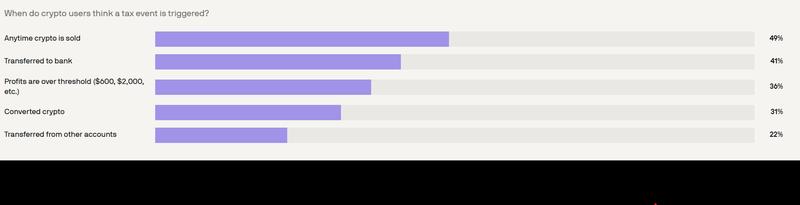
Many United States cryptocurrency holders may find Section 502 particularly beneficial; research conducted in 2026 by CoinTracker and Coinbase revealed that a mere 49% correctly understood that selling crypto can be a taxable event.