Crypto Industry Leaders Push Back Against Treasury's GENIUS Act Stablecoin Regulations
Leading crypto firms Hyperliquid Policy Center and Paradigm are calling on Treasury officials to modify anti-money laundering requirements under the GENIUS Act, citing excessive burdens on stablecoin providers.

Paradigm, a prominent venture capital firm, alongside the policy advocacy division of cryptocurrency futures platform Hyperliquid, have called upon the United States Treasury Department to modify a draft regulation concerning anti-money laundering protocols and sanctions enforcement for stablecoin providers.
In correspondence submitted on Tuesday, the Hyperliquid Policy Center together with Paradigm expressed concerns that certain compliance requirements for secondary market activities require either clarification or refinement "to avoid unintended consequences for permissionless blockchain infrastructure and the DeFi ecosystem."
Both organizations voiced their support for the Financial Crimes Enforcement Network's (FinCEN) methodology of placing compliance responsibilities on the "primary market," including issuers who maintain access to customer data, while adopting a "limited approach" toward the secondary market, where issuers can only observe wallet addresses and transaction records.
The same principle should guide the agencies' implementation of AML and sanctions requirements for stablecoins deployed to permissionless environments.
The correspondence came as a response to regulations put forward by the Treasury in April designed to execute GENIUS Act stipulations regarding stablecoin issuers, mandating that stablecoin providers maintain technical capabilities to block, freeze or reject transactions that breach US legal requirements or sanctions in both primary and secondary market operations.
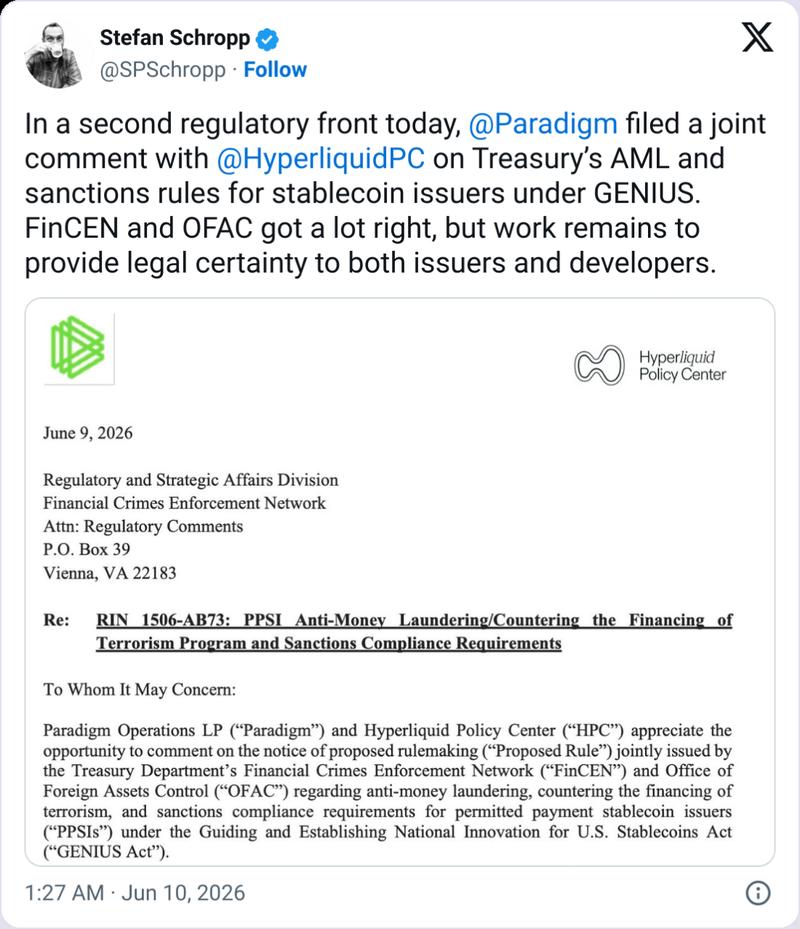
According to Hyperliquid and Paradigm, the regulatory proposal extends secondary market operations into an issuer's compliance scope that they "cannot meaningfully police."
Their position emphasized that the rule also categorizes smart contract interactions as activities bearing sanctions liability "regardless of whether the issuer has any relationship with, or visibility into, the transacting parties."
Both entities contended that any issuer subject to the proposed compliance requirements would be incentivized to exclusively operate within a permissioned framework, which they maintained would result in US-regulated stablecoins being withdrawn from decentralized finance to create "a void filled by unregulated, offshore, non-dollar alternatives."
United States President Donald Trump enacted the GENIUS Act into law last year, which established the regulatory framework for stablecoins and their issuing entities. Federal regulatory bodies are presently examining implementation strategies for the legislation, which must take effect no later than January 2027.
The Senate is currently deliberating a cryptocurrency bill that may incorporate additional regulations for stablecoin issuers and eliminate liability for developers of crypto platforms regarding money laundering and sanctions compliance.
Stipulations for the proposed legislation, known as the CLARITY Act, remain under negotiation, and certain legislators are advocating for a complete Senate floor vote on the measure prior to the November elections.