Court Postpones Decision on Aave's Request to Release $71M in Frozen Ethereum
Supplemental documentation has been ordered by a New York judge following Aave's failure to sufficiently demonstrate how accumulated losses might arise should the restraining notice continue to be enforced.


A judge in New York has postponed ruling on Aave's urgent request to release $71 million in cryptocurrency assets connected to individuals affected by the $293 million Kelp DAO security breach, requesting further documentation before scheduling a new court session in June.
The decentralized finance platform Aave has attempted to access $71 million in ETH that was frozen by Arbitrum to help with recovery initiatives in the aftermath of the Kelp DAO hack, which stands as one of the most significant DeFi exploits of this year.
Nevertheless, Gerstein Harrow LLP, a law firm based in the United States, submitted a restraining notice in early May, contending that their clients possess a legitimate claim to these assets. In response, Aave submitted an emergency petition to have the assets released, maintaining that liquidations affecting users and possible destabilization of the DeFi marketplace might result if the funds remain locked.
Based on documentation submitted on Wednesday to the Southern District of New York, Judge Margaret M. Garnett determined that Aave had failed to sufficiently explain how "compounding losses" affecting user assets could "occur if the restraining notice remains in place" within its submission from earlier this month.
Judge requests more information from both sides
The complexity of the case and the potential risks facing the victims were recognized by Judge Garnett, who requested supplemental briefs from both parties to provide more comprehensive details regarding their positions.
The court recognizes the risk of potential near-term harm to Aave LLC and Aave Protocol users. Due to the complexity of the issues raised in the parties' motions and at oral argument on May 6, 2026, and the extremely abbreviated timeline on which they were briefed, the Court orders the parties to submit supplemental briefing.
Judge Margaret M. Garnett
Six critical areas were identified by the judge regarding matters on which the court seeks additional details, such as whether New York's shelter principle applies to the hacking transactions; the legal differentiation between fraudulent activity and theft and what rights hackers possess in misappropriated assets; which legal framework determines creditor precedence concerning the frozen assets; whether establishing a constructive trust would constitute a suitable remedy and whether Aave or Arbitrum possesses the capability to identify individual victims for pro rata asset distribution.
Both Aave and Gerstein Harrow now face a May 22 deadline for submitting their supplemental briefs, with the court hearing rescheduled for June 5.
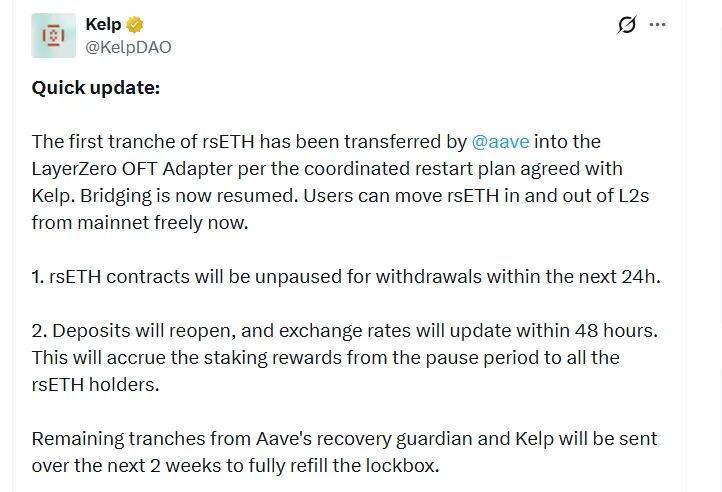
This legal matter unfolds as wider Kelp DAO recovery initiatives continue. An announcement made Tuesday by Kelp and Aave revealed that they had completed significant actions toward restoring the backing of rsETH.
The hacker's rsETH tokens have undergone burning on Arbitrum, whereas the missing tokens, valued at approximately $278 million, are scheduled to be restored during the upcoming two-week period through assets from the Aave Recovery Guardian multisignature wallet.
Following the reactivation of the relevant smart contracts, normal functionality for all rsETH applications will be restored.