Coinbase Moves Prediction Markets Battle With New York to Federal Jurisdiction
In a strategic legal maneuver that could clarify the CFTC's authority over prediction markets, Coinbase has moved its case against New York's attorney general from state to federal court.

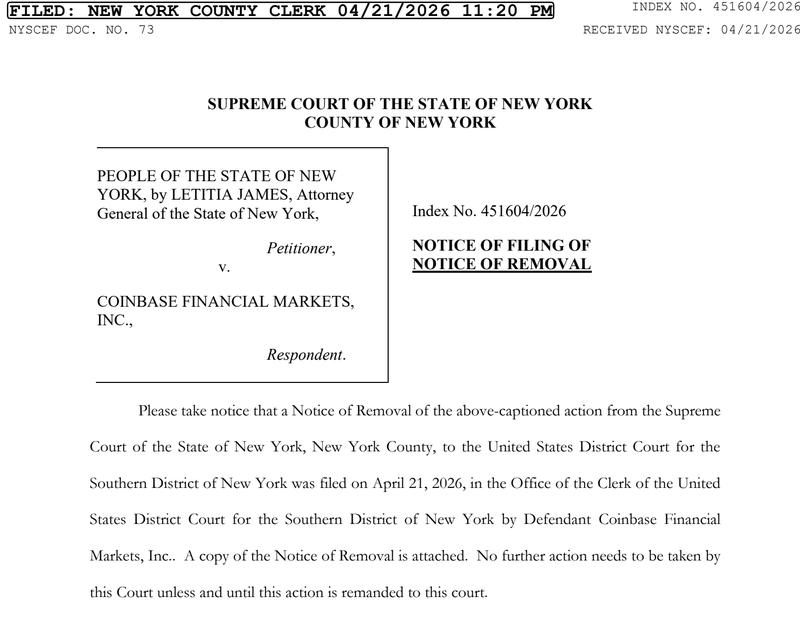
In a statement issued on Wednesday, Paul Grewal, who serves as Coinbase's chief legal officer, announced that the cryptocurrency exchange had successfully transferred the prediction markets case initiated by New York Attorney General Letitia James from state court to the federal level. Grewal contended that the litigation centers on contested matters of federal law concerning the regulatory framework for event contracts.
The strategic legal maneuver intensifies an ongoing battle that may ultimately determine whether prediction markets operate under federal commodities regulations and fall within the purview of the US Commodities and Futures Trading Commission (CFTC) or are instead governed by state-level gambling statutes. The outcome carries significant ramifications for regulatory oversight of exchanges such as Coinbase and Gemini.
In a Wednesday post on X, Grewal declared, "We have removed this action to federal court," further explaining that the claims brought by New York involve "disputed and substantial questions of federal law" and are governed by "complete preemption."
The federal transfer follows legal action initiated on Tuesday by New York Attorney General Letitia James targeting Coinbase Financial Markets and Gemini Titan. The lawsuit contends that their prediction market platforms breach New York's gambling statutes by enabling users to place wagers on sports events, entertainment outcomes and electoral results without obtaining a state gaming license. The complaint specifically highlights that the platforms allow participation from users aged between 18 and 20 years old.
James' lawsuit demands monetary penalties, seizure of purportedly unlawful proceeds and customer restitution. Additionally, the legal action requests that the court prohibit these companies from providing comparable services in New York unless they achieve compliance with state regulations.
Cointelegraph has reached out to Coinbase seeking commentary on this development and requesting access to the official court documentation.
State authorities escalate efforts to claim prediction markets oversight
Regulatory authorities at the state level have intensified enforcement actions targeting prediction market operators in recent weeks, with 11 states having initiated legal proceedings against such platforms as they attempt to establish dominance over federal regulatory bodies.
In a post on X published Tuesday, Coinbase's Grewal asserted that prediction markets represent "federally regulated national exchanges" operating under CFTC oversight, and emphasized the company's commitment to "fight for the federal oversight of these markets that Congress intended."
On Jan. 28, Coinbase rolled out its prediction markets platform throughout all 50 US states, New York included, enabling users to trade on "any real-world outcomes" spanning categories such as sports, political events, cultural phenomena and additional topics.
The legal challenge brought by the New York Attorney General represents another indication that state-level regulators are attempting to claim jurisdictional authority over the nascent prediction markets industry. This position conflicts with the CFTC's position, which maintains it possesses exclusive regulatory authority over prediction markets that have registered as designated contract markets, including platforms like Polymarket and Kalshi.
On April 2, the CFTC initiated three distinct legal actions against gaming regulatory bodies in Illinois, Connecticut and Arizona. The federal agency contended that these state governments lack authority to impose their gambling statutes and licensing mandates on event contracts traded through CFTC-supervised platforms.
On April 8, both the CFTC and the US Department of Justice (DoJ) petitioned a federal court to prevent Arizona from implementing state gambling regulations against event contracts offered by Kalshi. Their argument rested on the assertion that such contracts operate under the CFTC's sole regulatory jurisdiction.