Chasing moonshots: Why crypto investors still ignore fundamentals despite market evolution
The urge to gamble everything for transformative wealth has characterized cryptocurrency markets since inception. However, a shift is emerging as institutional participation begins reshaping how returns are generated.

"Investments change fast; human nature and human aspirations stay constant."
This observation from Meir Statman, a behavioral finance pioneer and finance professor at Santa Clara University, sheds light on one of the enduring mysteries of investing. It might also explain why cryptocurrency market cycles have consistently centered on pursuing the latest trending narrative instead of fundamentals, from DeFi to meme coins to decentralized compute.
Within an industry that has progressively evolved into an ecosystem featuring institutional investors, protocols that generate revenue, and practical real-world applications, investor focus continues drifting toward whatever new opportunity promises extraordinary returns.
"Crypto remains an emerging asset class, and in young markets, price discovery tends to be attention-driven before becoming analysis-driven," explains Samar Sen, head of international markets at Talos, in his conversation with Magazine.
"A new narrative gives investors a simple story to underwrite quickly, while assessing the fundamentals of an established protocol takes real work, from understanding usage and revenue to token design and competitive position."
This pattern isn't exclusive to digital assets; it simply manifests more dramatically in an industry that values memes above sustainable business models.
A Pokémon card, a digital asset and a tech stock
Recent research from MarketWise examined hypothetical $10,000 investments spanning cryptocurrencies, stocks, exchange-traded funds and collectibles from January 2021 through April 2026.
The research revealed that a sealed Pokémon card box delivered superior returns compared to Bitcoin, while limited-edition sneakers nearly replicated Dogecoin's performance.
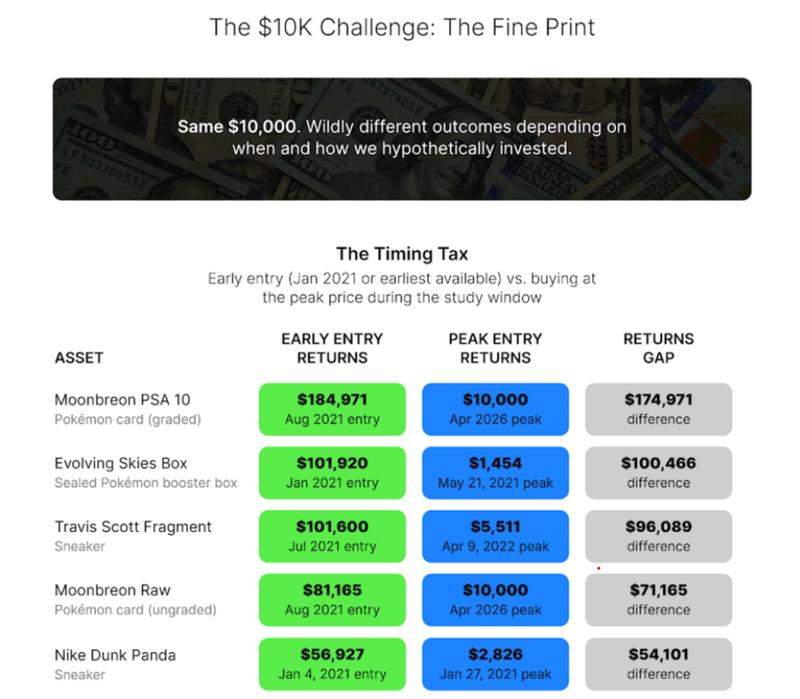
What connects a Pokémon card, a digital asset and a tech stock? According to Statman, they share a common driver: investors aren't merely seeking the optimal asset; they're purchasing a lottery ticket toward a transformative outcome.
Investors are chasing transformation, not crypto
Conventional finance typically assumes investors seek to maximize returns while minimizing risk, but Statman contends that people frequently invest for entirely different motivations.
Within an unpublished paper provided to Magazine, Statman proposes that numerous investors mentally separate their wealth into two distinct layers.
The initial layer represents a "not-poor" component, designed to maintain their current standard of living and prevent descent into poverty. The second represents a "be-rich" component, allocated for transformative objectives, such as purchasing a house, achieving financial independence, or fundamentally altering their life circumstances.
Under this framework, concentrated investments aren't inherently irrational; they exist because diversified investing, despite being statistically sound, may never provide someone with modest capital a genuine opportunity of reaching those objectives.
"The asset class may change, but the behavior barely does… Investors aren't exactly loyal to crypto, stocks or collectibles. Their loyalty is to whatever promises lucrative returns next."
Statman notes that, whereas some contemporary investors place their hopes on meme stocks, "a century ago it was railroad stocks [...] today's investors are simply expressing the same aspirations through a new asset class."
Investors aren't developing greater risk tolerance, however, just increasing willingness to accept volatility in exchange for a shot at life-changing wealth.
"Investors aren't necessarily on the hunt for risk, but they've got a case of FOMO on the next life-changing return, and that can lead them down a path of underestimated downside risk," Royal says.
Why stories beat fundamentals
When investors seek transformation rather than straightforward returns, this clarifies why narratives frequently overpower fundamentals, especially in crypto.
The decentralized finance sector exemplifies this phenomenon. Despite leading protocols like Aave or Uniswap producing significant revenue, attracting billions in deposits and facilitating enormous trading volumes, their tokens fail to generate the same enthusiasm as emerging narratives constructed around the newest trend.
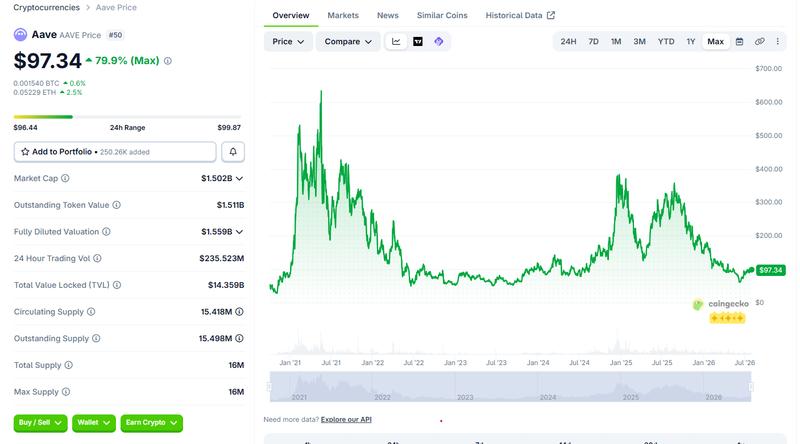
Aave's token traded at approximately $98 at the time of writing, roughly 85% below its 2021 peak, but its TVL exceeds $14 billion, and had climbed above $37 billion during the bull market peak in October 2025.
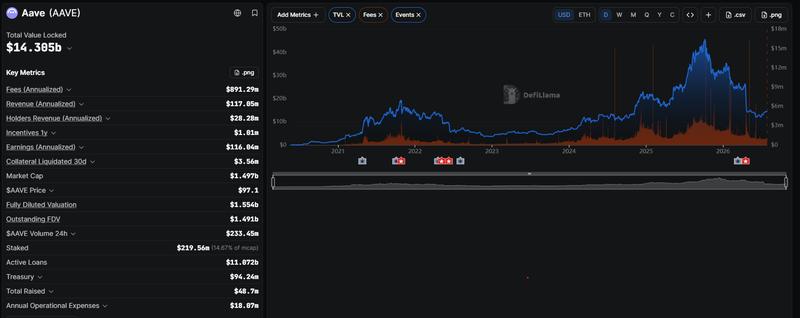
Thomas Probst, a research analyst at market data provider Kaiko, explains that although assets might outperform short-term, fundamentals remain paramount long-term.
"Market fundamentals continue to play an important role, particularly resilience, liquidity, and volatility... [an asset's] ability to establish itself over time also depends on the robustness of its market structure," he says.
Still, while an established protocol producing sustainable cash flow might represent an appealing long-term investment, it holds minimal attraction to investors directing money toward their "be-rich" bucket. A token potentially doubling over multiple years will perpetually struggle competing against the possibility, regardless how unlikely, of a 100x moonshot.
"Investors like to confuse a great technological breakthrough with a great investment opportunity," Royal says, potentially explaining why numerous AI-focused ETFs have underperformed, despite AI arguably emerging as the defining investment narrative of our era.
"The real skill isn't identifying exciting investments, it's recognizing when optimism has already been priced in."
This same skill proves valuable with market timing. MarketWise's report discovered that investors purchasing Bitcoin in January 2021 transformed a hypothetical $10,000 investment into over $24,000 by April 2026, with +141% gains.
Those purchasing during its cycle peak in October 2025, however, watched the same investment decline to just over $6,000 with a -38% return by April (and it'd be worth about $5,000 today).
Anyone who FOMO'd into AAAVE around the same time would be sitting on +85% losses today.
Institutions play a different game
Institutional investors approach investing from a completely different perspective, Sen explains:
"Institutional mandates simply don't allow for chasing outsized, speculative returns. Institutions are underwriting risk-adjusted performance, liquidity, custody arrangements and operational resilience long before they look at upside potential."
And although this doesn't imply institutions remain immune to emerging narratives, they typically evaluate whether the underlying infrastructure can accommodate substantial capital allocation instead of whether the token could 100x.
"It's usually a mix, and the order matters," Sen says. "Most of these themes, DeFi, AI, memecoins, do start with a genuine shift: a real technical unlock or a new use case that wasn't possible before."
When the narrative starts attracting speculative money, however, prices frequently advance faster than fundamentals, he explains.
"Investors arriving later in a cycle are often responding to the narrative as much as the fundamentals that started it [...] Institutional capital, which tends to move on process and discipline rather than trend-following, is often a step behind the initial narrative and a step ahead of the correction."
The next Bitcoin isn't really the point
The pursuit of the next life-changing investment shows no signs of disappearing, and neither, Statman contends, does the human aspiration to improve one's circumstances.
The next 100x token undoubtedly exists, and investors will persist in seeking it — even when the odds and fundamentals indicate they're searching in the wrong place.