Buterin Shifts ETH Narrative Toward Store of Value as Crypto Reacts to Midterm Election Results: Hodler's Digest
While transaction volumes climb and fee income declines, Vitalik Buterin advocates for ETH to adopt a store of value positioning. The cryptocurrency sector evaluates the impact of Democratic control.

Ethereum's founder advocates for ETH as a store of value asset
Vitalik Buterin, the founder of Ethereum, is making the case that the network needs to position ETH as a store of value asset instead of treating it as something whose worth stems from fee burning mechanisms.
In a social media thread, Buterin contended that the concept of "ETH as fee-burning token never was as strong as it seemed" and suggested that optimizing the network around that narrative would have detrimental effects on Ethereum's "decentralization and capture resistance."
He proposes instead that Ethereum should derive its worth from the stability that comes from its commitment to "decentralization and CROPS" — an acronym representing censorship and capture resistance, open source, privacy and security — attributes he believes will become increasingly valuable during an "era of AI disruption."
The EIP-1559 upgrade implemented in 2021 temporarily transformed Ethereum into a deflationary asset during periods of elevated fee revenue, prompting advocates such as the hosts of the Bankless podcast to promote Ethereum as "ultrasound money."
However, architectural decisions have resulted in continuously declining fees and revenue, rendering that messaging untenable. Between January and October of this year, median transaction costs dropped from 35 cents down to 3.5 cents, even as daily transaction counts rose by over fifty percent.
Bitcoin advocates, who view BTC's store of value designation as sacrosanct, responded harshly to Buterin's commentary. Dan Held, founder of Held Media, mocked Buterin's statements as "ETH trying to pivot to Bitcoin's SoV narrative after all of its previous narratives collapsed. Again." Held contended it was "wild that you think a protocol with a constantly changing monetary policy (just like fiat) can be a 'sound money.'" Nevertheless, supporters point out that Ethereum has maintained a consistent monetary policy since The Merge in 2022, with each modification reducing, not increasing, issuance rates.
Ethereum maximalists celebrated the protocol's creator establishing a definitive narrative framework. Gabriel Shapiro, an attorney at MetaLeX, described it as a "nature is healing moment" from Buterin, stating "I think on fundamentals ETH can be a much better SoV than both ZEC and BTC."
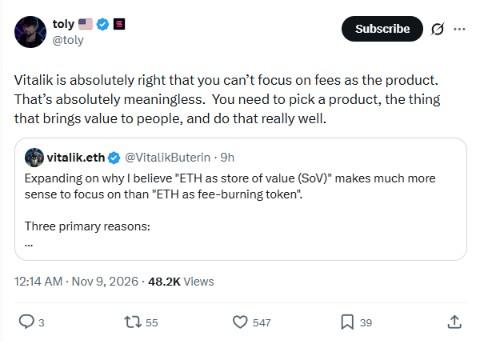
Even Anatoly Yakovenko, co-founder of Solana, acknowledged Buterin was "absolutely right that can't focus on fees as the product" though he subsequently made a subtle jab at Ethereum's "product."
Democratic control raises questions about crypto's regulatory landscape
After investing $176 million across 100 electoral contests — which included $64 million in an unsuccessful effort to defeat Sherrod Brown in his Senate race — cryptocurrency super PACs appeared to have limited impact on the election outcome. Or did they?
Although Democrats now hold majorities in both the Senate and House of Representatives, Stand With Crypto observes that pro-crypto legislators now make up the majority in both chambers, with 50 out of 100 senators classified as "pro-crypto" and just 33 labeled "anti-crypto," while 241 representatives support the sector, compared to only 106 who actively oppose it.
The anti-crypto faction will nonetheless occupy influential positions, with Brown expected to join the Senate Agriculture Committee and Elizabeth Warren anticipated to assume chairmanship of the Senate Banking Committee.
"The next Congress will bring a fundamentally different environment for crypto in Washington, and the industry should expect significantly more scrutiny," said Kyle Bligen, executive director at the Decentralization Research Center.
Democratic lawmakers are already purportedly exploring expansion of proposals from Representative Maxine Waters into a more comprehensive market structure bill. A slim possibility remains that the CLARITY Act could be revived, though only with substantially strengthened ethics provisions targeting President Donald Trump's alleged corruption.
"A sitting president's family launching memecoins and a stablecoin is a real governance problem," Fidelity Digital founder Hadley Stern told Magazine. "If I'd done that at Fidelity, I'd have been walked out the same afternoon."
The TRUMP memecoin dropped one-third of its value during the week, becoming the worst performer among the top 100 cryptocurrencies.
Election results triggered a decline in AI-related equities, and Bitcoin dropped beneath $76,000 where it continues to trade.

North Korean hackers used fraudulent job interview to execute Binance's $6.34 billion breach
According to Binance, North Korean threat actors initially infiltrated its infrastructure in June, when a staff member downloaded a compromised Homebrew installation during an attempt to set up an AI coding application. Although the exchange rapidly identified the intrusion, the attackers had already acquired information regarding employees working on Binance's wallet infrastructure.
During September, the threat actors impersonated recruiters and targeted a different software engineer, deceiving the employee into downloading a malicious file presented as a coding challenge.
On Oct. 20, the perpetrators leveraged the compromised computer and an internal AI tool to penetrate the systems of two more engineers and install malware. They subsequently obtained access to the exchange's internal wallet-signing service, allowing them to extract billions of dollars.
"This wasn't one mistake or one breach — it was a months-long campaign," Binance co-CEO Richard Teng said in a Tuesday post on X.

Ethereum developer aims for 2028 quantum resistance deadline, beating earlier timeline
Justin Drake, a researcher at the Ethereum Foundation, has set December 2028 as the target date for finalizing Ethereum's post-quantum and post-AI transition, accelerating the timeline by one year compared to the foundation's prior quantum-resistance target.
During his presentation at Devcon 8 in Mumbai on Tuesday, Drake detailed the expedited schedule. "Our hope is that by December 2028 we'll be able to wrap up the full post-quantum and post-AI transition," Drake said, noting that developers have 24 months to deliver three additional network upgrades.
The Ethereum Foundation published a roadmap in September establishing December 2029 as its target for achieving quantum resistance.
The roadmap has currently stalled, however, with core developers postponing the Glamsterdam upgrade indefinitely pending resolution of security issues related to eight smart contract invariants.

THORChain resumes operations in defiance of FBI directive
THORChain has disregarded the FBI's clear directive against processing assets from the Binance hack, with the permissionless protocol resuming trading on the majority of networks on November 4.
The RUNE token appreciated 15% within a 24-hour period following the announcement that Bitcoin, Ethereum, Bitcoin Cash, Dogecoin, Litecoin, Tron and Zcash had been reactivated. Avalanche, Base and XRP were already functional.
Analysis from Chainalysis revealed that THORChain had processed over $46 million in funds from the hack within the initial 72 hours, earning $200,000 in fees according to the Wall Street Journal. Trading was temporarily suspended automatically due to an unrelated Ethereum block reorganization.
JPThor, a co-founder, argued that the FBI warning's inability to affect the DEX demonstrated that THORChain operates in a truly decentralized manner.
"The fact that the FBI did in fact call out the protocol —— and nobody could do anything —— means in fact the protocol is decentralised. Nobody in their right mind in a western country would flagrantly ignore a direction like that."
Weekly Market Winners and Losers
As the week concludes, Bitcoin (BTC) has declined 4.5% to trade at $74,302, Ethereum (ETH) has dropped 6.3% to trade at $2,117 and XRP (XRP) has decreased 5% to $1.11. The total market capitalization stands at $2.49 trillion according to CoinMarketCap.
Within the top 100 cryptocurrencies by market capitalization, the three leading altcoin gainers of the week are Pieverse (PIEVERSE) with a 39.2% gain, Injective (INJ) on 11.1%, and Tether Gold (XAUt) on 4.2%.
The three biggest altcoin losers of the week are OFFICIAL TRUMP which was down 32.8%, Worldcoin (WLD) down 20.8% and Ethena (ENA) down 19%.
Leading Prediction of the Week
Binance security breach could prove 'temporary setback' for cryptocurrency markets, Grayscale's Pandl suggests
The $6.3 billion Binance hack could deal a short-term blow to confidence in cryptocurrency markets but would eventually result in enhanced security practices throughout the exchange ecosystem, according to Grayscale.
"It also underscores the importance of institutional custody, such as offered by US-based crypto [exchange-traded products]," said Grayscale's head of research, Zach Pandl, in a Tuesday report.
"These vehicles hold their assets at state-chartered banks and qualified custodians, typically offering offline storage, multi-signature wallets, SOC attestations and insurance policies," he added.
Leading FUD of the Week
Binance France sends emails announcing account closures effective Dec. 31
Binance France is shutting down its operations in the country. User accounts will be terminated on Dec. 31, and any remaining assets left on the exchange will incur monthly fees beginning on Nov. 29, according to emails distributed to users by Binance.
Beginning on that date, accounts that continue to hold a balance will be charged a monthly maintenance fee of 0.025% of the balance, or a minimum of 10 USDC, a stablecoin tracking the US dollar.
Cointelegraph reported in late June that Binance had informed European Union users that access to key services would be restricted after the exchange was unable to obtain Markets in Crypto-Assets (MiCA) regulatory authorization from a member state before a July 1 deadline.
Questionable prediction market trades detected prior to election poll publication: NYT
Unusual prediction market wagers were executed shortly before two recent New York Times/Siena political polls were made public, according to a report.
Researchers at Vanderbilt University indicated that a Polymarket user wagered almost $200,000 on Oct. 31 predicting that Nebraska Senator Pete Ricketts would secure re-election. An hour later, a Times/Siena poll was released showing Ricketts in the lead.
A Friday New York Times report said while it was not clear if the user had access to inside information, they won more than $77,000. The user also placed similar large bets on other markets, including Kalshi, the report said.
Gnosis Pay data breach compromises personal information and card data
Gnosis Pay, a crypto-linked Visa debit card provider, announced a security breach on Friday that compromised customers' payment card details, home addresses and cryptocurrency wallet addresses.
Gnosis Pay stated it identified unauthorized access to its legacy consumer card system on Nov. 3 and initiated containment of the breach within two hours. The company indicated that customer funds and its separate enterprise platform, which powers white-label card programs, were unaffected.