Bitcoin whale investors face mounting pressure to sell as paper profits surge to $9B milestone
Whale investors who recently entered Bitcoin markets have accumulated unrealized profits totaling $9 billion, marking an unprecedented high according to blockchain analytics data dating back to 2016.

Large-scale Bitcoin (BTC) investors known as whales are experiencing unprecedented unrealized profit levels, creating conditions that may trigger significant selling pressure not witnessed during any comparable period in Bitcoin's modern trading history.
Key points:
- Unrealized profits held by Bitcoin whale investors classified as short-term holders reached $9 billion on Sept. 4, representing the highest measurement ever documented in CryptoQuant's tracking history.
- These profit levels demonstrate high sensitivity to minor BTC price movements, declining by $1.5 billion following a modest 2% daily decrease in BTC/USD trading pairs.
- Bitcoin reserves held on the Binance exchange platform are nearing two-year peak levels at approximately 692,000 BTC.
Short-term holder whales sit on giant unrealized profits
Blockchain analytics information from CryptoQuant reveals that whale-sized investors who entered the market more recently are currently holding paper gains that surpass the $9 billion threshold.
This represents the highest measurement CryptoQuant has documented throughout its whale profitability monitoring efforts, which commenced in 2016. The metric specifically tracks short-term holder (STH) whales — cryptocurrency addresses containing coins acquired within the preceding six-month timeframe.
During trading on Sept. 4, the cumulative unrealized profit across the STH whale investor group reached a fresh multi-year peak of $9.07 billion. Nevertheless, due to its responsiveness to spot price movements, this figure contracted by 17% within the following 24-hour period as BTC/USD experienced a decline of just under 2%. This volatility occurs because the average acquisition price of STH whales remains much closer to current market levels compared to long-term holders. The average cost basis for STH whales is currently positioned near $69,000.
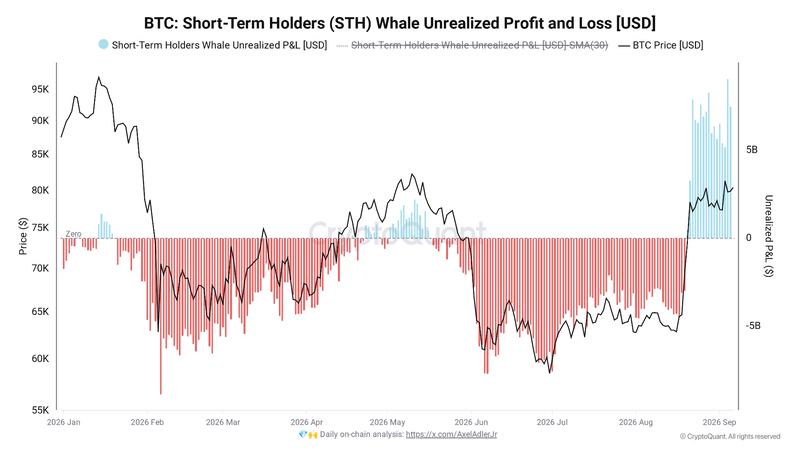
Within their supplementary assessment, CryptoQuant issued a cautionary statement regarding potential STH whale selling activity should BTC prices experience additional downward movement, noting that more recent market entrants have historically demonstrated speculative trading behaviors and heightened reactivity to modest market fluctuations.
Unrealized profit at that scale is exposure. A cohort sitting on a record paper gain can turn into sellers the moment price wobbles, and STH whales are historically the fastest to take profit when it's available.
Binance BTC reserves near two-year high
In earlier coverage, Cointelegraph documented how existing sell-side liquidity positioned on exchange order books has been constraining spot price action beneath the $83,000 resistance level.
Blockchain data provides additional evidence supporting the potential for short-term holder selling activity, demonstrating accelerating inflows to cryptocurrency exchanges beginning in early May. By Sept. 2, Bitcoin reserves maintained on Binance, the world's largest exchange, climbed to 691,658 BTC, marking the most elevated level recorded since November 2024.
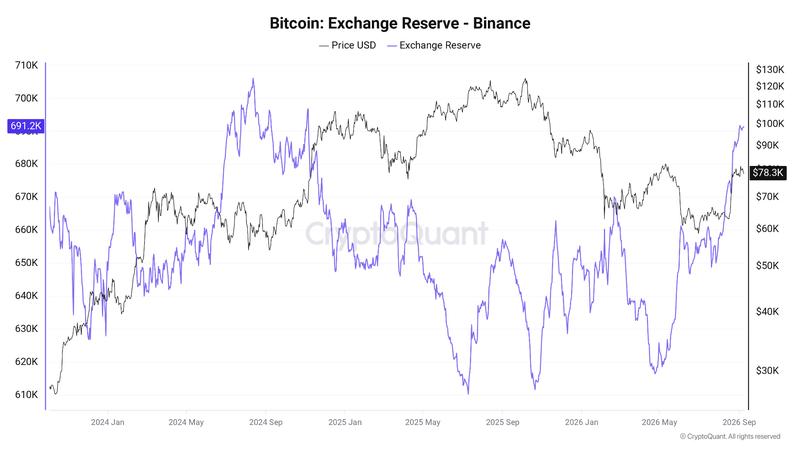
Addressing this developing trend, CryptoQuant analysts characterized whale involvement in exchange deposit activity as "relatively contained."
The key tension is clear: liquidity and positioning on Binance remain orderly, but the elevated reserve base means that any meaningful breakout above $83K will require strong, sustained spot absorption from ETFs and organic demand to clear the available supply.
CryptoQuant emphasized once again the critical importance of renewed Bitcoin spot market demand making a return, identifying this as a crucial element that has remained conspicuously absent from market dynamics throughout the entirety of 2026.