Bitcoin Serves as Tool for American 'Power Projection,' Says Top US Admiral
Admiral Samuel Paparo of the US Navy highlighted that Bitcoin's proof-of-work mechanism holds 'really important' applications in computer science, particularly in the realm of cybersecurity.

A high-ranking officer in the United States military has praised Bitcoin, describing it as a "valuable computer science tool" whose utility goes far beyond its function as currency and can bolster American national security objectives.
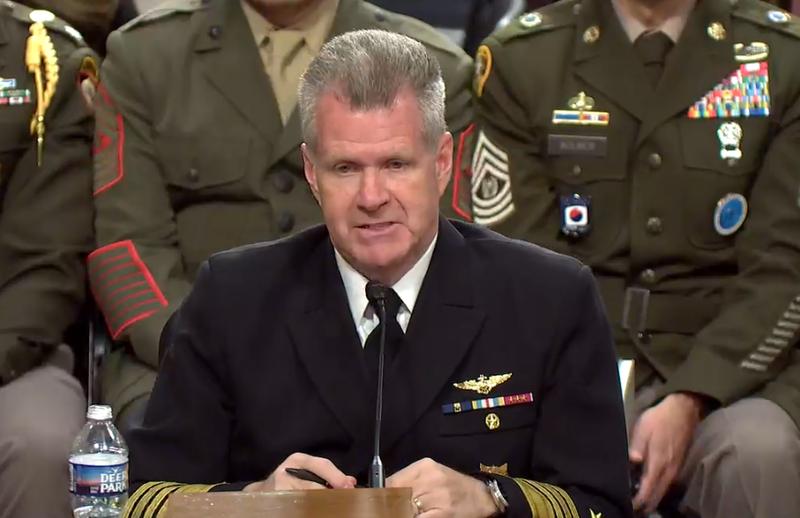
During testimony before the Senate Armed Services Committee on Tuesday, Admiral Samuel Paparo stated that Bitcoin functions as "a valuable computer science tool, as a power projection." He further emphasized that the proof-of-work technology underlying Bitcoin "imposes more cost" on malicious actors who seek to breach the network's security:
"Outside of the economic formulation of it, it has got really important computer science applications for cybersecurity."
The congressional hearing examined the strategic positioning of American military forces throughout the Indo-Pacific region, encompassing discussions about active conflicts in Ukraine and Middle Eastern territories, the expansion of China's military capabilities and its collaboration with foreign adversaries, as well as security threats emanating from North Korea.
The admiral's statements mirror comparable observations made by US Space Force member Jason Lowery in December 2023, who argued that Bitcoin along with other proof-of-work blockchain networks could serve as protective mechanisms for the United States in cyber conflict scenarios.
During that time, Lowery pointed out that despite Bitcoin being primarily perceived as a "monetary system" designed to safeguard financial assets, relatively few individuals understand that Bitcoin's technology can be leveraged to protect "all forms of data, messages or command signals."
"As a result, this misconception underplays the technology's broad strategic significance for cybersecurity, and consequently, national security."
Investigations into Bitcoin's potential application as a cybersecurity mechanism emerge at a time when numerous adversaries — including those with state sponsorship — have increasingly relied on cyberattacks including phishing schemes, ransomware campaigns and distributed denial-of-service attacks to undermine critical infrastructure and gain economic leverage.
The Lazarus Group from North Korea stands as one of the most prominent illustrations of this trend, having successfully exfiltrated billions of dollars worth of cryptocurrency throughout the last ten years to fund its nuclear weapons development program.
The admiral's testimony came as a response to an inquiry from US Senator Tommy Tuberville, who questioned how the United States and its legislative body can take the lead in Bitcoin competition, observing that China's premier monetary research institution now also recognizes Bitcoin as an asset of strategic importance.
While Paparo did not provide a direct answer to the specific question posed, he elaborated by stating, "Bitcoin is a reality. It is a peer-to-peer zero-trust transfer of value. Anything that supports all instruments of national power for the United States of America is to the good."
Senators introduce national security-focused Bitcoin bill
The United States maintains the world's largest Bitcoin reserves among sovereign nations and commands the largest portion of Bitcoin hashrate globally. Nevertheless, the country continues to depend on foreign-manufactured mining hardware, a dependency that has generated national security apprehensions concerning supply chain vulnerabilities.
In the previous month, US Senators Bill Cassidy and Cynthia Lummis put forward the Mined in America Act designed to address that challenge by repatriating more Bitcoin mining equipment production to American soil.
The proposed legislation additionally aims to formalize Trump's executive order that established the Strategic Bitcoin Reserve.