Bitcoin Faces Potential Downturn as Crude Oil Surges Past $105 Three-Year Peak
Past market patterns reveal Bitcoin's tendency to experience deeper bear cycles during oil price spikes. Could the latest WTI crude reaching $105 on Monday trigger another BTC downturn?

Key takeaways:
- When WTI crude reaches the $105 mark, Bitcoin has historically experienced price declines ranging from 14% to 27% in the following weeks.
- Whether BTC and oil prices are truly correlated remains questionable, as significant events such as the Mt. Gox incident and Terra-Luna's implosion may have been the primary drivers of past crypto downturns.
Crude oil markets witnessed a significant rally on Monday, with prices climbing to $105—a level not observed in close to four years. Throughout Bitcoin's (BTC) trading history, this particular price point has coincided with substantial downward pressure on the cryptocurrency. That said, given that such instances occurred just once during 2014 and on two occasions throughout 2022, a deeper examination of the data is necessary to assess whether present-day concerns hold merit.
Does the $105 oil price threshold spell trouble for Bitcoin?
Back on June 12, 2014, West Texas Intermediate (WTI) crude oil broke through the $105 barrier in response to the Islamic State (ISIS) making territorial gains in northern Iraq, seizing control of Mosul and Tikrit.
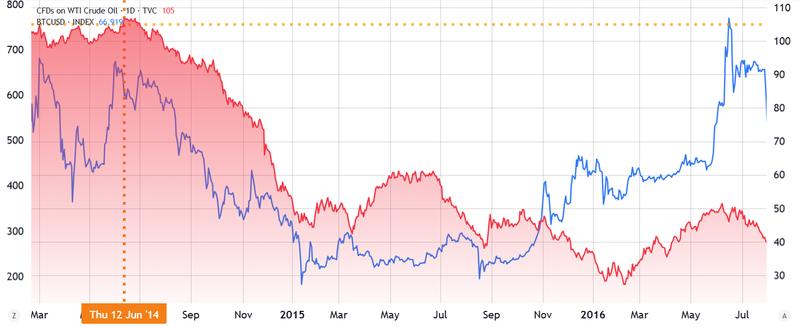
Although Bitcoin's immediate response during the initial week showed little movement, the cryptocurrency subsequently experienced a 21% decline over a period of less than 10 weeks, dropping from $600 to $468. Bitcoin would not return to the $600 price point for more than two years. The subsequent occurrence wouldn't materialize until nearly 8 years had passed. On March 1, 2022, WTI crude oil prices jumped beyond $105 as tensions intensified in the Russia-Ukraine conflict.
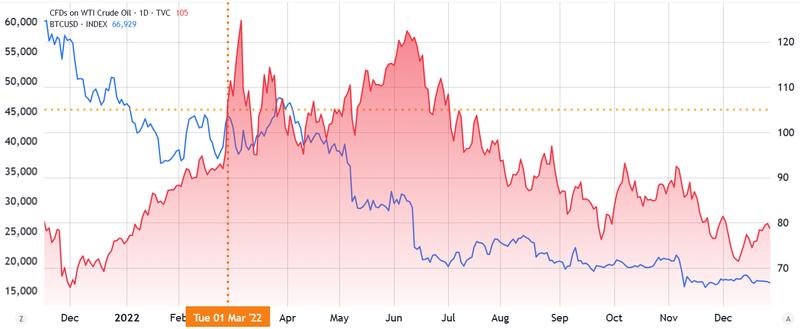
Bitcoin's value underwent a 14% pullback in just seven days, declining to $38,100 from its March 1, 2022 price of $44,370. Remarkably, these losses were completely recovered in under a month, even though oil prices continued trading above the $105 threshold.
How the 2022 Russian oil embargo affected Bitcoin's trajectory
The latest episode of WTI crude oil climbing past $105 took place on May 4, 2022, following the European Commission's official announcement of a gradual embargo targeting all Russian oil imports.
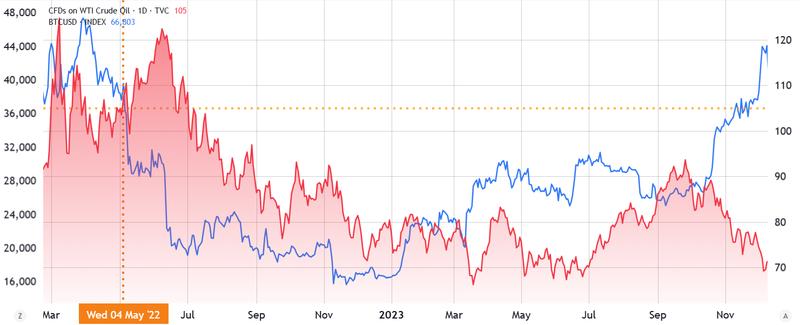
Bitcoin's valuation plummeted by a dramatic 27% during the subsequent 7 days, and market participants suffered through an extended bear market as the cryptocurrency entered a 19-month downward trend before eventually recovering to the $39,700 mark. Although oil prices stayed beneath the $100 level for multiple years, they have now returned to triple-digit territory this week.
According to Yahoo Finance, US President Donald Trump expressed his desire for the United States to maintain control over Iran's oil sector "indefinitely." Despite the perception that $105 oil represents a negative indicator for Bitcoin, just three occurrences over a 12-year span fall short of establishing a definitive correlation.
Additional variables, including the Mt. Gox exchange collapse and subsequent liquidation in February 2014 and the devastating Terra-Luna ecosystem failure in May 2022, were more plausibly responsible for those extended bearish periods. Consequently, attributing a Bitcoin market crash to a specific oil price level appears to be a significant stretch.
This article is produced in accordance with Cointelegraph's Editorial Policy and is intended for informational purposes only. It does not constitute investment advice or recommendations. All investments and trades carry risk; readers are encouraged to conduct independent research before making any decisions. Cointelegraph makes no guarantees regarding the accuracy or completeness of the information presented, including forward-looking statements, and will not be liable for any loss or damage arising from reliance on this content.