Bitcoin Eyes $80K Recovery as VIX Plunges 45% Over Three-Week Period
The declining VIX index suggests stronger risk appetite among investors, potentially paving the way for Bitcoin to surge past the $80,000 threshold with renewed buying interest.

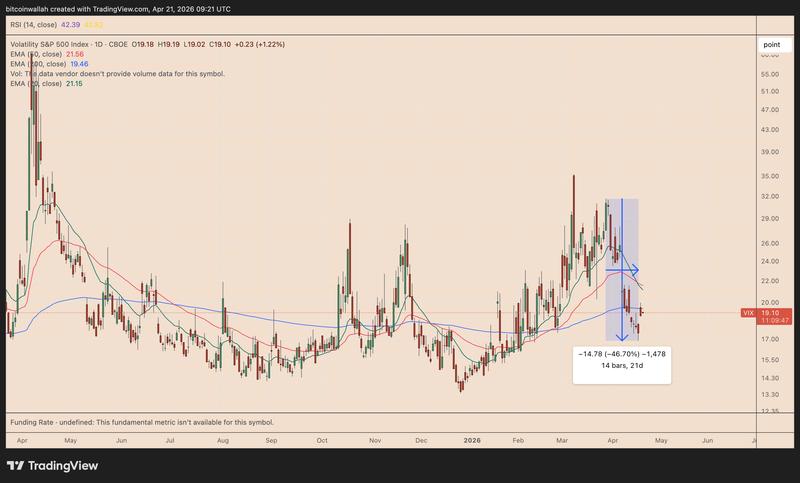
Wall Street's go-to indicator for gauging market risk and investor sentiment, the CBOE Volatility Index (VIX), has plummeted more than 45% in less than a month's time. This development could serve as an important bullish indicator for Bitcoin (BTC).
Key takeaways:
- If VIX continues its underperformance, Bitcoin could climb toward $82,700.
- Strategy's aggressive Bitcoin accumulation provides additional support for BTC's bullish outlook.
Declining VIX suggests BTC could reach $82,700
Commonly referred to as the "fear gauge" of Wall Street, the VIX measures the level of volatility that market participants anticipate in the S&P 500 index during the upcoming 30-day period.
An increasing VIX typically indicates growing market anxiety and heightened risk aversion among investors. Conversely, a declining VIX points to investors gaining confidence and becoming more willing to hold higher-risk assets like equities and cryptocurrencies.
Historical patterns show that Bitcoin tends to benefit when the VIX experiences a decline of 40% or greater.
As an example, during the April 2025–May 2025 timeframe, BTC surged roughly 40%, with this increase corresponding to a 70% decrease in the VIX.
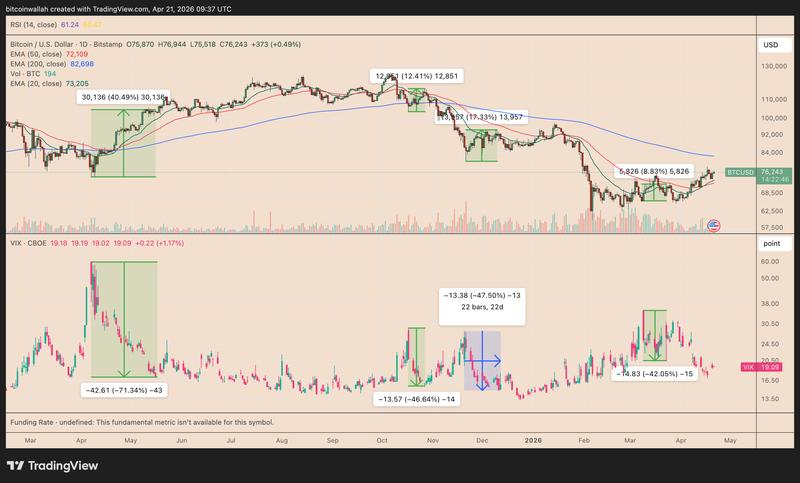
In a similar fashion, when the VIX fell 46% between October and November 2025, Bitcoin registered a 12% price increase.
The most recent VIX decline of 42%–47% has also been accompanied by an 8%–9% recovery in BTC prices, which strengthens the optimistic outlook for Bitcoin in the near term.
Technical analysis points to BTC's next resistance level being near the 200-day exponential moving average (200-day EMA, the blue line) positioned around $82,700 as early May approaches.
How would Bitcoin react if VIX begins climbing?
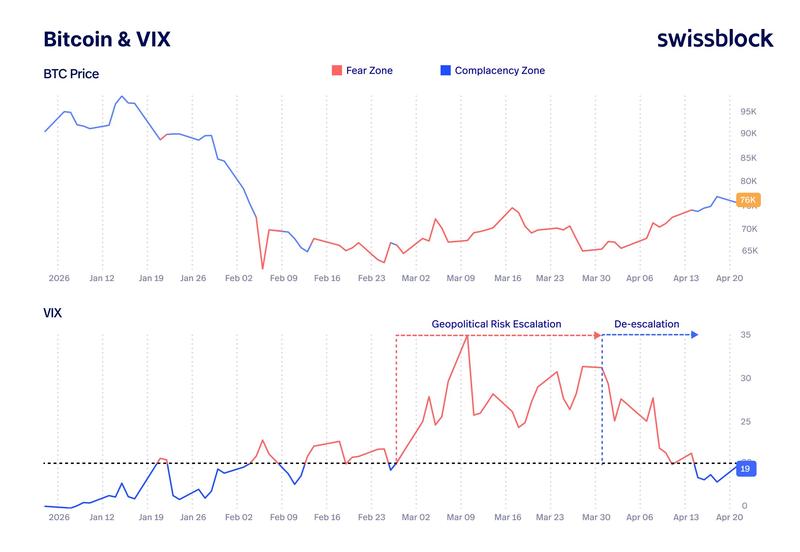
Generally speaking, an increasing VIX tends to be negative for risk-on assets such as Bitcoin. That said, this inverse relationship temporarily broke down in March, based on data highlighted by wealth management company Swissblock.
During the US–Iran tensions in March, both BTC and VIX climbed simultaneously. Meanwhile, the wider risk asset market, including American equities, struggled to maintain performance.
Strategy's intense Bitcoin purchasing activity could be one explanation for Bitcoin's resilience, as the company has absorbed the equivalent of approximately 30 weeks of newly minted coin supply starting in March.
"Bitcoin has already shown inherent strength in a very complex environment", Swissblock said, adding:
"Do not be surprised if it starts to outperform on its own again."
Having said that, should Strategy reduce or halt its buying activity, Bitcoin's support level during VIX increases could be compromised, elevating the potential for price declines.
Several market analyses indicate that BTC might fall beneath $50,000 at some point in 2026.