Bitcoin Community Marks Historic Moment as Network Hits 20 Million Coin Milestone
"A digital currency framework featuring transparent, predictable, and fundamentally limited supply... holds growing attraction in the current economic climate given the tail risks associated with fiat money," Grayscale stated.

Bitcoin's blockchain has achieved a significant landmark by mining its 20 millionth coin, with only one million BTC remaining to be extracted during the next hundred years.
"The marketplace is on the verge of experiencing something unprecedented: A worldwide asset with virtually no additional supply remaining," stated Energy Co managing partner David Eng through a post on X this past Sunday.
Currently, approximately 450 fresh Bitcoins enter circulation daily based on present mining rates. This production rate experiences a reduction by half approximately once every four years through the mechanism known as the Bitcoin halving. Given that only 1 million Bitcoin remains unmined, the final Bitcoin is projected to be extracted sometime around the year 2140.
Bitcoin's finite supply offers "predictable rules"
Raphael Zagury, CEO of Bitcoin mining operation Elektron Energy, shared with Cointelegraph that the degree of transparency surrounding Bitcoin's total supply represents something "unprecedented."
"The emission timeline is clearly visible extending decades ahead. People place value on dependable frameworks, particularly regarding monetary systems," Zagury explained.
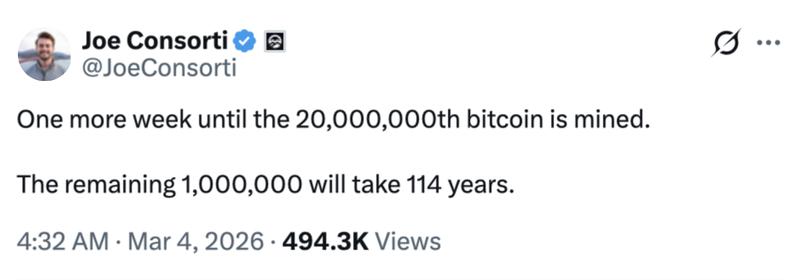
"This countdown to one million remaining coins underscores all the distinctive characteristics that define Bitcoin," commented Tommy Rogulj, portfolio manager at cryptocurrency exchange Swyftx.
"Bitcoin represents a hard-capped, permissionless, and neutral bearer instrument functioning on a visible supply schedule that is immune to expansion unlike traditional fiat money. This characteristic holds significance in an era increasingly characterized by geopolitical tensions and technology-driven unpredictability."
Back in December, investment management company Grayscale Investments noted that a "digital currency framework featuring transparent, predictable, and fundamentally limited supply is a straightforward concept, yet it holds growing attraction in the current economic climate given the tail risks associated with fiat money."
"Non-event, no impact" on BTC's price: Crypto exec
Despite this achievement, cryptocurrency market analysts remained skeptical that this latest landmark would have any meaningful effect on Bitcoin's market value.
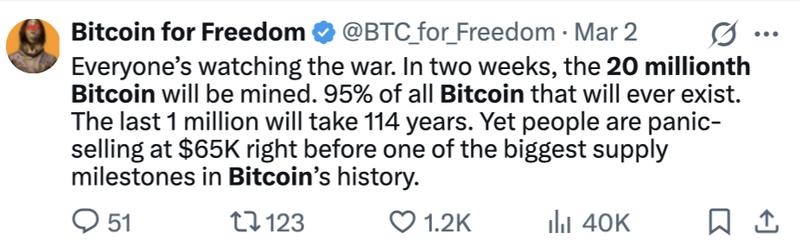
"This is already factored into current valuations, as market participants understand BTC's supply expansion rate (its inflation metric) with complete certainty, and it currently sits beneath gold's rate," Charles Edwards, founder of Capriole Investments, explained to Cointelegraph. "In my view, this qualifies as a non-event with zero price impact."
Zagury's perspective aligns closely with Edwards' assessment. "The milestone by itself won't drive price action in the near term," Zagury noted, further emphasizing that "market liquidity and macroeconomic factors continue to be the dominant forces."
"However, looking at the long-term horizon, the combination of scarcity and predictable monetary policy represents a potent mix. Given sufficient time, financial markets generally favor systems that inspire confidence," he elaborated.
At the time of publication, Bitcoin was changing hands at $68,670, representing a decline of roughly 19% over the preceding twelve months, based on data from CoinMarketCap.
What happens once Bitcoin supply stops?
Among the most pressing questions within the Bitcoin community concerns what will transpire after the final Bitcoin gets mined in 2140, with certain observers expressing concern that network security might be compromised, given that miners would lose the incentive provided by newly created coins.
The prevailing understanding suggests that when this occurs, Bitcoin's economic model will transition to relying on transaction fees as the primary mechanism for incentivizing miners to maintain their role in securing the network, although there are legitimate concerns that this shift could result in elevated transaction costs for users.