AI Successfully Unmasks Vitalik Buterin's Secret Ethereum Document Contribution
Ethereum's co-founder acknowledged that artificial intelligence detected his unique thinking patterns, concluding a two-week open competition to unmask an anonymous document he authored.

Vitalik Buterin has validated that artificial intelligence-powered analysis employed by Franklyn Wang, CEO of Co-Invest, successfully pinpointed his undisclosed contribution to a proposal within the Ethereum ecosystem.
The successful identification occurred two weeks following Buterin's public test to determine whether contemporary AI technology could break through digital anonymity barriers.
The winning entry from Wang pinpointed an anonymously authored revision of EIP-7503 through examination of how mathematical and technical ideas were conveyed within the document.
"The doc was an anonymous EIP-7503 rewrite he'd hidden by writing it in Chinese and machine-translating it," Wang wrote in a Monday X post after Buterin confirmed the result. "The tell wasn't his words, it was his reasoning."
Several of the cryptocurrency sector's most notable figures, including the enigmatic Bitcoin founder Satoshi Nakamoto, have depended on pseudonymous identities to maintain anonymity. Certain experts suggest that should AI achieve reliable author identification through reasoning pattern recognition, maintaining anonymous technical participation would become significantly more challenging throughout open-source blockchain development communities.
Buterin tests AI deanonymization
Within a February research publication, scientists from ETH Zurich and Anthropic asserted that large language models have enabled online deanonymization to become practically achievable on a massive scale.
The research discovered that AI systems could unmask pseudonymous internet users through extracting identity-relevant data from unstructured written content, conducting searches for probable matches and applying logical reasoning to determine the most probable candidates, surpassing conventional deanonymization methods in performance.
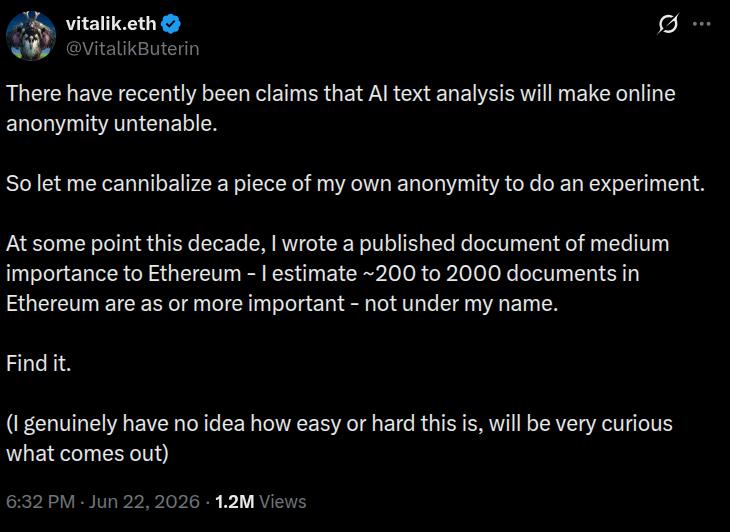
"There have recently been claims that AI text analysis will make online anonymity untenable. So let me cannibalize a piece of my own anonymity to do an experiment," Buterin said on June 22.
He admitted to having published a document characterized as having "medium importance" for Ethereum sometime during the previous ten years using an alternative identity.
"Find it," he challenged.
According to Wang's statement, Co-Invest determined Buterin as the most probable author behind an anonymously published December 2024 revision of EIP-7503, assigning approximately 20% confidence to this conclusion, which represented about ten times greater probability than the subsequent candidate within their examination of 27 documents.
Buterin subsequently disclosed that he had composed the anonymous revision in the Chinese language, converted it to English utilizing Qwen 2.5 and performed manual corrections on the translation in an effort to conceal his distinctive writing style.
"Notice that the stylistic hints that his AI picked up on were intellectual habits and style of math and algorithm explanation, which bypassed my obfuscation strategy (which only covered prose) completely," Buterin wrote.
Vladimir Novakovski, CEO of Lighter, stated Monday that he collaborated with Wang on a 2023 initiative that utilized GPT-4 in an attempt to unmask Bitcoin's creator Nakamoto through matching writing patterns in cryptography-related research publications, though he indicated the endeavor did not yield a high-confidence outcome.
Based on Novakovski's account, Wang subsequently employed a comparable methodology when tackling Buterin's anonymity experiment.