Wave of account suspensions marks Balaji's vision for Farcaster's 'Singapore-style' social network
Balaji Srinivasan, the founder of Network School, is reimagining Farcaster as a sanctuary for courteous techno-optimists. The transformation kicked off with some initial cleanup efforts.

The Network School, led by Balaji Srinivasan, has commenced its stewardship of Farcaster, the decentralized social media platform. The initial move? What appears to be a sweeping series of account suspensions that has triggered criticism from community members of the decentralized network.
On Thursday, Network School revealed its purchase of Farcaster from Neynar, giving it a new identity as the Network State Protocol. That same day, multiple users reported on X that their accounts on Farcaster had been limited to "read-only" status, stemming from earlier content that violated its newly implemented guidelines.
"I know most of these folks. They shaped Farcaster with their quirks and wit," said Kunal Gandhi, former India ecosystem lead at Eigen Labs. "Obliterating accounts from the get-go for past posts is pretty silly. Goes against the ethos of decentralized social."
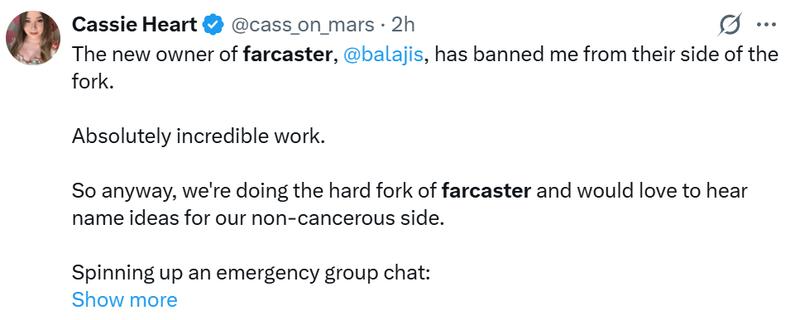
This transformation represents the most recent effort to establish a viable path forward for Farcaster, which is now experiencing its second ownership transition within the current year. According to co-founder Dan Romero, the platform recorded 250,000 monthly active users in December 2025.
Srinivasan's vision: Creating the 'Singapore of social media'
Through a Thursday post on Farcaster, Srinivasan explained that the account suspensions were integral to his strategy of transforming the reference app into "the Singapore of social media," described as a positive-sum environment populated by techno-optimists who abide by a collective code of conduct.
Among the initial priorities was establishing "law and order," according to his statement. "In the pre-Internet world, it was simply unheard of to run up to a stranger and start cursing at them. We're restoring that offline norm online."
"Much like how President Bukele jailed a small fraction of repeat offenders to essentially eliminate crime in El Salvador, we've moderated out the small fraction of repeat offenders that have been muted or blocked by many accounts to stop random attacks within this Farcaster reference client."
According to Srinivasan, a combination of human reviewers and artificial intelligence was deployed to analyze millions of posts in order to identify accounts warranting suspension, while noting that an appeals mechanism has been established for affected users.
Incentivizing "pro-social behavior"
Within Network School's framework for the Network State Protocol, participants agree to a "social smart contract" that grants its leadership team authority to establish the application's regulations. An accompanying "Network Code" categorizes infractions as digital felonies, misdemeanors or infractions, with consequences spanning from warnings and temporary suspensions to permanent bans. These regulations are retroactively applied to historical posts in addition to future content.
The code further promises incentives for positive contributions, such as educating fellow users, showcasing projects and engaging in respectful disagreement, though specific details about these rewards have not been disclosed.
According to Network School, an open-weight artificial intelligence model will enforce these regulations, supplemented by some human oversight, with plans to eventually alert users about potential rule violations prior to publishing their posts.
The foundational Farcaster protocol will continue to remain open, based on the official announcement. Those users who reject the contract will retain read-only privileges within the primary app while maintaining control of their keys, funds, followers and posting history, enabling them to migrate to alternative clients. Srinivasan characterized this capability to join, exit or create competing clients as "decentralized democracy."
The long-term vision reaches far beyond social media platforms. Network School stated that its objective involves the online community manifesting in physical form through organized meetups and temporary events, with the ultimate aim of evolving into startup cities and network states.
Network School's acquisition of Farcaster comes months after Malaysian authorities revoked its Forest City business licence and ordered it to cease operations, citing alleged licensing and premises-use violations. Srinivasan subsequently announced an agreement to establish a campus in Kazakhstan.