US-Iran Peace Agreement Critical for Bitcoin's Path Forward Amid Weak Market Signals
Despite Bitcoin's recent price bounce, the cryptocurrency's momentum and volume indicators continue to show weakness, with further upward movement dependent on the stability of the US-Iran peace agreement.

The future of Bitcoin's price recovery depends significantly on whether the peace agreement between the United States and Iran holds, as blockchain data reveals the digital asset continues to show weakness despite its latest upward movement, according to market analysts.
In an interview with Cointelegraph, Nick Ruck, who serves as a director at LVRG Research, explained that even though Bitcoin (BTC) has managed to climb back above the $67,000 level, the cryptocurrency's "momentum remains weak, with declining volume and stagnant on-chain metrics indicating that the recovery lacks conviction and could quickly fade."
Ruck further explained that should the recently negotiated peace agreement between the United States and Iran collapse, the resulting geopolitical turbulence and possible disruptions to oil markets would place Bitcoin on a "volatile path."
"It may initially find bids as a hedge asset before broader risk-off flows push it toward key support zones, underscoring how macro and geopolitical catalysts continue to dominate crypto price action."
In recent times, Bitcoin has been moving in correlation with traditional markets as institutional investors have accumulated positions in the digital currency. The latest upward price movement occurred after US President Donald Trump announced on Sunday that the United States had finalized a peace agreement with Iran to bring an end to months of tensions, with the formal signing scheduled for Friday.
While many details of the agreement remain undisclosed, Trump revealed it would result in the reopening of the Strait of Hormuz and the removal of the US blockade affecting both the Strait and Iranian ports. Following this, the two nations will enter into 60 days of discussions concerning Iran's nuclear program and possible sanctions relief, as the Associated Press reported on Monday.
In a separate analysis released on Monday, Swissblock noted that Bitcoin's price momentum, which gauges the power of its price changes, along with on-balance volume (OBV), an indicator that tracks buying and selling pressure, continue to exist in a "weak momentum and participation regime."
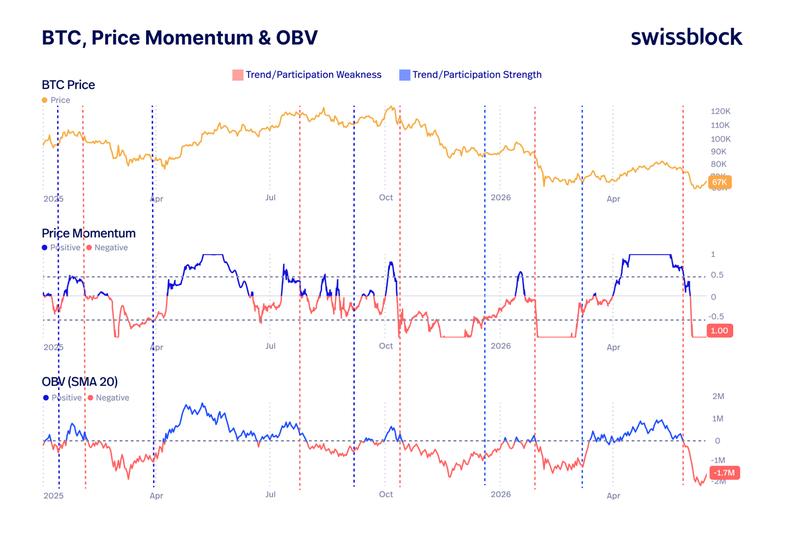
These two metrics continue to show negative readings even as Bitcoin (BTC) has bounced back to surpass $67,000 on Monday after dropping under $60,000 on June 6, with the price momentum indicator sitting at -1, reflecting weak directional strength, and OBV reaching its most depressed level in years at -1.7 million.
According to Swissblock's analysis, during a conventional bear market, similar to the one Bitcoin appears to be navigating currently, momentum deteriorates initially, followed by OBV contraction, before price ultimately breaks to lower levels.
That said, historical patterns indicate that the more robust signal for recovery emerges when both momentum and OBV transition back into positive territory. "Until then, the risk of another retest of the lows remains on the table," the firm stated.
Bitcoin had already begun retreating from its intraday peak on Monday, sliding back below the $66,000 mark during early hours of trading on Tuesday.