UNDP Explores Blockchain Technology's Role in Modernizing Government Infrastructure Worldwide
A comprehensive United Nations Development Programme study analyzes over 40 blockchain initiatives across the globe, revealing governmental experiments with digital payment solutions, identity verification platforms, and environmental financing mechanisms.


Government agencies worldwide face mounting demands to digitally transform at a pace that exceeds the capabilities of their legacy infrastructure. Through its newly published document, New Tech, New Partners: Transforming development in the digital era, the United Nations Development Programme (UNDP) presents a comprehensive framework for integrating blockchain solutions into wider initiatives aimed at upgrading governmental operations. The document highlights more than 40 experimental implementations across various nations that leverage distributed ledger technology to enhance openness, efficiency and responsibility within public service delivery. These applications span diverse areas including financial transaction infrastructure and welfare support networks, extending to environmental funding initiatives and grassroots financing systems, powered by crowdfunding platforms, digital wallet solutions and electronic certification tools.
The UNDP employs a strategic pipeline approach, establishing customized collaborations that unite government entities, emerging blockchain enterprises and regional firms to address challenges within the public administration sector. Government organizations gain the chance to evaluate innovative technologies through compact, challenge-focused programs and targeted implementation scenarios. These technological solutions are deployed at community levels and engineered to tackle particular challenges, including ineffective payment channels for small-scale business owners or territorial environmental, social, and governance oversight.
Within its operational structure, UNDP positions blockchain networks as a dependable distributed ledger system for collaborative coordination and data authentication. The capacity of distributed ledger technologies to facilitate shared record-keeping, auditable financial flows and automated rule-based operations among various stakeholders renders them valuable instruments for public sector applications. UNDP simultaneously emphasizes that such advantages come with prerequisites. Inadequate oversight mechanisms, insufficient data protection measures and problematic implementation architecture can generate substantial vulnerabilities, including flaws in automated contract code or unauthorized exploitation of transaction networks. The document arrives at a balanced assessment: Distributed ledger technology offers genuine utility, but exclusively when proper institutional controls are integrated from inception and the technology gets deployed responsibly under stringent supervision.
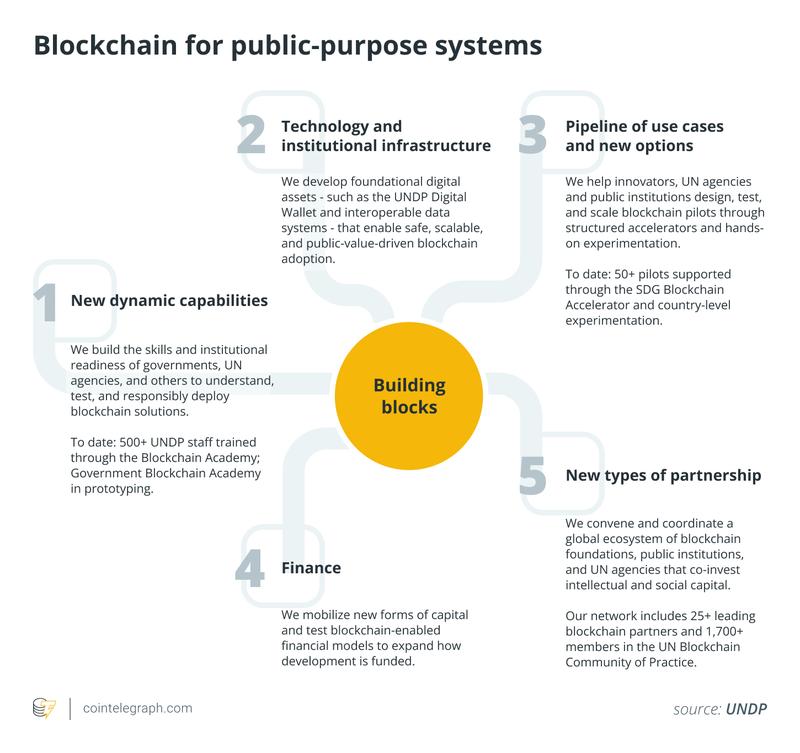
Fundamental to UNDP's methodology is a dedication to platform-neutral implementation strategies, which guarantees that no individual vendor or blockchain protocol establishes fresh vendor lock-in scenarios, and that the technological infrastructure under development today stays accessible, compatible across systems, and authentically aligned with citizen needs and collective benefit objectives.
The publication demonstrates how distributed ledger systems can be deployed to render governmental organizations more productive and accountable, featuring illustrations from over 40 nations spanning transaction processing, economic inclusion, verification platforms and environmental program initiatives. Case studies encompass initiatives such as cryptocurrency wallet infrastructure for unregistered commercial transactions, the deployment of environmental credit tokenization systems and additional applications. The documented examples additionally illustrate how technological solutions can assist institutions in expanding service delivery throughout emerging economies, particularly where institutional confidence remains low and basic infrastructure exists in fragmented form.
Explore the full UNDP report to see the complete framework, lessons and portfolio of use cases.